



Last updated:
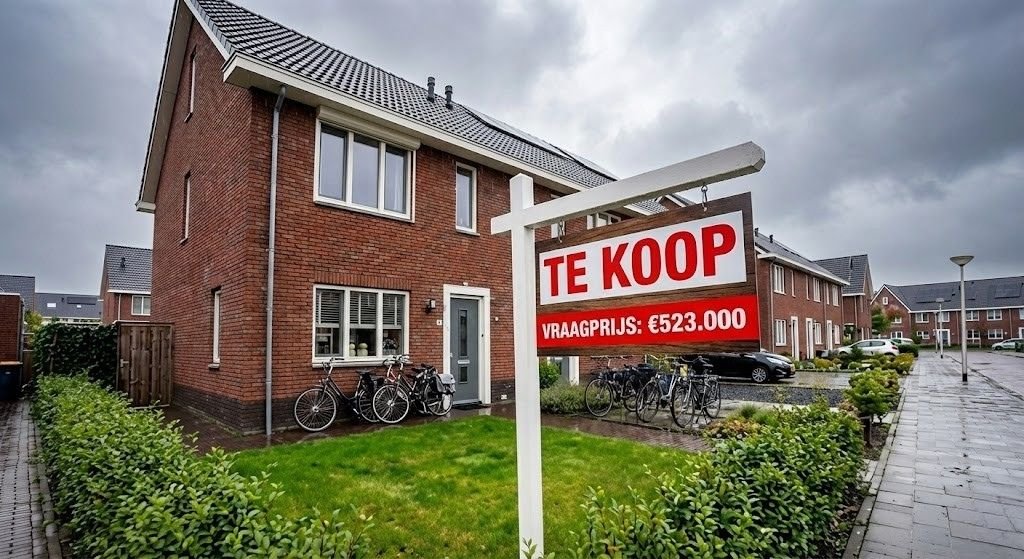
The Dutch housing market continues to defy expectations, with new-build home prices exceeding €523,000 in the third quarter of 2025, according to official data released this week. Existing homes also saw a significant price increase of 7.8% year-on-year, highlighting the persistent affordability crisis. This sustained growth, driven by a severe shortage of homes, puts immense pressure on first-time buyers trying to enter the Dutch property landscape.
Table of Contents
Detailed Report
Data published jointly by Kadaster (Land Registry) and CBS (Statistics Netherlands) reveals that the average selling price of existing homes rose by 7.8% compared to the same period last year. New-build homes experienced a slightly lower, but still substantial, annual increase of 7.4%.
-
Price Gap: Existing homes averaged €487,000, while new-builds jumped to €523,000.
-
Sales Shift: Sales of new homes dropped by 12.7% (only ~6,000 units sold), while sales of existing homes surged by 15.6% (reaching 63,000 units). This suggests buyers are flocking to older homes due to the high premium and long wait times for new construction.
Deep Analysis & Context
Historical Context
The Dutch housing market has been on a prolonged upward trajectory, fueled by a “perfect storm” of population growth, limited supply, and rising wages. While interest rates have stabilized somewhat, the fundamental lack of housing stock keeps prices high. The government’s ambitious building targets are struggling to keep pace with demand, exacerbating the problem.
Future Implications
The continued rise in housing prices risks widening the gap between homeowners and renters. ABN AMRO economists predict that while price growth may slow down slightly in 2026 (projecting a ~3% rise), a significant price drop is unlikely due to the persistent shortage. The market is becoming increasingly inaccessible for single-income households and starters (starters).
Expert Analysis
Economic analysts from ABN AMRO emphasize that the market is remarkably resilient. “Even with potential interest rate fluctuations, the underlying demand remains strong,” experts note. “The imbalance between supply and demand is structural. With the supply of new homes trending downwards since 2023, prices are supported by scarcity rather than speculation”.
EU Comparison: The Netherlands is an outlier. While Dutch prices rose by 7.7% (combined), the European average was only 5.5%. Finland even saw a price decline of 3.1%.
Key Takeaways
-
New Benchmark: Average new-build price hit €523,000 in Q3 2025.
-
Existing Homes: Prices rose 7.8% year-on-year.
-
Sales Volume: Buyers are shifting to existing homes (+15.6% sales) as new builds become too expensive or unavailable.
-
EU Context: Dutch price growth (7.7%) is significantly higher than the EU average (5.5%).
Dutch Learning Corner
| Word | Pronun. (Eng) | Meaning | Context (NL + EN) |
|---|---|---|---|
| 📈 De Huizenmarkt | De Hoy-zen-markt | Housing Market | De huizenmarkt is oververhit. (The housing market is overheated.) |
| 💰 De Vraagprijs | De Vrahkh-prays | Asking Price | Wat is de vraagprijs? (What is the asking price?) |
| 🧱 Nieuwbouw | New-bow | New Construction | Nieuwbouw is vaak duurder. (New construction is often more expensive.) |
| 🔑 De Bezichtiging | De Be-zikh-ti-ging | Viewing | Ik heb morgen een bezichtiging. (I have a viewing tomorrow.) |
(Swipe left to see more)
Community CTA
Is the ‘Dutch Dream’ of Homeownership Fading?
With average prices topping half a million euros, buying a house feels like a distant dream for many. Are you currently hunting for a house? What is your strategy: waiting for a crash or buying whatever you can find? Share your story below!
More in our guide: Housing in the Netherlands – all our renting, buying and energy guides
Renting or buying in 2027?
Our free checklist covers the transfer tax cut, box 3, energy and every deadline before 1 January. Confirm your email and the PDF is yours; we will also email you when the 2027 figures are confirmed.
 Read nextBusiness & FinanceStarting a Business in the Netherlands as an Expat: KvK, VAT and Your First Website