



Last updated:
The Hague – Plans to legally guarantee the right to pay with cash in the Netherlands are facing a significant setback. Amendments proposed this week by the VVD and D66 parties threaten to derail legislation designed to force all shops to accept physical currency. The move throws into question the future of cash in a nation where digital payments have become the default. Currently, four out of five transactions in the Netherlands are conducted electronically, but proponents argue that cash is vital for privacy and inclusion.
Table of Contents
- The Core Issue: Mandate vs. Freedom
- The Cost of Cash: €1.5 Billion
- Arguments For and Against
- Proposed Exceptions and Concerns
- Future Implications
- Expert Analysis
- Key Takeaways
- Dutch Learning Corner
- Community CTA
The Core Issue: Mandate vs. Freedom
The draft legislation, initially championed by the SP (Socialist Party) and the SGP, gained initial parliamentary backing last year. It aimed to legally require all businesses—from pharmacies to supermarkets—to accept cash payments. However, a newly proposed amendment by VVD parliamentarian Wendy van Eijk and D66’s Nathalie van Berkel seeks to overturn this mandate. Their argument is simple: forcing entrepreneurs to accept cash is an unnecessary burden in a digital-first society.
The Cost of Cash: €1.5 Billion
The liberal parties argue that enforcing universal cash acceptance would impose a substantial financial burden on businesses. They estimate the cost of maintaining cash infrastructure (security, transport, counting, depositing) at a staggering €1.5 billion annually. “Businesses should decide for themselves how they want to be paid,” Van Eijk argues, suggesting that the market, not the state, should regulate payment methods.
Arguments For and Against
- Pro-Cash (SP, SGP, Consumer Groups): They maintain that 1-2 million Dutch citizens (elderly, visually impaired, low-literacy) rely on cash. For them, cash isn’t just a payment method; it’s about budget control, privacy, and independence.
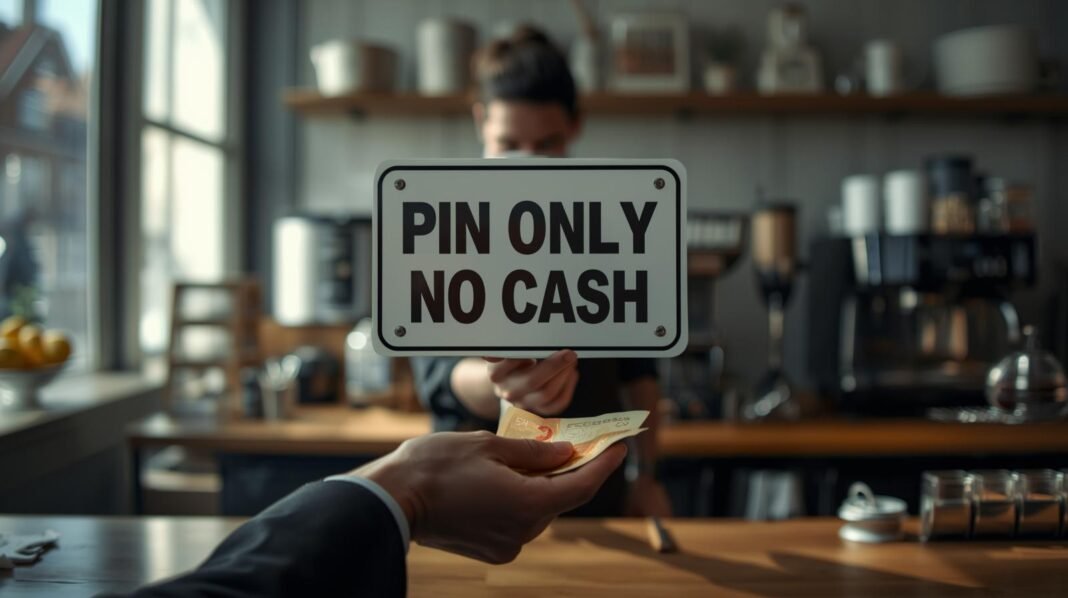
- Pro-Digital (VVD, D66): They contend that 95% of Dutch businesses already accept cash voluntarily. The few that don’t (“Pin Only” cafes or cinemas) usually have legitimate reasons, such as robbery risks or efficiency.
Proposed Exceptions and Concerns
Caretaker Finance Minister Eelco Heinen is currently exploring potential exemptions to the original proposal to find a middle ground. These include:
- Safety Opt-Out: Allowing businesses to refuse cash if they can prove a high robbery risk.
- Small Business Exemption: Exempting tiny shops with fewer than four employees.
- Nighttime Exemption: No cash obligation during night shifts (e.g., gas stations).
Critics argue that these exceptions create a “Swiss cheese” law—full of holes—rendering it ineffective for those who truly need cash access.
Future Implications
If the VVD and D66 amendment passes, it signals a definitive shift towards a “Cashless Netherlands.” While efficient, this risks excluding vulnerable groups from participating in the economy. It also raises questions about system resilience: what happens when the internet goes down?
Expert Analysis
The Dutch Central Bank (DNB) and Nibud (National Institute for Family Finance) warn against a completely cashless society. “Relying solely on digital payments creates a systemic risk,” experts note. Nibud advises households to keep a cash reserve (approx. €50-€100) at home for emergencies. “A widespread cyberattack or power outage could paralyze the economy. Cash is the only backup system that works without electricity.”
Key Takeaways
- The Conflict: VVD & D66 want to stop the law that forces shops to take cash.
- The Cost: Accepting cash costs businesses ~€1.5 billion/year.
- The Risk: 1-2 million people rely on cash for daily life.
- The Backup: Experts warn that a 100% digital system is vulnerable to outages.
Dutch Learning Corner
| Word | Pronun. (Eng) | Meaning | Context (NL + EN) |
|---|---|---|---|
| 💳 Pinnen | Pin-nen | To pay by card | Mag ik hier pinnen? (Can I pay by card here?) |
| 💰 Contant | Kon-tant | Cash | Ik betaal liever contant. (I prefer to pay cash.) |
| 🚫 Weigeren | Vay-ghe-ren | To refuse | Winkels mogen contant weigeren. (Shops may refuse cash.) |
| 🏦 De Munteenheid | De Munt-ayn-hayt | Currency | De Euro is onze munteenheid. (The Euro is our currency.) |
Is “Pin Only” Discriminatory?
Many cafes in Amsterdam already refuse cash (“Hier Alleen Pinnen”). Do you find this convenient and safe, or does it annoy you? Is forcing grandma to use a card fair? Drop your opinion below!
More in our guide: Moving to the Netherlands – the newcomer guide for internationals
Free: Netherlands 2027 Money Checklist
Every deadline and number you need before and after 1 January 2027, on two printable pages. Confirm your email and the PDF is yours; we will also email you when the 2027 figures are confirmed.
 Read nextBusiness & FinanceStarting a Business in the Netherlands as an Expat: KvK, VAT and Your First Website