



Last updated:
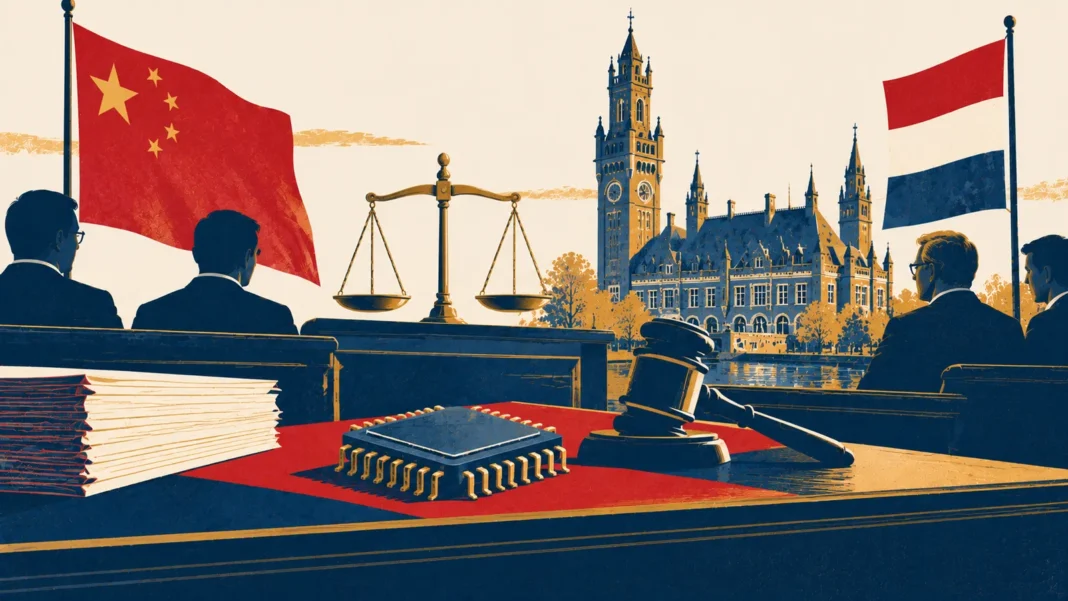
Amsterdam – The fate of Europe’s semiconductor security is being decided today in a high-stakes legal battle at the Amsterdam Enterprise Court. Judges are examining whether Nexperia’s Chinese parent company, Wingtech, intentionally attempted to dismantle the Dutch chipmaker to relocate its technology and manufacturing to China—a move that triggered a major diplomatic rift between The Hague and Beijing.
Table of Contents
- The Core Dispute: Strategy or Sabotage?
- Government Intervention & Beijing’s Retaliation
- Court Action: Executive Suspensions
- Future Implications for European Chips
- Key Takeaways
- Dutch Learning Corner
- Community CTA
The Core Dispute: Strategy or Sabotage?
The case centers on allegations that Wingtech planned to siphon off Nexperia’s intellectual property and manufacturing capacity from its Nijmegen headquarters to China. Last September, the Dutch government invoked a rare 1952 national security law to place Nexperia under state supervision. Wingtech, led by Zhang Xuezheng, denies any wrongdoing and is suing the Dutch state for €8 billion in damages, citing illegal political interference.
Government Intervention & Beijing’s Retaliation
The decision by Economic Affairs Minister Vincent Karremans to step in led to immediate consequences. China responded by temporarily blocking the export of essential transistors, causing a weeks-long disruption in the European automotive industry. This move highlighted Nexperia’s critical role in the global supply chain for cars, smartphones, and solar panels. While government supervision was eventually paused in November, the underlying legal struggle remains unresolved.
Court Action: Executive Suspensions
The Amsterdam Enterprise Court (Ondernemingskamer) has already taken dramatic steps to limit Chinese influence:
- Executive Suspended: Zhang Xuezheng has been removed from his role as executive director.
- Independent Control: A former director has been appointed with a casting vote to ensure Dutch interests are protected.
- Share Freeze: Wingtech’s shares in the subsidiary have been placed under administrative control.
Future Implications for European Chips
With the European Chips Act in full swing, the Nexperia case is seen as a litmus test for Europe’s ability to protect its technological sovereignty. If a major manufacturer can be successfully “hollowed out” by a foreign parent company, it sets a dangerous precedent for future investments in critical sectors like AI and telecommunications. Analysts warn that losing Nexperia’s expertise would be a massive blow to the Dutch tech ecosystem.
Key Takeaways
- Strategic Battle: A Dutch court is deciding if China tried to “steal” a key European chipmaker.
- Economic Impact: Nexperia is vital for the EU’s car and phone manufacturing industries.
- State vs. Company: Wingtech is seeking €8 billion in damages from the Netherlands.
- Legal Precedent: The outcome will define how Europe manages foreign tech ownership in the future.
Dutch Learning Corner
| Word | Pronun. (Eng) | Meaning | Context (NL + EN) |
|---|---|---|---|
| 📟 De Halfgeleider | De Half-khay-ley-der | Semiconductor / Chip | De tekort aan halfgeleiders is voorbij. (The semiconductor shortage is over.) |
| 🏭 De Fabriek | De Fah-breek | The Factory / Plant | Nexperia heeft een fabriek in Nijmegen. (Nexperia has a factory in Nijmegen.) |
| 🛡️ De Soevereiniteit | De Soo-veh-rey-ni-teyt | Sovereignty | Technologische soevereiniteit is belangrijk. (Technological sovereignty is important.) |
| ⚖️ De Rechter | De Rekh-ter | The Judge | De rechter doet vandaag uitspraak. (The judge will rule today.) |
National Security or Economic Overreach?
Should the Dutch government have the power to take control of a private company owned by foreign investors? Does this move protect our future, or will it scare away much-needed international investment? Share your opinion in the comments.
Source / Official Proceedings: Ondernemingskamer (Amsterdam Enterprise Court)
More in our guide: Taxes, Salary & Money in the Netherlands – all our guides
Free: Netherlands 2027 Money Checklist
Every deadline and number you need before and after 1 January 2027, on two printable pages. Confirm your email and the PDF is yours; we will also email you when the 2027 figures are confirmed.
 Read nextBusiness & FinanceStarting a Business in the Netherlands as an Expat: KvK, VAT and Your First Website