


Last updated:
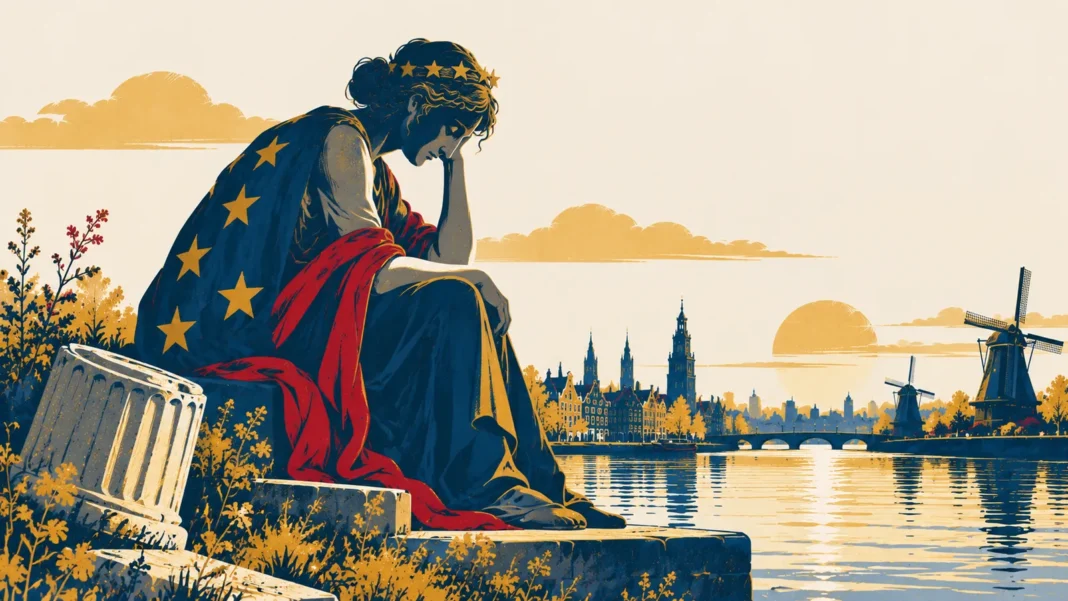
Brussels / Amsterdam – In the 19th century, the term “Sick Man of Europe” was a diagnosis of the declining Ottoman Empire. Today, in 2026, the metaphor has returned with a haunting shift in scope. It no longer describes a single failing nation but identifies a structural decay spreading across the entire European continent. Europe is no longer just a “continent in crisis”—it is a system struggling to remain relevant in a world dominated by American tech giants and Chinese industrial might.
The euphoria of the post-war “Golden Age” has officially evaporated, replaced by a sobering reality: a shrinking workforce, soaring energy costs, and a productivity gap that is quickly becoming a chasm. With the landmark Draghi Report now nearly 18 months old, the question remains: Can Europe reform, or is it destined to become a “museum of past prosperity”?
Table of Contents
- The Demographic Trap: A Continent Structurally Old
- The Energy Death Spiral: Paying the Price for Dependency
- Innovation Paralysis: Why Europe Fails the Tech Race
- The Draghi Assessment: €800 Billion or Irrelevance?
- The Welfare Test: Can the ‘Dutch Model’ Survive?
- Key Takeaways
- Dutch Learning Corner
- Community CTA
The Demographic Trap: A Continent Structurally Old
According to the latest Eurostat projections for 2026, the median age in the European Union has stabilized at a staggering 45 years. In “aging engines” like Italy and Germany, that number pushes toward 49.
This isn’t just a statistic; it’s an economic handbrake. Europe’s famous “cradle-to-grave” welfare model was designed for a population pyramid with a wide base of young workers. Today, that pyramid is inverted.
The Math of Decline:
By 2040, the EU is expected to lose roughly 2 million workers annually. This shrinking tax base must somehow fund an ever-expanding healthcare and pension system for the elderly. In countries like the Netherlands, this “Vergrijzing” (Aging) is already the primary driver behind the labor shortage in healthcare and education, stifling growth even when capital is available.
The Energy Death Spiral: Paying the Price for Dependency
One of the most brutal structural disadvantages facing European industry is energy cost. Since the geopolitical shifts of 2022, Europe has decoupled from cheap Russian gas, but the replacement—imported LNG and a slow green transition—has left European manufacturers paying 3 to 4 times more for electricity than their competitors in the United States.
Industry leaders warn that “de-industrialization” is no longer a threat; it is an active process. When energy costs remain structurally high, the “Old Continent” loses its appeal for heavy industry. From German chemical giants to Dutch greenhouses, the struggle to remain profitable is forcing capital to flee to North America or Southeast Asia, leaving behind a “rust belt” of former European excellence.
Innovation Paralysis: Why Europe Fails the Tech Race
The gap between the EU and the US in digital transformation is now a primary cause for concern. Since 2008, the US economy has grown twice as fast as the EU in real terms.
Why does Europe fail to produce a Google, an OpenAI, or a Tesla?
1. **Regulatory Burden:** Europe regulates first and innovates second. The “AI Act” and “GDPR” provide safety but often act as hurdles for startups that lack the legal budgets of American giants.
2. **Fragmented Capital:** While the US has a unified capital market, Europe remains a collection of 27 different regulatory environments. A startup in Amsterdam faces massive friction trying to scale into France or Poland.
3. **The Brain Drain:** High taxes on labor and lower salaries for high-tech roles continue to push Europe’s brightest minds toward Silicon Valley.
The Draghi Assessment: €800 Billion or Irrelevance?
Mario Draghi’s 2024 report on European Competitiveness was a “wake-up call” that many leaders are still trying to hit the snooze button on. Draghi argued that Europe needs an additional €800 billion per year in investment to keep pace with the US and China.
Without a massive, coordinated investment in energy grids, defense, and AI, Draghi warns of a “slow agony.” The report emphasizes that Europe’s productivity—the amount of value produced per hour worked—has stalled. Without productivity growth, the dream of social equality and environmental leadership becomes financially impossible.
The Welfare Test: Can the ‘Dutch Model’ Survive?
For residents of the Netherlands, this “Sick Man” syndrome manifests in the crumbling of the social contract. The “Polder Model”—based on consensus and shared prosperity—is under strain.
As the state spends more on healthcare and energy subsidies, it has less to spend on housing and education. This scarcity creates a fertile ground for political populism. Anti-immigration sentiment is often a symptom of this structural decline; when the “economic pie” stops growing, the debate over how to slice it becomes increasingly aggressive.
Key Takeaways
- Structural Decay: Europe’s issues are not temporary cycles but deep, structural losses in competitiveness.
- Demographic Burden: An aging population is shrinking the tax base while ballooning social costs.
- The Productivity Gap: Europe is lagging behind the US and China in AI, software, and energy efficiency.
- The Choice: Without “bold and immediate” reforms in regulation and investment, Europe faces a permanent decline in living standards.
Dutch Learning Corner
| Word | Pronun. (Eng) | Meaning | Context (NL + EN) |
|---|---|---|---|
| 📉 De Stagnatie | De Stag-nah-tsee | Stagnation | De economische stagnatie baart zorgen. (The economic stagnation is causing concern.) |
| 👴 De Vergrijzing | De Ver-grei-zing | Aging (Demographics) | Vergrijzing is een uitdaging voor de zorg. (Aging is a challenge for healthcare.) |
| ⚡ De Energiekosten | De E-ner-zhee-kos-ten | Energy Costs | Hoge energiekosten schaden de industrie. (High energy costs harm the industry.) |
| ⚙️ De Productiviteit | De Pro-duk-tee-vee-teit | Productivity | We moeten de productiviteit verhogen. (We must increase productivity.) |
Is Europe Destined for Irrelevance?
With an aging population and high energy costs, some say Europe’s best days are in the rearview mirror. Do you think a “United States of Europe” with a unified army and capital market is the only solution? Or should nations focus on their own survival? Let us know in the comments below.
Source / Analysis: Eurostat & European Commission (Draghi Report).
Free: Netherlands 2027 Money Checklist
Every deadline and number you need before and after 1 January 2027, on two printable pages. Confirm your email and the PDF is yours; we will also email you when the 2027 figures are confirmed.
 Read nextBusiness & FinanceCzech Defence Giant Czechoslovak Group Targets Amsterdam IPO