



Last updated:
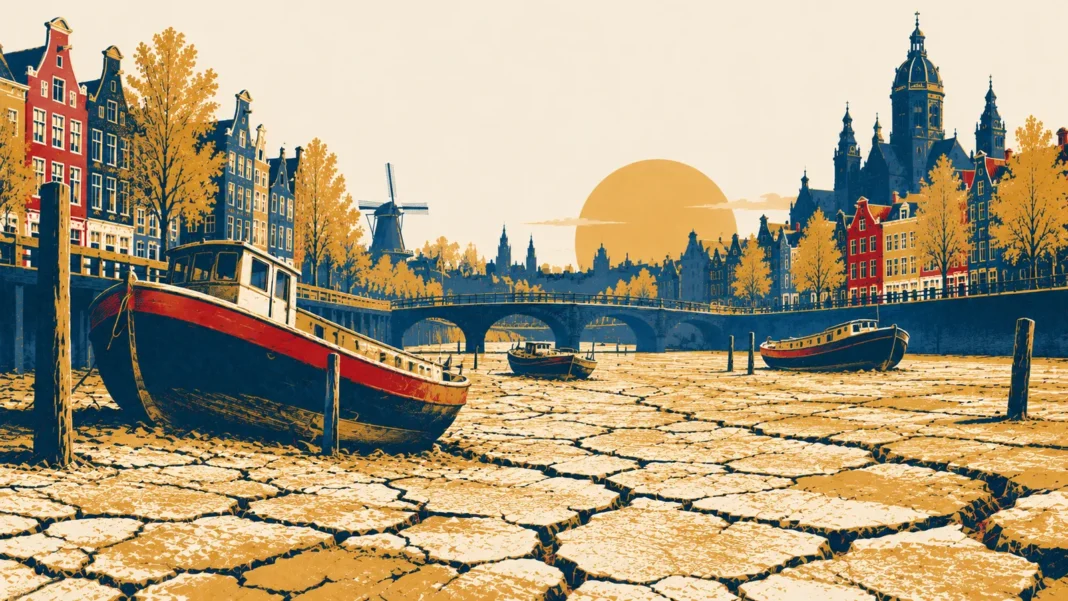
Amsterdam / Kabul – The world is waking up to a chilling new financial metaphor that has nothing to do with banks: “Water Bankruptcy.” While the global economy frets over inflation, a much more permanent deficit is hollowing out the foundations of our greatest metropolises. According to a landmark UN-backed report and recent data from CNN Climate, the Afghan capital of Kabul is now officially on a four-year countdown before its groundwater reserves disappear entirely.
Kabul is not alone. From the parched plains of Tehran to the shimmering but precarious neon of Las Vegas, the “water budget” of the 21st century is deep in the red. As we navigate the Mercury Cazimi of January 21, 2026—a day theoretically reserved for mental clarity—the reality of our ecological insolvency has never been clearer. We are no longer just facing “shortages”; we are facing the total systemic collapse of urban habitability.
Table of Contents
- Kabul: Six Million People on a Four-Year Clock
- The Tehran Sinkhole: When Soil Fails
- The American Mirage: Las Vegas and Los Angeles
- Expert Analysis: Living Above the Liquid Budget
- The Rise of the ‘Water Refugee’
- From Conservation to Efficiency: The Only Way Out
- Key Takeaways
- Dutch Learning Corner
Kabul: Six Million People on a Four-Year Clock
Kabul, a city of six million people, is the “ground zero” of global water bankruptcy. For decades, the city has relied on unregulated deep-well pumping to sustain its explosive population growth. Today, the bill has come due.
The Imminent Crisis:
Groundwater levels in Kabul have plummeted by dozens of meters in the last decade alone. Without a massive, coordinated international effort to divert surface water or implement radical recharge projects, Kabul faces becoming a “ghost town” by 2030. The mix of political isolation, lack of infrastructure investment, and changing Himalayan snow-melt patterns has created a perfect storm of thirst. For the millions living there, “Day Zero” isn’t a theory; it is a date on the calendar.
The Tehran Sinkhole: When Soil Fails
In Tehran, the crisis is literally visible from space. As groundwater is sucked dry, the very earth is collapsing. Tehran is currently experiencing some of the highest rates of subsidence (sinking land) in the world.
The city is effectively “hollowing out” from below. When aquifers are depleted beyond a certain point, the geological structure collapses, meaning the earth can never hold water again, even if it rains. This “permanent bankruptcy” means that even a return to normal rainfall patterns cannot save the city’s future. Tehran’s residents are witnessing the slow-motion death of their city’s foundation, driven by unsustainable agricultural policies and urban over-extension.
The American Mirage: Las Vegas and Los Angeles
It is a mistake to think water bankruptcy is reserved for the developing world. The American West—specifically Las Vegas and Los Angeles—is operating on a borrowed timeline.
Despite being global leaders in water recycling and conservation technology, these cities are tethered to the Colorado River—a source that is being over-allocated to the point of exhaustion. The “mirage” of lush golf courses in the middle of the Nevada desert is maintained only by aggressive engineering. However, the report warns that even these measures have a ceiling. If the primary “bank account” (Lake Mead and Lake Powell) hits “dead pool” status, the economic viability of the entire American Southwest will vanish within months.
Expert Analysis: Living Above the Liquid Budget
Kaveh Madani, a world-renowned water expert and lead author of the UN report, uses a stark financial analogy to explain the crisis:
“Many regions are living far above their water budget. Everything looks fine on the surface—construction continues, populations grow—until suddenly, it doesn’t. By the time the tap runs dry, the bankruptcy is already years in the making. We have treated water as a gift, but it is actually a finite credit line that we have exhausted.”
The “epiphany” required today, aligned with the Mercury-Sun conjunction, is the realization that Conservation (doing less with less) is no longer enough. We must move toward Absolute Efficiency—a total circular water economy where every drop is tracked, treated, and reused.
The Rise of the ‘Water Refugee’
The geopolitical implications of water bankruptcy are catastrophic. We are entering the era of the “Water Refugee.” When a city of six million people like Kabul runs out of water, they don’t just stay and thirst; they move.
This creates a domino effect of mass migration that could destabilize neighboring regions and eventually Europe. Water scarcity is already a primary driver of conflict in the Middle East and Africa. If the “Big Four” cities (Kabul, Tehran, LA, Las Vegas) hit their breaking points, the resulting migration flows will dwarf anything seen in the last century. For the Netherlands and Europe, “Water Security” in the Middle East is directly tied to “Border Security” at home.
From Conservation to Efficiency: The Only Way Out
Is there a way to avoid the “Ghost Town” status? The report highlights three pillars of survival:
- AI-Driven Precision Agriculture: Since 70% of global water is used in farming, using AI to deliver water only where and when it’s needed can save billions of liters.
- Circular Water Systems: Cities must become “sponges,” capturing every drop of rainwater and recycling 100% of wastewater, a technology the Dutch have mastered but the rest of the world has yet to implement.
- Decoupling Growth from Consumption: We must stop measuring “success” by how much we can build in a desert. Economic models must adapt to the “Water Budget” of the local environment.
Key Takeaways
- The Deadline: Kabul has roughly four years of water remaining.
- The Scope: Half the global population (4 billion people) experiences severe water scarcity at least one month per year.
- The Mechanism: Subsidence and aquifer collapse are making water bankruptcy “permanent” in cities like Tehran.
- The Solution: A shift from simple conservation to high-tech water efficiency and circular economies.
Dutch Learning Corner
| Word | Pronun. (Eng) | Meaning | Context (NL + EN) |
|---|---|---|---|
| 🌵 De Droogte | De Drooh-te | Drought | De droogte in Kabul is zorgwekkend. (The drought in Kabul is worrying.) |
| 🌊 Het Watertekort | Het Wah-ter-tekort | Water Shortage | Er is bir wereldwijd watertekort. (There is a global water shortage.) |
| ♻️ Het Hergebruik | Het Her-guh-bruk | Reuse / Recycling | Hergebruik van water is de oplossing. (Reuse of water is the solution.) |
| 🌍 De Grondwaterstand | De Gront-wah-ter-stant | Groundwater Level | De grondwaterstand daalt snel. (The groundwater level is falling fast.) |
Is Water a Human Right or a Finite Resource?
When the ‘Water Bank’ goes bust, who gets the last drop? Should we stop building cities in the desert, or can technology solve the crisis? As a nation that lives with water (The Netherlands), what advice should we give to cities like Kabul? Share your thoughts below.
Source / Global Environment: United Nations Water Report & CNN Climate.
Free: Netherlands 2027 Money Checklist
Every deadline and number you need before and after 1 January 2027, on two printable pages. Confirm your email and the PDF is yours; we will also email you when the 2027 figures are confirmed.
 Read nextLiving in NLAmsterdam Bans Meat and Fossil Fuel Ads: A Landmark Climate Decision