



Last updated:
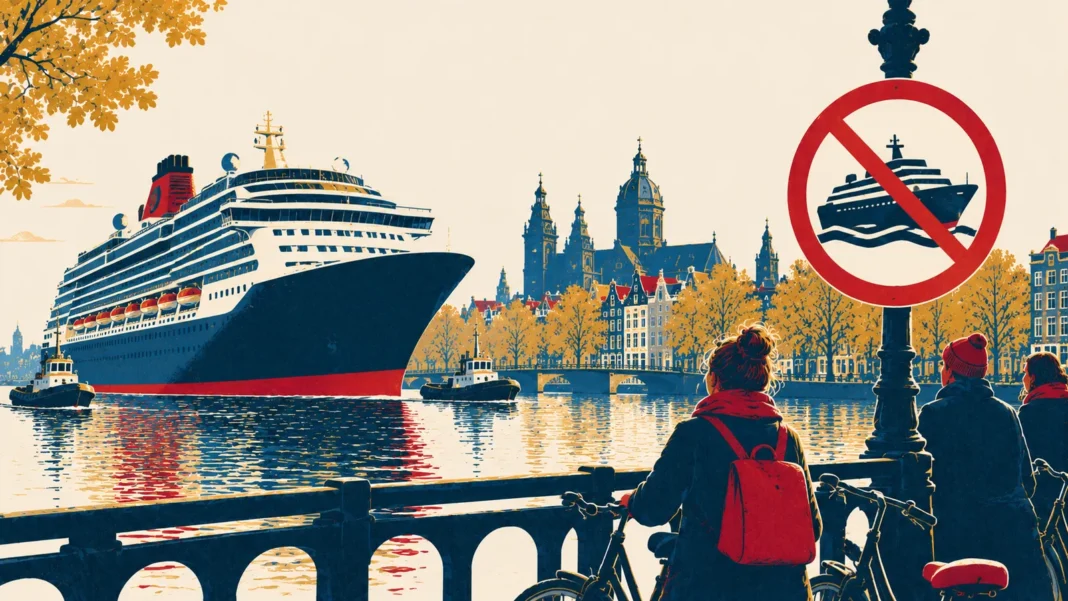
Amsterdam – The silhouette of massive luxury liners docking near Amsterdam’s historic center may soon become a memory of the past. In a decisive move toward prioritizing “liveability over revenue,” the city’s executive board announced on Thursday that it is exploring a total ban on sea cruises by 2035.
Hester van Buren, Amsterdam’s Port Chief, confirmed that the city has officially scrapped plans to build a new €85 million terminal in the western docks. Instead, the municipal focus has shifted toward eliminating sea cruise tourism entirely—a move that signifies a paradigm shift in how Europe’s most iconic cities handle mass tourism and environmental sustainability.
Table of Contents
- The €85 Million Rejection: Why the West Dock Plan Failed
- Sustainability vs. Taxes: A €46 Million Sacrifice
- The March 18 Deadline: Politics and the Port
- Global Precedent: Will Other Ports Follow?
- Liveability: Reclaiming the IJ Waterfront
- Key Takeaways
- Dutch Learning Corner
- Community Discussion
The €85 Million Rejection: Why the West Dock Plan Failed
For years, the proposed solution to Amsterdam’s cruise congestion was relocation. The plan was to move the Passenger Terminal Amsterdam (PTA) from its current prime location near Centraal Station to the more industrial “Coenhaven” in the western docks.
However, a comprehensive feasibility study released this week delivered a shock to the city council: the relocation would cost at least €85 million. The city executive deemed this investment “undesirable,” especially when the long-term goal is to reduce ship numbers. Investing nearly a hundred million euros into a facility for an industry the city is actively trying to curb was seen as a strategic contradiction. Consequently, the vote to relocate has been indefinitely postponed, paving the way for the discussion of a complete exit.
Sustainability vs. Taxes: A €46 Million Sacrifice
Implementing a total ban is not without significant financial consequences. Amsterdam’s treasury estimates that stopping sea cruises would result in a loss of €46 million in port fees and tourist taxes over the next 30 years.
Despite this, the current administration argues that the “hidden costs” of cruise tourism—including air pollution (nitrogen and CO2 emissions), overcrowding in the historic core, and the strain on local infrastructure—far outweigh the direct tax revenue. The city has already begun tightening the noose; dockings are being reduced from 190 per year to a maximum of 100 by 2026. A total ban by 2035 would be the final stroke in a long-running battle to de-massify the city’s tourism sector.
The March 18 Deadline: Politics and the Port
The timing of this announcement is highly strategic. With the March 18 local elections looming, the current coalition is framing the cruise ban as a central pillar of their platform. By postponing the final decision until after the elections, Hester van Buren and the city executive are effectively handing a “policy mandate” to the next administration.
This move forces competing political parties to take a clear stance: do they support the economic revenue of the cruise industry, or do they side with residents demanding a quieter, cleaner IJ waterfront? In the politically charged atmosphere of 2026, the “cruise vote” could determine the future of Amsterdam’s urban identity.
Global Precedent: Will Other Ports Follow?
Amsterdam is not alone in its struggle. Cities like Venice, Barcelona, and Santorini have all implemented various restrictions on cruise liners. However, Amsterdam’s proposal of an absolute ban is the most aggressive stance taken by a major European port to date.
Industry experts suggest that if Amsterdam succeeds, it may create a “domino effect” across the North Sea circuit. If major hubs like Amsterdam close their doors, cruise lines will be forced to adjust their itineraries toward smaller, perhaps less prepared ports, or invest heavily in zero-emission vessels to meet the city’s future stringent requirements.
Liveability: Reclaiming the IJ Waterfront
For the residents of Amsterdam-Noord and the city center, the cruise liners have long been seen as “floating apartment blocks” that block views and pollute the air. The removal of the terminal from the Veemkade would free up massive amounts of space for public use, housing, or green zones along the IJ.
The city’s “Liveability” (Leefbaarheid) index has become a primary driver for policy in 2026. “A city is a place to live first, and a place to visit second,” has become the unofficial motto of the council. By removing these ships, Amsterdam aims to transition toward “quality tourism”—visitors who stay in hotels, dine in local restaurants, and respect the city’s fabric, rather than thousands of day-trippers who return to their ships for meals and accommodation.
Key Takeaways
- The Shift: Amsterdam is moving away from relocating the cruise terminal and toward a total ban by 2035.
- The Cost: The city rejected an €85 million relocation project as financially and strategically undesirable.
- The Impact: A ban would cost the city €46 million in lost taxes but is expected to drastically improve local air quality and liveability.
- Election Focus: The final decision rests with the incoming administration after the March 18 local elections.
Dutch Learning Corner
| Word (Dutch) | Pronun. (Eng) | Meaning | Context (NL + EN) |
|---|---|---|---|
| 🚢 Het Cruiseschip | Het Kroo-zeh-skip | The Cruise Ship | Het cruiseschip verlaat de haven. (The cruise ship is leaving the harbor.) |
| 🗳️ De Verkiezing | De Ver-kee-zing | The Election | De gemeenteraadsverkiezingen zijn in maart. (The local elections are in March.) |
| 🌇 De Leefbaarheid | De Leef-bah-r-hayt | Liveability | Toerisme mag de leefbaarheid niet schaden. (Tourism must not harm liveability.) |
| 🏗️ De Verplaatsing | De Ver-plaat-sing | The Relocation | De verplaatsing van de terminal is te duur. (The relocation of the terminal is too expensive.) |
Is Amsterdam Trading Prosperity for Peace?
Should a city have the right to ban an entire sector of tourism to protect its environment, even if it means losing millions in tax revenue? Or is this move a populist reaction that will eventually hurt the city’s global standing? Share your thoughts below on the future of the IJ waterfront.
Source / Municipal Policy: Gemeente Amsterdam (Official Archive) & Port of Amsterdam Authority.
More in our guide: Moving to the Netherlands – the newcomer guide for internationals
Free: Netherlands 2027 Money Checklist
Every deadline and number you need before and after 1 January 2027, on two printable pages. Confirm your email and the PDF is yours; we will also email you when the 2027 figures are confirmed.
 Read nextBusiness & FinanceStarting a Business in the Netherlands as an Expat: KvK, VAT and Your First Website