



Last updated:
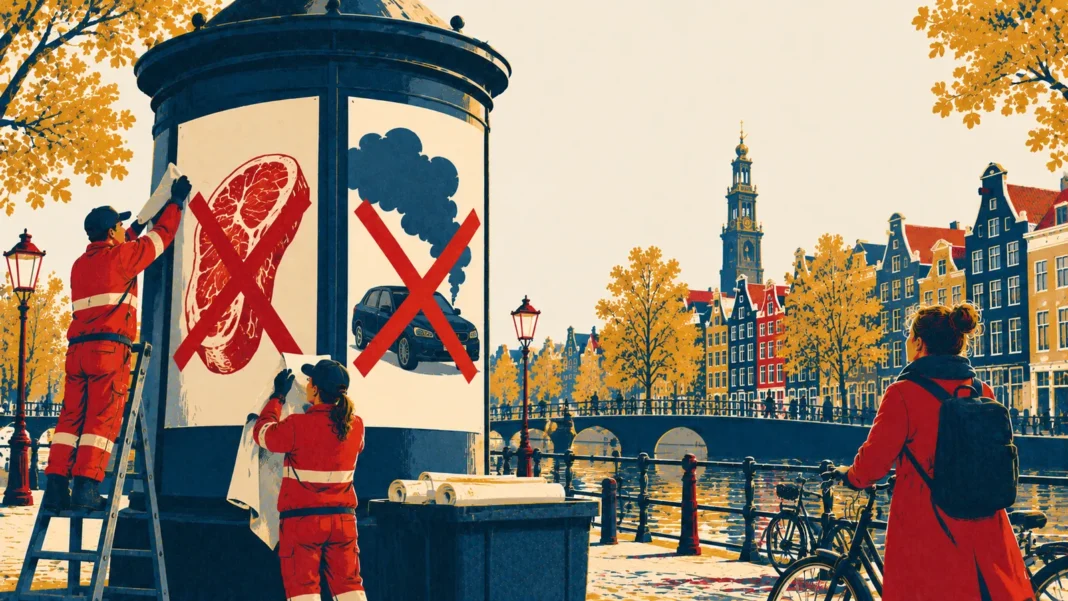
Amsterdam – In a decision that signals a major shift in urban policy, Amsterdam has officially voted to scrub its public spaces of advertisements promoting meat and fossil fuels. The landmark ruling, passed by the city council on Thursday, January 22, makes the Dutch capital the largest city in the world to implement such a comprehensive ban on “unsustainable” commercial messaging.
While similar bans have been introduced in smaller cities like Nijmegen and Tilburg, Amsterdam’s move targets the heart of the Dutch advertising market. From May 1st, billboards, bus shelters, and digital screens across the city will no longer feature juicy burgers or cheap flights, as the city struggles to align its commercial reality with its ambitious 2030 climate goals. However, the move is not without its “juridisch” (legal) complications, as officials prepare for a high-stakes battle with the advertising industry.
Table of Contents
- The Vote: Breaking Down the New Bylaws
- Legal Hurdles: Why Melanie van der Horst is Cautious
- Meat vs. Fuel: The Statistical Disparity
- The Dutch Wave: From Nijmegen to the Capital
- Global Impact: A Blueprint for European Cities?
- Expert Analysis: Can Ads Really Change Consumption?
- Key Takeaways
- Dutch Learning Corner
- Community CTA
The Vote: Breaking Down the New Bylaws
The Amsterdam City Council’s decision followed months of intense debate. The new regulations specifically target “out-of-home” (OOH) advertising—meaning any screen or poster visible in the public domain.
Crucially, the ban does not apply to the interior of shops. A supermarket can still advertise a meat discount inside its own doors, but it cannot promote that same discount on a bus stop billboard outside. The goal is to reduce the “passive exposure” of citizens to products that the city is simultaneously trying to discourage through environmental education and carbon-neutral initiatives.
Legal Hurdles: Why Melanie van der Horst is Cautious
Melanie van der Horst, the alderwoman for public spaces (D66), supported the ban but issued a stark warning to the council. The city has long-term contracts with major advertising giants like JCDecaux and Global.
“There is a real possibility that advertisers will launch legal claims against the city,” Van der Horst explained. Terminating these contracts or forcing a change in content could trigger millions of euros in compensation claims. The city’s legal department is currently “bracing for impact,” looking for ways to implement the ban without violating existing commercial law or freedom of expression statutes. The outcome of these potential lawsuits will be closely watched by city planners globally.
Meat vs. Fuel: The Statistical Disparity
One of the most interesting revelations during the council session was the actual breakdown of ads in Amsterdam.
* Meat Advertisements: Account for only 0.1% of all public advertising in the city.
* Fossil Fuel Advertisements: (Including budget flights, petrol cars, and gas-powered utilities) account for a significant 4.3%.
Critics argue that the meat ban is “symbolic politics” (symboolpolitiek) given its tiny share of the market. Proponents, however, argue that symbolism is exactly the point. By removing meat from the public eye, Amsterdam is officially de-normalizing high-carbon diets, just as it did with tobacco advertising decades ago.
The Dutch Wave: From Nijmegen to the Capital
Amsterdam is the latest—and loudest—voice in a movement that began in Nijmegen in 2024. Following Nijmegen’s lead, The Hague, Utrecht, and Delft all initiated similar bans with varying degrees of success.
The Netherlands has a long history of being a “climate pioneer.” While the national government often focuses on technological solutions like hydrogen or carbon capture, cities are increasingly focusing on behavioral change. The logic is simple: if the city wants people to cycle more and eat less meat, it shouldn’t allow the public sphere to be used as a megaphone for the industries that profit from the opposite behavior.
Global Impact: A Blueprint for European Cities?
If Amsterdam successfully defends its ban in court, experts expect a “domino effect.” Major capitals like Paris, London, and Berlin are already facing pressure from environmental groups to enact similar measures.
The future implications extend beyond the posters themselves. This policy forces advertising agencies to rethink their client portfolios. If a massive market like Amsterdam becomes “fossil-free” for billboards, agencies may begin prioritizing sustainable clients to ensure their campaigns can actually be seen by the public.
Expert Analysis: Can Ads Really Change Consumption?
Analysts at the University of Amsterdam (UvA) suggest that while a ban on billboards won’t stop people from eating meat overnight, it alters the social norm.
“Advertising is the background music of our lives,” one researcher noted. “When the music stops for a specific product, the product slowly loses its status as an ‘obvious choice.’ However, the city must be careful. If they ban meat ads but meat remains cheaper than plant-based alternatives due to subsidies, the policy will be seen as elitist and ineffective. The ban must be part of a broader economic strategy.”
Key Takeaways
- The Ban: Amsterdam will prohibit meat and fossil fuel ads in public spaces from May 1, 2026.
- The Scope: Only affects outdoor ads (billboards, bus stops); shop interiors are exempt.
- Legal Risk: Possible lawsuits from advertising giants due to existing contracts.
- The Movement: Amsterdam follows Nijmegen, The Hague, and Utrecht in this green initiative.
Dutch Learning Corner
| Word (Dutch) | Pronun. (Eng) | Meaning | Context (NL + EN) |
|---|---|---|---|
| 🚫 Het Verbod | Het Ver-bot | The Ban | Het verbod op vleesreclame is uniek. (The ban on meat ads is unique.) |
| ⛽ Fossiel | Fos-seel | Fossil (Fuel) | Geen reclame meer voor fossiele brandstoffen. (No more ads for fossil fuels.) |
| ⚖️ Juridisch | Yu-ree-disch | Legal | Er zijn juridische risico’s. (There are legal risks.) |
| 📢 De Reclame | De Re-klah-me | Advertisement | De reclame op bushokjes verdwijnt. (The ads on bus shelters are disappearing.) |
Should Cities Control What We See on the Streets?
Does a city council have the right to curate public advertising based on environmental goals, or is this a step too far into “thought control”? Would you rather see green plants on bus shelters instead of burger ads, even if it meant a slight increase in local taxes to cover the lost revenue? Share your opinion below.
Source / Municipal Policy: Gemeente Amsterdam (Council Minutes) & D66 Amsterdam Official.
More in our guide: Moving to the Netherlands – the newcomer guide for internationals
Free: Netherlands 2027 Money Checklist
Every deadline and number you need before and after 1 January 2027, on two printable pages. Confirm your email and the PDF is yours; we will also email you when the 2027 figures are confirmed.
 Read nextLGBTQ+ CommunityWorldPride Amsterdam 2026 Canal Parade: The Complete Expat Guide to Route, Tickets & Best Viewing Spots