



Last updated:
The South – If you live north of the rivers (Amsterdam, Utrecht, Haarlem), you might think next week is just a normal work week. But if you live in North Brabant or Limburg, life is about to stop completely.
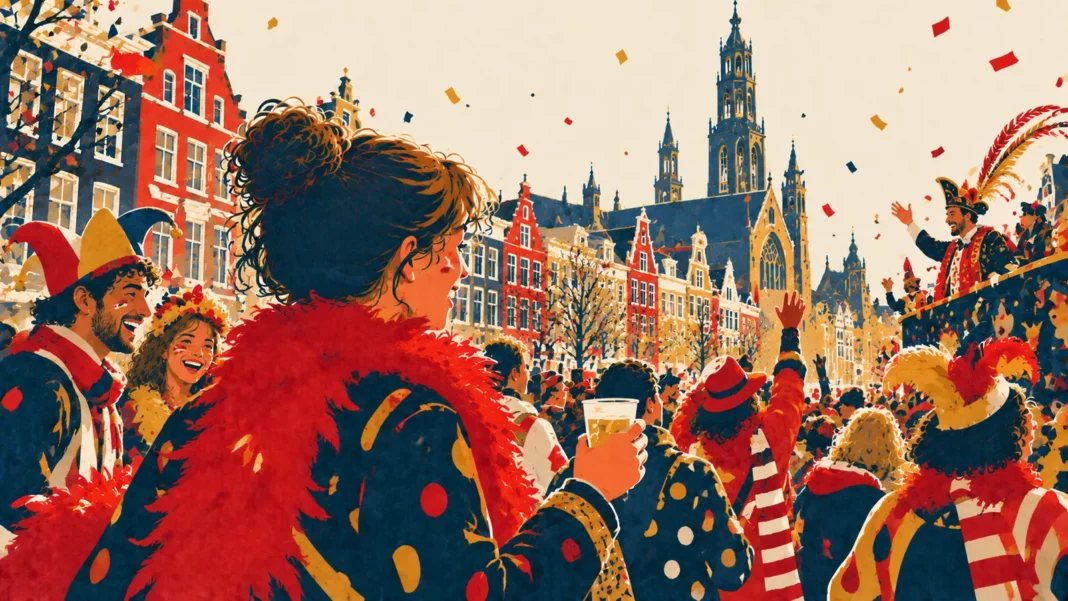
Dutch Carnaval is not just a party; it is a cultural phenomenon, a state of mind, and for three days, a completely different reality. Mayors hand over the keys of the city to “Prince Carnaval,” street names change, banks close, and wearing a normal suit to work might get you laughed at.
For expats, this can be overwhelming. Why is everyone saying “Alaaf”? Why is Den Bosch suddenly called “Oeteldonk”? And strictly: What should I wear so I don’t offend the locals?
Here is your comprehensive survival guide to the madness of Dutch Carnaval 2026.
Table of Contents
- The Dates: When Does the Madness Start?
- The North vs. South Divide (Below the Rivers)
- Secret City Names: Where are Lampegat and Oeteldonk?
- The Costume Police: Know the Rules
- Key Traditions: The Prince & The Number 11
- 5 Survival Tips for First-Timers
- Dutch Learning Corner: Carnaval Edition
The Dates: When Does the Madness Start?
Officially, Carnaval takes place on the Sunday, Monday, and Tuesday before Ash Wednesday (the start of Lent). However, in reality, the party starts on Friday afternoon and doesn’t stop until Wednesday morning.
📅 Official Carnaval Dates 2026
- Official Start: Sunday, February 15, 2026
- Official End: Tuesday, February 17, 2026
- The “Unofficial” Start: Friday, February 13 (office parties & pub crawls)
Note: While it is not an official national holiday, most businesses, schools, and municipalities in the South are closed. If you work in Eindhoven but your HQ is in Amsterdam, good luck explaining why you need time off.
The North vs. South Divide (Below the Rivers)
There is a famous saying in the Netherlands: “Above the rivers, they work. Below the rivers, they live.”
Carnaval is a Catholic tradition. Therefore, it is celebrated intensely in the historically Catholic provinces of Noord-Brabant and Limburg.
If you go to Amsterdam during Carnaval, you won’t see much. If you go to Breda, you won’t be able to walk down the street without dancing.
Secret City Names: Where are Lampegat and Oeteldonk?
This is the most confusing part for expats. During Carnaval, cities undergo a metamorphosis. They change their names, their flags, and their identities. If you check your train app, it will still say “Eindhoven,” but the station signs might say “Lampegat.”
Here is the essential decoding table for 2026:
| Real City Name | Carnaval Name | Translation / Meaning |
|---|---|---|
| ‘s-Hertogenbosch (Den Bosch) | Oeteldonk | “Frog Hill” (Refers to the marshlands) |
| Eindhoven | Lampegat | “Lamp Hole” (Reference to Philips/Lightbulbs) |
| Tilburg | Kruikenstad | “Jug City” (History of textile workers using urine in jugs) |
| Breda | Kielegat | Refers to the traditional peasant smock (Kiel) |
| Oss | Ossekoppenrijk | “Kingdom of Ox Heads” (History of meat industry) |
| Maastricht | Mestreech | (Dialect for Maastricht) |
The Costume Police: Know the Rules
WARNING: This is where 90% of expats make a mistake. There are two distinct styles of Carnaval, and wearing the wrong one in the wrong city is a faux pas.
1. The Burgundian Style (North Brabant)
In cities like Den Bosch (Oeteldonk) and Breda, the tradition is to look uniform, erasing social status.
What to wear: A peasant smock (boerenkiel) covered in patches (emblems).
Specific Rule for Den Bosch: You MUST wear the Red-White-Yellow scarf. Do not show up in a banana costume or a Spiderman suit. You will be the only one, and you will look like a lost tourist.
2. The Rhenish Style (Limburg)
In Maastricht and Venlo, it is all about elaborate, beautiful makeup and creativity.
What to wear: Venetian masks, face paint, wildly creative homemade costumes. Here, being unique is the goal.
3. The “Anything Goes” Zone (Eindhoven/Tilburg)
In Lampegat (Eindhoven), the rules are looser. You will see people in smocks, but also people dressed as minions, cowboys, or beer bottles. If you don’t have a smock, a funny costume is acceptable here.
Key Traditions: The Prince & The Number 11
Why the number 11? It is the “fool’s number” (het gekkengetal).
The preparations start on 11/11 (November 11th) at 11:11 AM. During Carnaval, a “Prince Carnaval” is elected to rule the city. The actual Mayor symbolically hands over the key to the city, signifying that for three days, the “fools” are in charge.
5 Survival Tips for First-Timers
- Don’t Drive: Seriously. Roads are closed for parades, and everyone is drinking. Use the train (NS runs special night trains in Brabant).
- Eat “Worstenbroodjes”: This Brabant sausage roll is the fuel of Carnaval. It absorbs the beer and keeps you going.
- Bring Cash (Muntjes): Many large tents or outdoor bars use a token system (muntjes). You buy plastic coins at a booth and use them to pay for drinks.
- Learn the Greeting: In Brabant, the greeting is generally just “Alaaf!” (with a specific hand gesture), but be careful—in some cities, they just say “Hoi!”. Observe before you shout.
- Layer Up: You will be drinking in warm bars and then walking in the freezing February cold. Wear thermal underwear (thermokleding) under your costume.
Dutch Learning Corner: Carnaval Edition
| Word (Dutch/Dialect) | Pronunciation | Meaning | Context |
|---|---|---|---|
| 🍻 Alaaf! | A-laaf | Official Greeting | Used mostly in Limburg and parts of Brabant. |
| 🕺 De Polonaise | De Po-lo-nay-ze | Conga Line | Put your hands on the shoulders of the person in front and walk. |
| 🌭 Het Worstenbroodje | Het Wors-ten-brood-je | Sausage Roll | Brabantse worstenbroodjes are essential survival food. |
| 🚜 De Optocht | De Op-tocht | The Parade | De Grote Optocht is on Sunday or Monday. |
TDD Community Question
Are you brave enough to venture South this year? Which city are you visiting: Oeteldonk, Lampegat, or Ossekoppenrijk? Share your costume plans in the comments!
More in our guide: Moving to the Netherlands – the newcomer guide for internationals
Free: Netherlands 2027 Money Checklist
Every deadline and number you need before and after 1 January 2027, on two printable pages. Confirm your email and the PDF is yours; we will also email you when the 2027 figures are confirmed.
 Read nextLiving in NLRent Increase Netherlands 2026 & Deposit Return: Huurcommissie, Legal Caps and How to Claim Your Borg