



Last updated:
Amsterdam – The phone rings. You look at the screen. It says “ABN AMRO” or “ING Bank.” Or perhaps, even more terrifyingly, it says “Daughter.”
You pick up. The voice on the other end is panic-stricken. It is your child’s voice. They are crying. They say they have been arrested, or they are in the hospital, or they lost their wallet in Bali. They need money. Now.
You panic. You transfer the money. And 10 minutes later, you call your daughter, only to find her sitting safely on her sofa, watching Netflix. You have just been hit by the newest, most terrifying wave of cybercrime in the Netherlands: AI Voice Cloning.
In 2026, scammers no longer need to be smooth talkers. They just need 3 seconds of your voice from an Instagram Story or a TikTok video to create a perfect digital clone. Combined with “Number Spoofing” and “Helpdesk Fraud,” they are emptying the bank accounts of expats at an alarming rate. Here is the TDD Ultimate Survival Guide to the digital minefield.
Table of Contents
- The New Threat: How AI Voice Cloning Works
- “Helpdeskfraude”: The #1 Expat Trap
- Spoofing: Why You Can’t Trust Caller ID
- WhatsApp 2.0: The “Friend in Need” Evolves
- The Psychology: Why Smart People Get Scammed
- The “Safe Word” Strategy: How to Protect Your Family
- I Was Scammed: Immediate Action Plan
- Dutch Learning Corner
The New Threat: How AI Voice Cloning Works
For years, we laughed at the “Microsoft Tech Support” scams with their heavy accents and bad scripts. Those days are over.
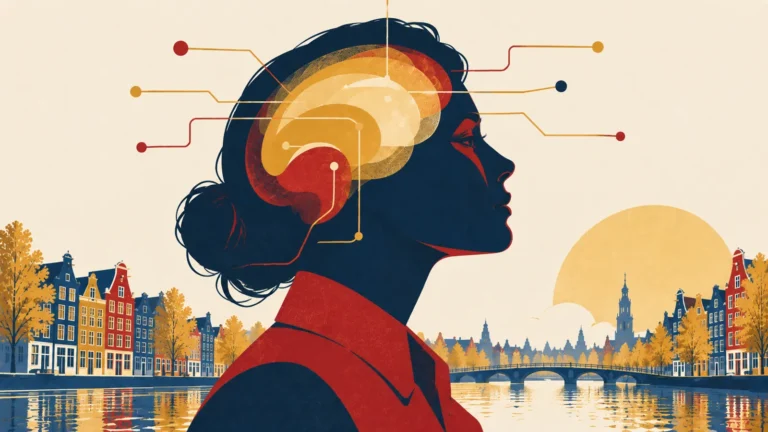
The Technology: With the rise of generative AI in 2025 and 2026, software can now analyze the pitch, tone, and cadence of a human voice from a tiny audio sample.
The Source: Where do they get your voice? Social media. If you have a public Instagram profile where you speak, or if you have posted a video on LinkedIn, your voice data is available.
The Scenario: The scammer calls you. They use a text-to-speech program that speaks in your loved one’s voice.
“Mom, I’m in trouble. Please don’t get mad. I need €500.”
Because the brain recognizes the voice, the skepticism filter shuts down. Panic takes over.
“Helpdeskfraude”: The #1 Expat Trap
While AI is the flashy new threat, the most common financial killer for expats remains Bank Helpdesk Fraud.
The Script
- The Call: You receive a call from what looks like your bank’s official number.
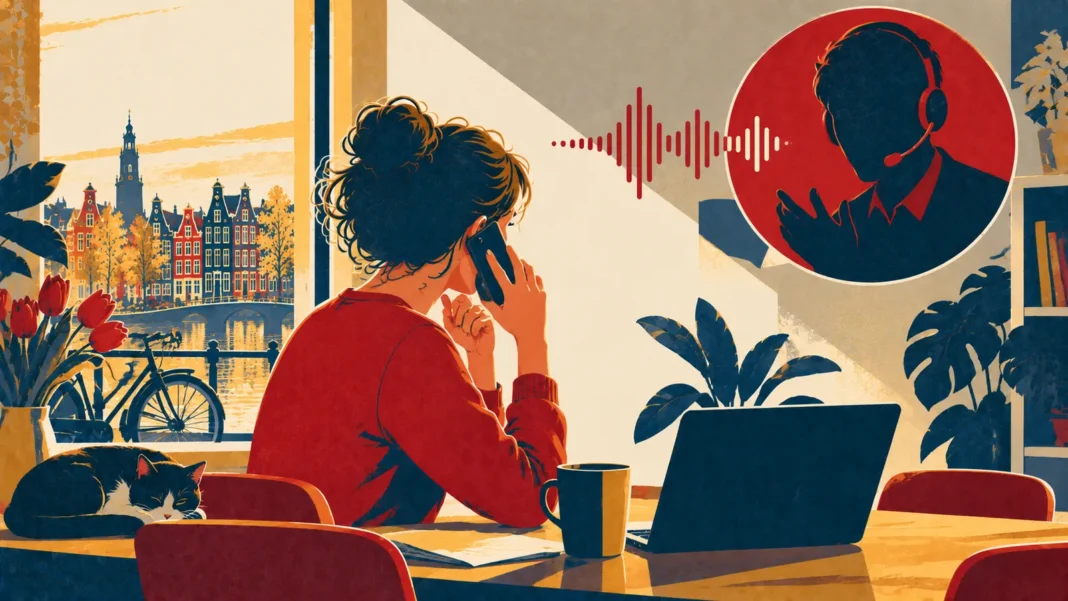
- The Hook: An eloquent, English-speaking agent says: “Mr. Smith, we have detected suspicious activity on your account. Someone in Frankfurt is trying to buy a Rolex for €8,000. Did you authorize this?”
- The Panic: You say “No!”
- The Solution (The Trap): The agent says: “We need to secure your funds immediately. We have opened a temporary ‘Safe Account’ (Kluisrekening). Please transfer your balance there while we investigate.”
- The Climax: They might even send a courier to your house to pick up your bank card “for forensic analysis.”
The Reality: NO DUTCH BANK has “Safe Accounts.” NO DUTCH BANK will ever ask you to transfer money to keep it safe. If they suspect fraud, they simply freeze your card. End of story.
Spoofing: Why You Can’t Trust Caller ID
How do they trick you into picking up? Through a technique called Spoofing.
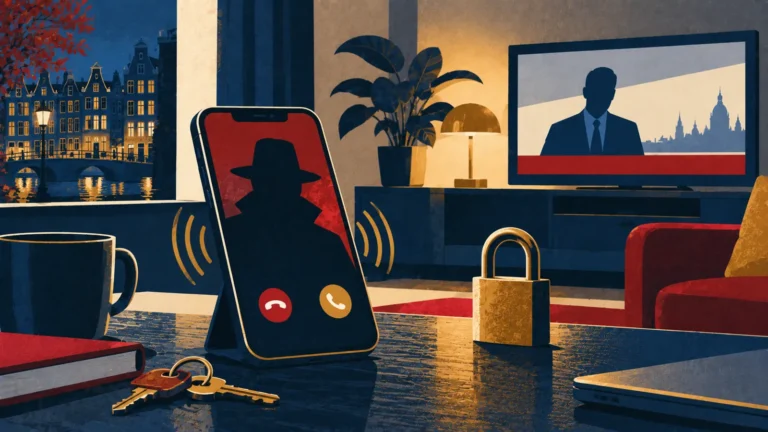
Scammers use VoIP (Voice over IP) software that allows them to choose what number appears on your screen. They can make it look like the official customer service number of ING (020 22 888 88) or the Police (0900-8844).
The Golden Rule of 2026:
If your bank calls you, hang up.
Look up the number yourself.
Call them back on a different line.
If the original caller was legitimate, they will have a note in your file. If it was a scammer, you just saved your life savings.
WhatsApp 2.0: The “Friend in Need” Evolves
The “Hi Mum, this is my new number” text message is a classic. But in 2026, it has mutated.
The Video Call Trick:
Scammers now use “Deepfake” overlays during video calls. You might get a WhatsApp video call from an unknown number. You answer, and for 3 seconds, you see your son’s face. The connection is “bad” and glitches (intentionally). The call drops.
Then the text comes: “Sorry, signal is terrible. Can you just pay this bill for me? I can’t access my banking app on this new phone.”
Seeing the face—even for a second—convinces you it’s real. Do not trust bad connections. Ask a question only the real person would know.
The Psychology: Why Smart People Get Scammed
Victims often feel immense shame. “How could I be so stupid?”
Stop blaming yourself. These scams are designed to hack your amygdala (the fear center of the brain).
- Urgency: “You must act NOW or the money is gone.” Urgency destroys critical thinking.
- Authority: They pretend to be Police, Bank Managers, or Tax Officials. Expats are naturally afraid of breaking rules in a foreign country, making them compliant.
- Isolation: They tell you “Do not tell anyone, this is an ongoing investigation.” This prevents you from getting a reality check from a friend.
The “Safe Word” Strategy: How to Protect Your Family
You cannot stop the technology, but you can upgrade your family’s protocol.
1. Establish a “Code Word” (Safe Word)
Tonight at dinner, agree on a secret word with your partner, children, and parents. It should be random (e.g., “Purple Elephant” or “Macaroni”).
The Rule: If anyone calls in an emergency asking for money or claiming to be kidnapped, ask: “What is the code word?”
An AI voice clone cannot know the code word. If they can’t say it, hang up.
2. Reduce Audio Footprint
Review your privacy settings. If your Instagram is public, anyone can clone your voice. Consider making personal accounts private.
3. The “4-Hour Rule” for Banks
If a “Bank Agent” pressures you to move money, say: “I will come to the branch tomorrow personally.”
If they get angry or aggressive, it is a scam. Real bank employees never get angry if you want to be safe.
I Was Scammed: Immediate Action Plan
If you realize you have transferred money to a scammer, speed is everything.
- Call Your Bank Immediately: Don’t use the app. Call the emergency fraud line. They might be able to freeze the transfer if it hasn’t cleared the “Instant Payment” network yet (though this is rare).
- Call the Police (0900-8844): Make an appointment to file a report (Aangifte doen). You need this report for any chance of insurance claims.
- Contact Slachtofferhulp: Scams are traumatic. Slachtofferhulp Nederland offers free psychological and legal support.
- The Refund Question:
- If the scammer hacked your account, the bank must refund you.
- If YOU authorized the transfer (even if tricked), banks historically refused to refund (citing Gross Negligence).
- Good News: As of 2026, new EU directives are putting more pressure on banks to refund victims of “Impersonation Scams,” especially if the bank failed to detect obvious anomalies (like you emptying your savings account to a completely new IBAN in Malta). Fight for your rights.
Dutch Learning Corner
| Word (Dutch) | Pronunciation | Meaning | Context |
|---|---|---|---|
| 📞 Helpdeskfraude | Help-desk-frow-de | Tech Support Scam | Expats zijn vaak doelwit van helpdeskfraude. (Expats are often targets of helpdesk fraud.) |
| 👮 Aangifte doen | Aan-hif-te doen | To file a police report | Je moet direct aangifte doen bij de politie. (You must file a police report immediately.) |
| 🐴 Geldezel | Held-e-zel | Money Mule | Jongeren worden geronseld als geldezel. (Young people are recruited as money mules.) |
TDD Community Question
Have you ever received a “fake bank call”? How did you realize it was a scam? Share your “Red Flags” in the comments to help warn others!
Free: Netherlands 2027 Money Checklist
Every deadline and number you need before and after 1 January 2027, on two printable pages. Confirm your email and the PDF is yours; we will also email you when the 2027 figures are confirmed.
 Read nextNewsWhat Is AI? A Screen-Free AI Activity Book for Kids