




Last updated:
Amsterdam/Utrecht – If you thought the housing madness of 2021 was a one-time event, brace yourself. The Dutch housing market in February 2026 is back in “Code Red” territory, but the rules of the game have completely changed. It is no longer just about low interest rates; it is about Energy Labels, Regulation, VvE health, and a disappearing rental market.
Here is the brutal reality on the ground: The rental sector is shrinking rapidly as landlords sell off their properties to escape the new “Middenhuur” rent controls and higher Box 3 taxes. This forces more people—including expats who just arrived—into the buying market. The result? “The Big Squeeze.” Prices are rising (projected +5.5% this year), supply is at a historic low, and overbidding is back with a vengeance. But unlike 5 years ago, you can’t just buy anything blindly. Foundation rot, inactive Owners’ Associations (VvE), and strict mortgage rules for freelancers make the process a minefield.
Whether you are looking to buy your first apartment in Rotterdam, trying to secure a mortgage as a ZZP’er, or figuring out if you can borrow money from your parents via the “Family Bank” construction, you need a strategy. In this massive, definitive guide, we break down the 2026 housing landscape, the hidden risks every expat ignores, and the specific financial hacks to win a bidding war.
Table of Contents
- The State of the Market 2026: Prices & Panic
- The Rental Apocalypse: Why Can’t I Find a Flat?
- The Great Calculation: Buying vs. Renting in 2026
- The “Jubelton” is Dead: Long Live the “Family Bank”
- Mortgage Deep Dive: Annuity vs. Linear Explained
- The “Energy Label” Bonus: Borrowing More for Green Homes
- Buying as a Freelancer (ZZP): The “Inkomensverklaring”
- The Hidden Costs: Notary, Tax & Translator Fees
- The VvE Trap: Understanding Service Costs & MJOP
- The Buying Process: Biedlogboek & “Gunfactor”
- Hidden Risks: Foundation Rot, Asbestos & Ground Lease
- Where to Buy? 2026 Investment Hotspots
- Dutch Housing Vocabulary Corner
The State of the Market 2026: Prices & Panic
According to the latest quarterly reports from the NVM (Dutch Association of Real Estate Agents) and Rabobank, the dip of 2023-2024 is officially a distant memory. The market has rebounded with aggressive momentum.
The Numbers:
The average house price in the Netherlands has crossed the €460,000 mark again. In Amsterdam, the average is closer to €650,000. The “Overbidding Percentage” has risen to 65% of all transactions in the Randstad.
Why is this happening?
1. Wages are Up: Collective Labor Agreements (CAO) in 2025 resulted in significant wage increases (approx. 4-6%), increasing borrowing capacity for couples.
2. Structural Scarcity: The government target of building 100,000 new homes a year has failed again due to strict nitrogen regulations and high material costs. We only built approx. 65,000 units last year.
3. The “Rental Refugees”: Thousands of people who would prefer to rent are forced to buy because there are literally no rental houses available. This adds artificial pressure to the bottom segment of the buying market (€350k – €500k).
The Rental Apocalypse: Why Can’t I Find a Flat?
If you are scrolling through Pararius or Funda and seeing zero results, you are not alone. The Dutch rental market is undergoing a structural collapse due to well-intentioned but flawed government policy.
The Cause: The “Wet Betaalbare Huur” (Affordable Rent Act)
Introduced fully in 2025, this law expanded rent controls (the WWS points system) to mid-market homes (up to approx. €1,250/month).
The Effect:
- Landlords are Selling (Uitponden): A private landlord who used to rent an apartment for €1,600 is now told by the government the maximum legal rent is €1,100. Combined with the higher Box 3 asset tax (36%), renting out property is no longer profitable.
- The Exodus: When a tenant leaves, the landlord puts the “For Sale” sign up instead of finding a new tenant. This shifts homes from the rental market to the buying market, reducing the rental stock by an estimated 40,000 units in 2025 alone.
The Expat Conundrum: Newcomers are hit hardest. Since you cannot buy immediately (lack of history, probation period), you are fighting for the few remaining “Free Sector” rentals (above €1,300), driving those prices sky-high. Expect to pay €2,200+ for a 1-bedroom in the Randstad.
The Great Calculation: Buying vs. Renting in 2026
Is it financial suicide to rent? Let’s look at two realistic scenarios for February 2026 to help you decide.
Scenario A: The Amsterdam Renter
Profile: Couple renting a 60m2 apartment in Amsterdam-West.
Rent: €2,400 per month (excluding gas/light).
Equity Built: €0.
Protection: High (Rent protection laws), but vulnerable to annual indexation increases (CPI + 1%).
Scenario B: The Almere Buyer
Profile: Couple buying a 100m2 row house in Almere (20 mins by train to Amsterdam).
Price: €450,000.
Mortgage (3.8% interest, 30 years): Approx. €2,100 per month (gross).
Net Monthly Cost (after Tax Deduction): Approx. €1,750.
Verdict: Buying is significantly cheaper on a monthly basis, if you can secure the down payment (approx. €20,000 for closing costs) and handle the commute. In 2026, moving to the “Commuter Belt” (Almere, Haarlem, Zaandam) is the only rational financial choice for many.
The “Jubelton” is Dead: Long Live the “Family Bank”
Until 2024, parents could give their children a tax-free gift of over €100,000 (The Jubelton) to buy a house. This is completely abolished in 2026. However, smart expats and locals are using the “Familiebank” (Family Bank) construction.
How it works:
Your parents do not give you the money; they lend you the money (e.g., €50,000).
The Trick: You sign a formal loan agreement with an interest rate slightly higher than the market rate (e.g., 5%).
1. Because it is a loan for a house, you can deduct this interest from your taxes (Hypotheekrenteaftrek).
2. Your parents receive the 5% interest income (which is usually untaxed in Box 3 up to a certain threshold).
3. The Kicker: Your parents can then gift that interest back to you annually (using the standard annual gift exemption of approx. €6,000).
This is a perfectly legal way to lower your monthly costs and help with the down payment, but it requires a notary or a strict contract.
Mortgage Deep Dive: Annuity vs. Linear Explained
When you sit with a mortgage advisor, they will ask: “Annuity or Linear?” Your answer determines your monthly payments for the next 30 years.
1. Annuity Mortgage (Annuïteitenhypotheek)
Most popular for Expats.
How it works: Your gross monthly payment stays exactly the same for 30 years (e.g., €1,500). In the beginning, you pay mostly interest and very little principal. Over time, this shifts.
Pros: Lowest initial monthly costs.
Cons: You pay more interest in total over 30 years compared to Linear.
2. Linear Mortgage (Lineaire hypotheek)
Best for long-term savers.
How it works: You pay off the principal in equal chunks every month, plus interest. Your monthly payment is highest at the start and decreases every month.
Pros: You pay off debt faster and pay less total interest.
Cons: High initial monthly costs make it harder to qualify for the maximum loan amount.
The Verdict: 90% of expats choose Annuity because it maximizes cash flow now. However, splitting your loan (50% Annuity, 50% Linear) is a savvy move to reduce risk.
The “Energy Label” Bonus: Borrowing More for Green Homes
The mortgage landscape has evolved. Interest rates have stabilized between 3.6% and 4.2% for a 10-year fixed period. But the biggest change is the Sustainability Bonus.
The “Label A+++” Rule:
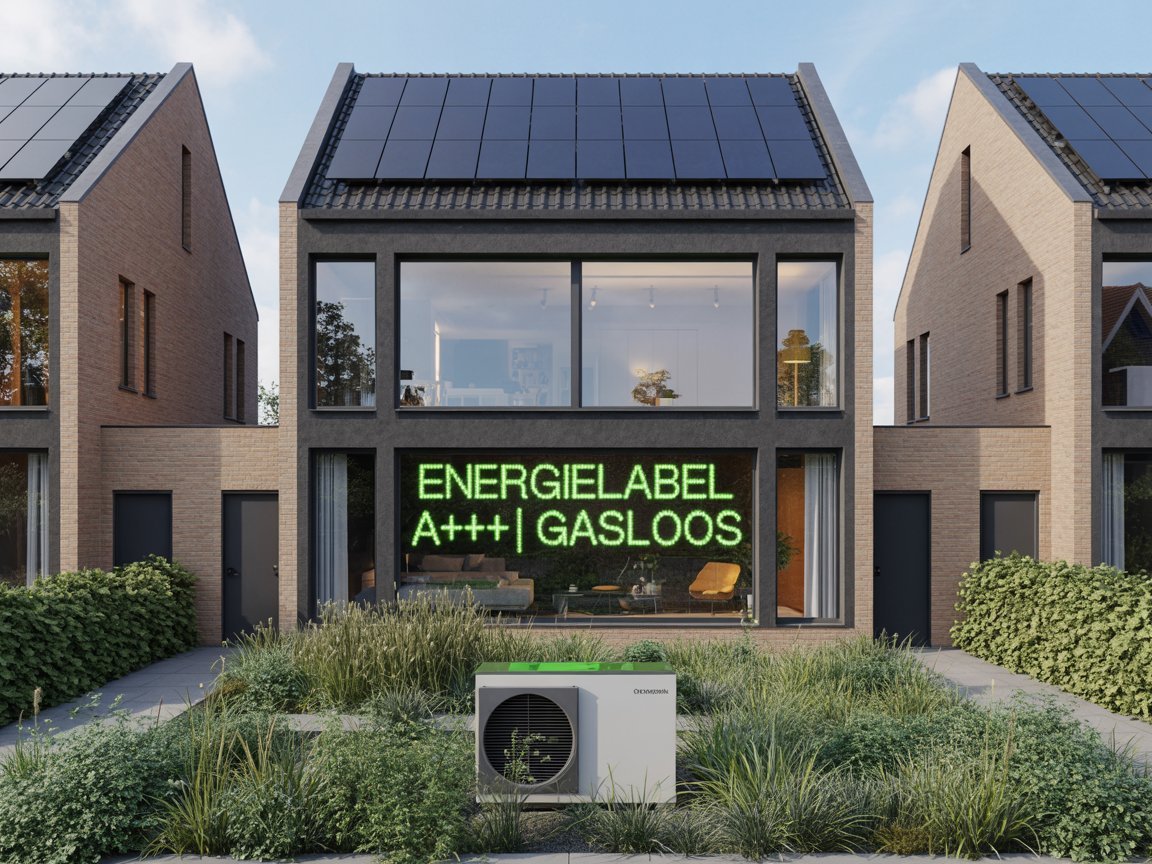
In 2026, banks are legally allowed to lend you more money if the house is energy-efficient, because your monthly energy bill will be lower.
- Label E, F, G: Standard borrowing capacity. (You might even face a “climate discount” on the house value).
- Label A or B: + €10,000 borrowing capacity.
- Label A++++ (Energy Neutral): Up to + €50,000 extra borrowing capacity.
Strategy: If you are maxing out your budget, look for a new-build (Nieuwbouw) or a deeply renovated home. That Label A rating is literally worth cash in your pocket.
Buying as a Freelancer (ZZP): The “Inkomensverklaring”
For the 1.2 million freelancers in NL, buying a house used to be a nightmare. In 2026, it is easier, but strict documentation is required.
The “3-Year Rule” is Dead: Banks no longer strictly require 3 full years of business figures. If you have 1 year of figures and a solid projection, you can get a mortgage.
The “Inkomensverklaring”: You cannot just show your tax return. You must hire a specialized accountant to produce an “Inkomensverklaring” (Income Statement) specifically for the mortgage. This costs approx. €250 – €400.
The Haircut: Banks will take your net profit, but they might apply a “risk haircut” (e.g., counting only 90% of your income). Ensure your advisor specializes in entrepreneurs (Ondernemershypotheek).
The Hidden Costs: Notary, Tax & Translator Fees
Many expats budget for the house price but forget the “Kosten Koper” (Buyer’s Costs). You cannot finance these; you must pay them from your savings.
- Transfer Tax (Overdrachtsbelasting): 2% of the purchase price. (Note: If you are under 35 and the house is under €510,000, you pay 0%!).
- Notary Fees: You need two deeds: the Transfer Deed (Leveringsakte) and the Mortgage Deed (Hypotheekakte). Total cost: approx. €1,200 – €1,800.
- Translator (Tolken): If you do not speak fluent Dutch, the law requires a sworn translator to be present at the notary signing. This is mandatory, not optional. Cost: €300 – €500.
- Bank Guarantee: 10% of the house price. Usually, you buy an insurance policy for this (Bankgarantie) costing approx. €250.
- Advisor Fee: Approx. €2,500 – €3,500.
The VvE Trap: Understanding Service Costs & MJOP
If you buy an apartment, you are not just buying a house; you are buying a share in a business: the Owners’ Association (Vereniging van Eigenaren – VvE). Ignoring this is the #1 mistake expats make.
Check 1: The MJOP (Maintenance Plan)
Ask for the “Meerjarenonderhoudsplan” (MJOP). This document outlines repairs for the next 10-15 years (roof, painting, elevator).
Red Flag: If there is no MJOP, or it hasn’t been updated in 5 years, you might face a surprise bill of €10,000 next year for a leaking roof.
Check 2: The Reserve Fund
Does the VvE have money in the bank? The law requires a minimum reserve (0.5% of rebuilding value). If the bank account is empty, banks may refuse to give you a mortgage on the apartment.
Check 3: Service Costs
Monthly VvE fees average between €150 and €300. Be careful: sometimes this includes “heating costs” (Block heating), sometimes it doesn’t. Always ask: “Is voorschot stookkosten inbegrepen?” (Is advance heating cost included?)
The Buying Process: Biedlogboek & “Gunfactor”
Buying a house in the Netherlands is a contact sport. Here is the 2026 playbook.
- Get an Aankoopmakelaar (Buying Agent): In this market, going solo is suicide. Agents have access to the NVM system and see listings before they hit Funda. They also know the “real” value. Cost: Approx. €3,000 – €5,000.
- The “Biedlogboek” (Bid Logbook): Since 2024, agents must keep a digital log of all bids. Once the sale is final, you have the right to see this log. This prevents the agent from lying (“We have a higher bid, you need to add €10k”) when no such bid exists. Demand to see the log if you lose a bid to understand market value.
- The Bid (Het Bod): Overbidding is back. In popular cities, expect to bid 5% to 12% over the asking price.
TDD Tip: NEVER waive the “Finance Clause” (Voorbehoud van financiering) unless you have the cash in the bank. If you waive it and don’t get the mortgage, you owe a 10% penalty immediately.
- The “Gunfactor”: Sometimes, the seller chooses the buyer they like. Write a “Love Letter” to the sellers. Tell them who you are, why you love their garden, and include a photo. It works.
Hidden Risks: Foundation Rot, Asbestos & Ground Lease
Expats often fall in love with “charming” 1930s houses, ignoring the financial black holes.
1. Foundation Rot (Paalrot)
Many pre-1950 houses are built on wooden poles. Due to climate change and lowering groundwater levels (especially in Rotterdam, Haarlem, and Zaandam), these poles are rotting.
The Cost: Fixing a foundation costs €60,000 to €120,000.
The Protection: Demand a “Funderingsonderzoek” report or check the “Funderingskaart” online. If the agent is vague (“monitoring needed”), run away.
2. Ground Lease (Erfpacht)
In Amsterdam and Utrecht, you often buy the building, but rent the land from the municipality.
The Trap: Is the canon (rent) paid off forever (eeuwigdurend afgekocht)? Or does it reset in 2035? If it resets, your monthly cost could jump from €300 to €2,000 based on new land values.
3. Asbestos & Lead Pipes
Houses built before 1994 may contain asbestos. Houses before 1960 may have lead water pipes (dangerous for children). Always ask for an “Asbestclausule” and check the pipes under the stairs.
New Construction (Nieuwbouw): Is it Worth the Wait?
With the scarcity of existing homes, Nieuwbouw seems attractive.
Pros: No overbidding (fixed price), Label A+++ (higher mortgage), no maintenance for 10 years, no transfer tax (Kosten Koper savings of 2%).
Cons:
- The Wait: You wait 2-3 years for construction.
- Double Costs: You pay your current rent AND the mortgage interest for the new house (Bauwdepsit) simultaneously.
- “Meerwerk”: The base price often excludes a kitchen, floors, and bathroom. Add €30k-€50k for finishing.
Where to Buy? 2026 Investment Hotspots
If Amsterdam is out of budget, where should you look? We analyzed connectivity and price growth potential.
| City | Commute to A’dam | Avg Price (100m2) | Vibe & Verdict |
|---|---|---|---|
| Amersfoort | 35 min (Intercity) | €520k | Historic, family-friendly, green. voted “Best City” frequently. Top pick for families. |
| Leiden | 30 min | €580k | University town, canals, mini-Amsterdam but cleaner. Expensive but retains value well. |
| Almere Poort | 20 min | €480k | Modern, beach-side, expat enclave. Lacks historic soul but offers space and new builds. |
| Rotterdam (South) | 40 min (HSL Train) | €390k | Gritty, gentrifying fast. Areas like Feyenoord City are booming. Good for high ROI risk-takers. |
Dutch Housing Vocabulary Corner
| Word (Dutch) | Pronunciation | Meaning & Context |
|---|---|---|
| 🔨 Kosten Koper (k.k.) | Kos-ten Ko-per | Buyer’s Costs. The approx. 2% tax + notary fees you pay on top of the purchase price. Not financeable! |
| 📜 Leveringsakte | Le-ve-rings-ak-te | Transfer Deed. The official document signed at the notary that transfers ownership to you. |
| 💸 Schenkbelasting | Schenk-be-las-ting | Gift Tax. Relevant if your parents help you buy. The exemption is approx €6,000 per year. |
| 🏢 VvE (Vereniging van Eigenaren) | Vee-Vee-Eee | Owners’ Association. The body responsible for maintaining the apartment building. Always check their finances. |
TDD Community Question
Are you actively house hunting? Are you considering using the “Family Bank” method to boost your budget? Or are you waiting for new-build projects? Share your strategies and questions with fellow TDD readers below!
More in our guide: Housing in the Netherlands – all our renting, buying and energy guides
Renting or buying in 2027?
Our free checklist covers the transfer tax cut, box 3, energy and every deadline before 1 January. Confirm your email and the PDF is yours; we will also email you when the 2027 figures are confirmed.
 Read nextLiving in NLRent Increase Netherlands 2026 & Deposit Return: Huurcommissie, Legal Caps and How to Claim Your Borg