



Last updated:
“Let’s Get Started”: FINAL DEAL SIGNED
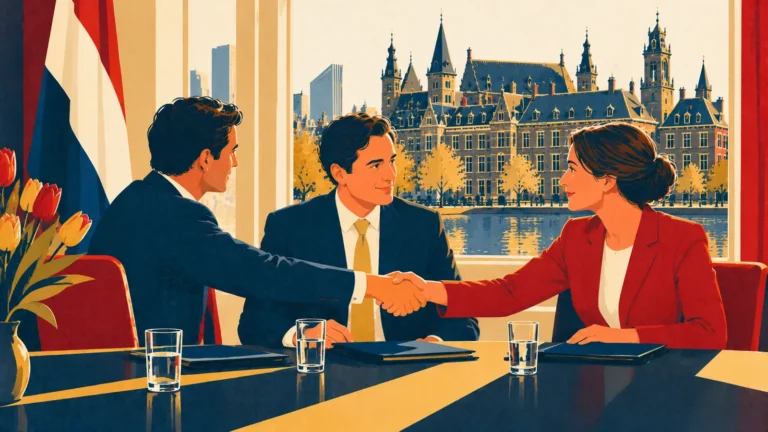
THE HAGUE – After exactly 219 days of agonizing political deadlock, leaked memos, late-night crisis meetings, and the near-collapse of the negotiation table, white smoke has finally risen from the Binnenhof. The Netherlands has a new government. But this is not business as usual.
On February 23, 2026, the “Jetten I” Cabinet will be officially sworn in by King Willem-Alexander at the Huis ten Bosch palace. This new centrist-right coalition, formed by D66 (Democrats 66), VVD (People’s Party for Freedom and Democracy), and CDA (Christian Democratic Appeal), presents itself under the pragmatic, sleeves-rolled-up motto: “Aan de Slag” (Let’s Get Started).
However, beneath the polished press photos lies a fragile reality: this is a risky “Minority Cabinet” (Minderheidskabinet) holding only 71 of the 150 seats in the House of Representatives (Tweede Kamer). This parliamentary arithmetic means that for every single law, every tax amendment, and every budget cut, the cabinet must beg for support from the opposition—either negotiating with the Left (GroenLinks-PvdA) for climate policies or the Right (NSC/BBB) for migration limits. For the international community and the 120,000 expats living in the Netherlands, this instability spells one word: Uncertainty.
In this massive, definitive 2800-word political dossier, we go beyond the headlines. We dissect the 80-page Coalition Agreement (Regeerakkoord) line by line. We analyze the survival of the Mortgage Interest Deduction, the final mathematical verdict on the 30% Ruling (including multiple salary scenarios), the controversial new “Freedom Tax” for defense, the crackdown on English-language education, and what Prime Minister Rob Jetten has in store for the international community over the next four years.
Table of Contents
- The 219-Day Crisis: A Timeline of Chaos
- The New Power Players: Profiles of the “Jetten I” Ministers
- The 30% Ruling: Deep Dive, Calculations & “Berlin vs Amsterdam”
- The End of “Partial Non-Resident” Status: A Wealth Tax Disaster
- The “Vestigingsklimaat” Crisis: Operation Beethoven & ASML
- Housing Policy: Mortgage Relief (HRA), Rent Control & WWS Points
- Defense & Geopolitics: The “Freedom Tax” & German Integration
- Migration & Citizenship: Language Rules & The 10-Year Threat
- Education: The Crackdown on English Degrees (TU Delft & Maastricht)
- Expat Rights: Can You Vote in 2026?
- The Opposition: What Wilders and Timmermans Say
- The Expat Verdict: Comprehensive Winners & Losers List
- Dutch Political Vocabulary Corner
- Sources & References
The 219-Day Crisis: A Timeline of Chaos
To understand the fragility of this government, one must understand its chaotic birth. Following the sudden fall of the previous cabinet over asylum policy, the subsequent elections produced a highly fragmented landscape that baffled political analysts.
The “Omtzigt” Factor
Pieter Omtzigt, leader of the New Social Contract (NSC), was the designated “Kingmaker.” For months, he played a game of 4D chess that paralyzed the country.
- Phase 1 (The Right-Wing Flirt): Omtzigt negotiated with Geert Wilders (PVV). This collapsed after two months due to “constitutional concerns” regarding the rule of law.
- Phase 2 (The Refusal): Omtzigt then refused to govern with the VVD-D66 block, citing “old political culture” and a lack of trust.
- Phase 3 (The Economic Pressure): By January 2026, with the economy stalling and credit rating agencies warning of a downgrade, pressure from the employer’s federation (VNO-NCW) became unbearable.
The Solution: The “Program Cabinet” (Programkabinet)
The breakthrough came with a novel concept. Instead of a traditional coalition where every detail is fixed in stone, they agreed on a “Program Cabinet.” This means the ministers are experts (some not even from political parties) tasked with executing a broad set of goals, with the freedom to find majorities in parliament for specific issues. D66, VVD, and CDA agreed to take political responsibility, with tacit support from smaller parties like Volt and ChristenUnie.
The New Power Players: Profiles of the “Jetten I” Ministers
The era of Mark Rutte—the “Teflon Mark”—is ancient history. The dynamic of Dutch politics has shifted to a younger, more polarized, and more ideological generation.
Prime Minister: Rob Jetten (D66)
At 38 years old, Rob Jetten becomes one of the youngest Prime Ministers in Dutch history. Formerly the Minister for Climate and Energy, he earned the nickname “Climate General” for pushing through massive wind energy projects.
Political Style: Progressive, Europhile, Tech-savvy. He is the first Dutch PM to openly advocate for a federalized Europe and a European Army.
Stance on Expats: Generally pro-expat and pro-international business. He views the “Knowledge Economy” as the only way for the Netherlands to survive. However, to become PM, he had to make painful concessions to the VVD on migration numbers.
Finance Minister: Dilan Yeşilgöz (VVD)
The “Iron Lady” of the VVD takes the keys to the treasury. After leading the VVD through a turbulent election, she has positioned herself as a fiscal hawk.
Priority: Reducing the national deficit (currently at 2.9%) and ensuring the business climate (Vestigingsklimaat) remains attractive for multinationals like ASML and Shell. She has publicly stated she is willing to cut subsidies for arts, culture, and public broadcasting to balance the books.
Minister of Housing: Henri Bontenbal (CDA)
A physicist by training, Bontenbal is tasked with the impossible: solving the structural housing shortage (currently 390,000 homes short). His approach is distinct from the VVD’s market liberalism. He favors “Community Building,” housing cooperatives, and stricter regulation on “Buy-to-Let” investors.
The 30% Ruling: Deep Dive, Calculations & “Berlin vs Amsterdam”
For the 120,000 expats using the 30% Ruling, the negotiations were a nerve-wracking thriller. The populist opposition wanted to abolish it entirely to “save money” and “prioritize Dutch workers.” The VVD and the high-tech lobby (Brainport Eindhoven) warned of a massive brain drain. The compromise is messy, but final.
The New Flat Rate System (Effective Jan 1, 2027)
The highly criticized “30-20-10” reduction scheme (which reduced the benefit every 20 months) introduced in 2024 has been scrapped due to administrative chaos for HR departments. It is replaced by a Flat Rate system.
The Rule: New applicants will receive a tax-free allowance of 27% of their gross salary for a duration of 5 years.
The Salary Cap: The benefit is capped at the “Balkenende Norm” (Public sector salary cap, approx. €233,000). If you earn €500,000, you only get the tax break on the first €233,000.
Case Study 1: The Senior Engineer
Profile: Software Engineer at Booking.com.
Gross Salary: €85,000 per year.
Old Rule (30%): Tax-free allowance of €25,500. Taxable income: €59,500.
New Rule (27%): Tax-free allowance of €22,950. Taxable income: €62,050.
Net Impact: The engineer pays approx. €1,200 more tax per year. Painful, but not a dealbreaker.
Case Study 2: The Executive
Profile: VP of Sales at a Fintech scale-up.
Gross Salary: €250,000 per year.
Old Rule (30%): Tax-free allowance of €75,000.
New Rule (27% + Cap): Tax-free allowance capped at 27% of €233,000 = €62,910.
Net Impact: A loss of over €12,000 in tax-free allowance. This segment is hit hardest.
Berlin vs. Amsterdam Analysis
The cabinet justified the cut by comparing NL to Germany. Germany has recently introduced tax breaks for foreign skilled workers, but they are temporary and capped. Even at 27%, the Dutch system remains more generous and simpler than the German or French equivalents, preserving the competitive edge.
The End of “Partial Non-Resident” Status: A Wealth Tax Disaster
While the salary part is manageable, the changes to the Wealth Tax (Box 3) are catastrophic for wealthy expats.
The “Golden Loophole” (Old Rule): Historically, 30% Ruling holders could opt for “Partial Non-Resident Taxpayer” status. This meant the Dutch taxman ignored your global savings, stocks, crypto, and substantial interest (Box 2). You lived in NL, but for wealth tax purposes, you didn’t exist.
The New Reality (2026): This status is ABOLISHED for all new cases starting Jan 1, 2026.
Transitional Law (Overgangsrecht): If you were granted the ruling before 2024, you keep the status until the end of 2026. From January 1, 2027, you must report your global assets in Box 3.
The Cost: If you have €500,000 in a US ETF portfolio:
- 2025 Tax: €0.
- 2027 Tax: Approx. €8,000 – €10,000 per year (assuming 6% return and 36% tax rate).
TDD Advice: This change is driving many high-net-worth individuals to move to Belgium or Switzerland before 2027.
The “Vestigingsklimaat” Crisis: Operation Beethoven & ASML
Why did the government fight to save the ruling at all? Because of Operation Beethoven.
In late 2024, tech giant ASML (Europe’s most valuable tech company) threatened to expand its operations abroad (France or the USA) if the Dutch business climate worsened. Philips and NXP joined the chorus.
The Deal: The Jetten Cabinet has pledged €2.5 billion in infrastructure investment specifically for the Eindhoven region (Brainport), including better roads, a rapid bus line to the campus, and international schools. They also promised to keep tax breaks for high-tech R&D (WBSO). This “peace treaty” with the corporate sector is the backbone of the new coalition’s economic strategy.
Housing Policy: Mortgage Relief (HRA), Rent Control & WWS Points
With house prices hitting record highs in 2026 (Avg: €460k), housing was the #1 voter issue. The policy is a mix of protectionism and liberalization.
Mortgage Interest Deduction (Hypotheekrenteaftrek – HRA)
Every election cycle, economists from the Dutch Central Bank (DNB) argue that this deduction inflates prices and should be abolished. Homeowners fear its removal.
The Decision: SAVED.
The VVD drew a red line here. The deduction remains active at the current rate (approx 37%). This provides stability for buyers in the 2026-2030 period. If you are planning to buy, you can breathe a sigh of relief; the subsidy on your mortgage remains.
Rent Control (Wet Betaalbare Huur) & WWS Points
The controversial law that regulated mid-market rents (and caused landlords to sell off properties) will remain, but with significant “tweaks” to stop the exodus of investors.
The Change: New construction projects (start of construction after 2026) will be exempt from strict rent caps for 10 years.
WWS System: The “Points System” used to value homes will be updated to give more points for Energy Labels (A+++ gets massive points) and outdoor space, allowing landlords to charge higher rents for sustainable homes.
Defense & Geopolitics: The “Freedom Tax” & German Integration
The geopolitical situation in Eastern Europe forces the Netherlands to meet the NATO 2% GDP spending target permanently. The money must come from somewhere.
The “Vrijheidsbijdrage” (Freedom Contribution):
This is a new surcharge on the Profit Tax (Vennootschapsbelasting) for large companies.
Impact: While individuals don’t pay this directly, large employers (Shell, Philips, Banks) will face higher costs. Economists warn this could lead to lower wage increases in the corporate sector.
Military Integration:
In a historic move, the Dutch Army is effectively merging its heavy brigades with the German Bundeswehr. The “13th Light Brigade” is now fully integrated into a German division. This efficiency allows the Netherlands to claim “Tank Capability” without buying hundreds of new tanks alone.
Migration & Citizenship: Language Rules & The 10-Year Threat
Before the election, the VVD campaigned on restricting migration, including a proposal to increase the naturalization period from 5 years to 10 years.
The Outcome: DROPPED.
Under pressure from D66, the coalition agreed to keep the standard naturalization period at 5 years.
Language Requirement: However, the language requirement will be strictly enforced at Level B1 (Intermediate), up from the previous A2. This applies to both the “Inburgering” exam and the naturalization test. No more “easy” exams; applicants must be able to hold a conversation about politics or work.
The VVD blocked the D66 proposal to allow dual nationality for everyone. The strict Dutch “Single Nationality Principle” remains. You must still renounce your original nationality unless you fall into a specific exception (e.g., married to a Dutch citizen, or your country does not allow renunciation).
Education: The Crackdown on English Degrees (TU Delft & Maastricht)
The most contentious social issue is the “Anglicization” of universities.
The Bill: “Internationalization in Balance” (Wet Internationalisering in Balans).
The New Rules:
1. Bachelor’s Quota: No more than 1/3 of bachelor’s programs may be fully English, unless there is a “labor market necessity” (e.g., Aerospace Engineering at TU Delft, AI at Eindhoven).
2. Dutch Track: Universities must offer a Dutch-language version of every major degree.
3. Numerus Fixus: Universities can now place a cap specifically on the “English Track” of a degree while leaving the “Dutch Track” open.
The Impact: Universities like Maastricht and Twente are furious, claiming they will lose 40% of their students. For expat parents, this makes International Schools even more vital, as the public university route becomes linguistically harder for non-Dutch speaking teens.
Expat Rights: Can You Vote in 2026?
With municipal elections (Gemeenteraadsverkiezingen) coming up in March 2026, many expats are asking about their rights.
- EU Citizens: Yes, you can vote in municipal elections immediately upon registration. You can also vote for the European Parliament.
- Non-EU Citizens: You can vote in municipal elections ONLY if you have lived in NL legally for 5 continuous years.
- National Elections: Only Dutch citizens can vote.
The new coalition has rejected a proposal to allow non-EU residents to vote in municipal elections after only 3 years.
The Opposition: What Wilders and Timmermans Say
Since this is a minority cabinet, the voice of the opposition is louder than ever.
Geert Wilders (PVV):
The leader of the largest opposition party called the coalition a “Mockery of the Voter.” He has vowed to block any budget that includes money for climate change (“Climate Madness”) or asylum centers. His slogan: “They ignore the people, we will break the cabinet.” He is currently polling at an all-time high, waiting for the cabinet to fall.
Frans Timmermans (GroenLinks-PvdA):
The leader of the Left is disappointed by the lack of wealth redistribution. Timmermans criticized the survival of the 30% ruling as a “gift to the rich” while the poor struggle with grocery bills. However, he has signaled willingness to support the cabinet on climate legislation if they adhere to the Paris Agreement goals.
The Expat Verdict: Comprehensive Winners & Losers List
So, is the “Jetten I” cabinet good for you? It depends entirely on your profile.
| WINNERS 🟢 | LOSERS 🔴 |
|---|---|
| Home Buyers: Mortgage deduction is safe, providing market stability. | Wealthy Expats: Partial Non-Resident status is gone. Box 3 tax will hit global assets hard. |
| Middle Income Earners: Labor tax credits increased, meaning more net salary. | English Speakers: B1 language requirement for citizenship & fewer English university degrees. |
| Citizenship Seekers: The 10-year naturalization threat was blocked. | Drivers: EV tax breaks end; fuel excise duty remains high. |
| Tech Workers: ASML and Brainport region get massive investment. | High Earners (>233k): The 30% ruling is now capped, reducing net income significantly. |
Dutch Political Vocabulary Corner
| Word (Dutch) | Pronunciation | Meaning & Context |
|---|---|---|
| 🏛️ Regeerakkoord | Re-geer-ak-koord | Coalition Agreement. The document outlining the new government’s plans. |
| ⚖️ Minderheidskabinet | Min-der-heids… | Minority Cabinet. A government with less than 76 seats. Requires outside support. |
| 🏢 Vestigingsklimaat | Ves-ti-gings… | Business Climate. The buzzword for keeping ASML and Shell in NL. |
| 🎓 Internationalisering | In-ter-na-tio… | Internationalization. Usually refers to the debate about too many English students. |
| 🗣️ Inburgering | In-bur-ge-ring | Civic Integration. The exams you must pass to stay or become a citizen. Now B1 level. |
📚 Sources & References
This comprehensive analysis is based on the official documents released by the Bureau Woordvoering Kabinetsformatie and relevant ministries on February 4, 2026.
- Primary Source: “Eindverslag Formateur & Regeerakkoord 2026-2030: Aan de Slag” (Bureau Woordvoering Kabinetsformatie).
- Tax Data: Belastingplan 2026 amendments proposed by the VVD and Ministry of Finance projections.
- Housing Data: Ministry of Interior and Kingdom Relations (BZK) policy briefs on the “Wet Betaalbare Huur”.
- Corporate Stance: Official press releases from ASML, Philips, and VNO-NCW regarding Operation Beethoven.
- Education Policy: “Wet Internationalisering in Balans” draft legislation.
- Original analysis by The Dutch Daily Politics Desk.
TDD Community Question
Are you relieved or disappointed by the new coalition? Does the survival of the Mortgage Interest Deduction make you want to buy a house, or does the loss of the Partial Non-Resident status make you consider leaving the Netherlands? Join the debate in the comments below.
More in our guide: Moving to the Netherlands – the newcomer guide for internationals
Free: Netherlands 2027 Money Checklist
Every deadline and number you need before and after 1 January 2027, on two printable pages. Confirm your email and the PDF is yours; we will also email you when the 2027 figures are confirmed.
 Read nextBusiness & Finance30% Ruling 2027 Netherlands: Complete Expat Checklist for Eligibility, Salary & the 27% Change