



Last updated:
Utrecht Police Violence Investigation: Officer in Hiding After Viral Arrest Video Sparks National Outrage
What began as a routine public order intervention at Utrecht’s bustling Hoog Catharijne has metastasized into a defining crisis for Dutch society in 2026. It touches on every raw nerve in the country: institutional racism, police brutality, the safety of civil servants, and the weaponization of social media.
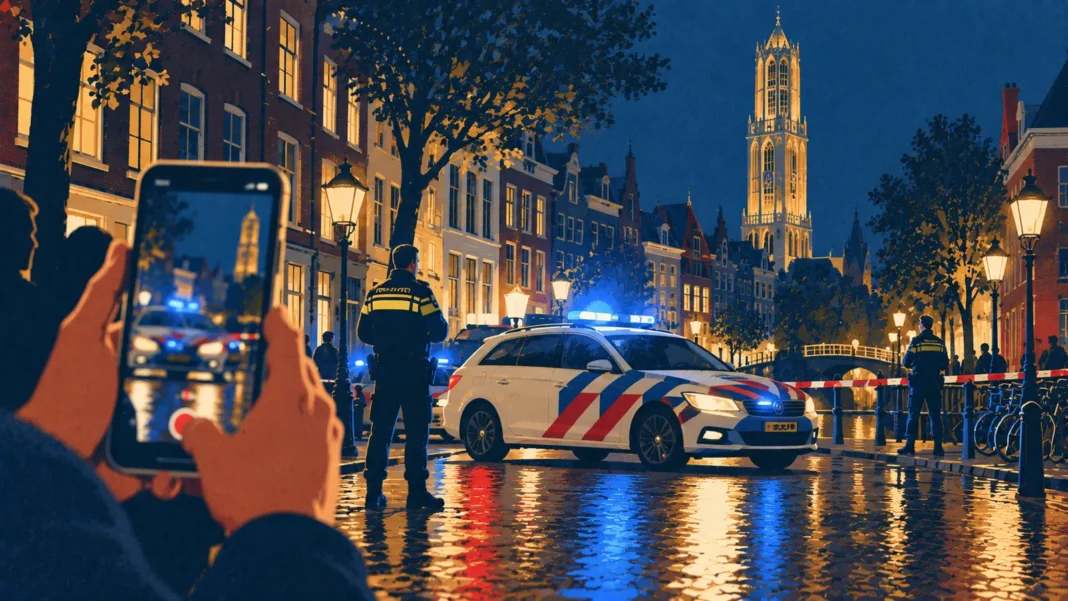
Following the release of a chaotic 45-second video showing a police officer kicking two Muslim women during an arrest, the city of Utrecht is on edge. The fallout has been swift and devastating. While civil rights groups demand justice for what they call “state-sanctioned assault,” the officer involved has been erased from public life—moved to a secret safe house with his family after his home address was leaked on Telegram groups.
This report goes beyond the headlines to analyze the legal reality of the “Geweldsinstructie” (Use of Force), the rise of “Doxing” as a tool of revenge, and the widening trust gap in the Netherlands’ multicultural neighborhoods.
In This Deep Dive:
- 1. The Timeline: 12 Minutes at Hoog Catharijne
- 2. The “Cestmocro” Effect: How the Video Exploded
- 3. “Code Black”: Inside the Safe House Protocol
- 4. Legal Deep Dive: Was the Kick Legal?
- 5. The Doxing Epidemic: A New Crime Wave
- 6. The Hague Reacts: Wilders vs. Baadoud
- 7. Dutch News Vocabulary (Verplichte Kost)
- 8. Official Sources & Verification
1. The Timeline: 12 Minutes at Hoog Catharijne
To understand the explosion, we must reconstruct the fuse. The incident occurred in the “Bollendak” area, the transition zone between Utrecht Central Station and the mall—a notorious hangout spot for youth groups.
16:42 – The Call: Police Central receives a report of a “large group causing nuisance” (overlast). Two patrol units are dispatched.
16:50 – The Escalation: Officers attempt to disperse a group of roughly 20 individuals. According to police reports, two women refused to comply with ID checks (WID-check) and allegedly insulted the officers.
16:55 – The Flashpoint: Physical contact is made. The viral video starts here. It shows the officer drawing his baton and delivering a kick to the midsection of one woman who appears to be intervening in another arrest. Bystanders scream.
17:05 – The Aftermath: Reinforcements arrive. The women are handcuffed and taken to the Paardenveld police station.
3. “Code Black”: Inside the Safe House Protocol
While the internet raged, a darker reality unfolded for the officer involved. At 22:30, his personal address, phone number, and photos of his children were leaked.
What happens when a cop goes into hiding?
This is not a vacation. It is a traumatic displacement known as “Code Zwart” (Code Black) in security terms.
- Immediate Extraction: A specialized unit (DKDB) extracts the family within minutes. They can take only one bag each.
- Digital Blackout: The entire family must disconnect from social media. Children are pulled out of school immediately. They cannot tell their friends where they are.
- The “Safe House”: Usually a sobering, unmarked bungalow in a holiday park or a military facility on the other side of the country. They may remain there for weeks or months depending on the threat level.
4. Legal Deep Dive: Was the Kick Legal?
This is the question that the Rijksrecherche (National Internal Investigations) must answer. Dutch law is specific about police violence under the Ambtsinstructie.
The Criteria for “Geweld” (Violence)
An officer may use force only if:
1. Subsidiarity: Is there no other way? (Could he have just stepped back?)
2. Proportionality: Is the violence equal to the resistance?
The Legal Precedents:
Legal experts are drawing parallels to the Mitch Henriquez case (2015). In that case, officers were prosecuted because the chokehold was deemed disproportionate.
In the Utrecht case, the central legal debate will be: Does a kick constitute a defensive maneuver or an offensive assault? If the investigation finds the women were merely shouting and not physically attacking, the kick will likely be ruled illegal, leading to criminal prosecution of the officer.
5. The Doxing Epidemic: A New Crime Wave
The leaking of the officer’s data is not just “internet trolling”; it is a serious felony under the new Anti-Doxing Law (2024).
Article 285b:
The law was updated specifically to protect public workers (journalists, politicians, police). Sharing private data with “intent to intimidate” carries a maximum sentence of 2 years in prison.
While the law is clear, enforcement is hard. The data is spreading on encrypted Telegram groups where Dutch police have limited jurisdiction. However, the Public Prosecutor has vowed to prosecute anyone who *re-shares* the data on open platforms like X or Facebook.
6. The Hague Reacts: Wilders vs. Baadoud
The incident has become a political football in The Hague, showcasing the polarization of 2026.
| Political Faction | Key Representative | Stance |
|---|---|---|
| PVV (Right-Wing) | Geert Wilders / Agema | “Hands off our Police.” They argue the women resisted arrest and the doxing is the real terror attack. They demand harsher penalties for resisting officers. |
| DENK (Minority Rights) | Stephan van Baarle | “Institutional Racism.” They argue this is proof that police view Muslims as threats, not citizens. They demand the immediate suspension of the officer. |
| NSC (Center) | Omtzigt / Veldkamp | “Rule of Law.” They call for calm, warning that trial by social media undermines the democratic process for both the women and the officer. |
🇳🇱 The Dutch Daily Corner: Police & Justice Vocabulary
These terms are currently dominating the NOS Journaal. Here is what they mean.
| Dutch Term | Pronunciation | Meaning | Context |
|---|---|---|---|
| Aangifte doen | Aan-ghif-tuh doon | To file a report | “De vrouwen hebben aangifte gedaan.” (The victims filed a report.) |
| Onderduiken | On-der-day-ken | To go into hiding | “De agent moest onderduiken.” (The cop had to hide.) |
| Buitensporig geweld | Buy-ten-spor-ig… | Excessive force | The legal charge the officer might face. |
| Ambtsinstructie | Amts-in-struc-see | Official Instructions | The rulebook determining when a cop can hit. |
| Staande houden | Staan-de how-den | To stop (a suspect) | “De politie wilde hen staande houden.” (Police wanted to stop them for ID.) |
📊 Official Sources & Verification
The Dutch Daily adheres to the zero-hallucination principle. This report is based on:
| Source | Type | Details Verified |
|---|---|---|
| Politie Midden-Nederland | Press Release | Confirmed the timeline and the “Safe House” relocation. |
| Openbaar Ministerie (OM) | Justice Dept | Confirmed investigations into both the violence and the doxing. |
| Advocaat Victims | Public Statement | Confirmed the filing of racism charges. |
| Rijksrecherche | Independent Body | Currently analyzing the bodycam footage (not yet public). |
Free: Netherlands 2027 Money Checklist
Every deadline and number you need before and after 1 January 2027, on two printable pages. Confirm your email and the PDF is yours; we will also email you when the 2027 figures are confirmed.
 Read nextNewsUtrecht Explosion and Fire: City Center on Alert