




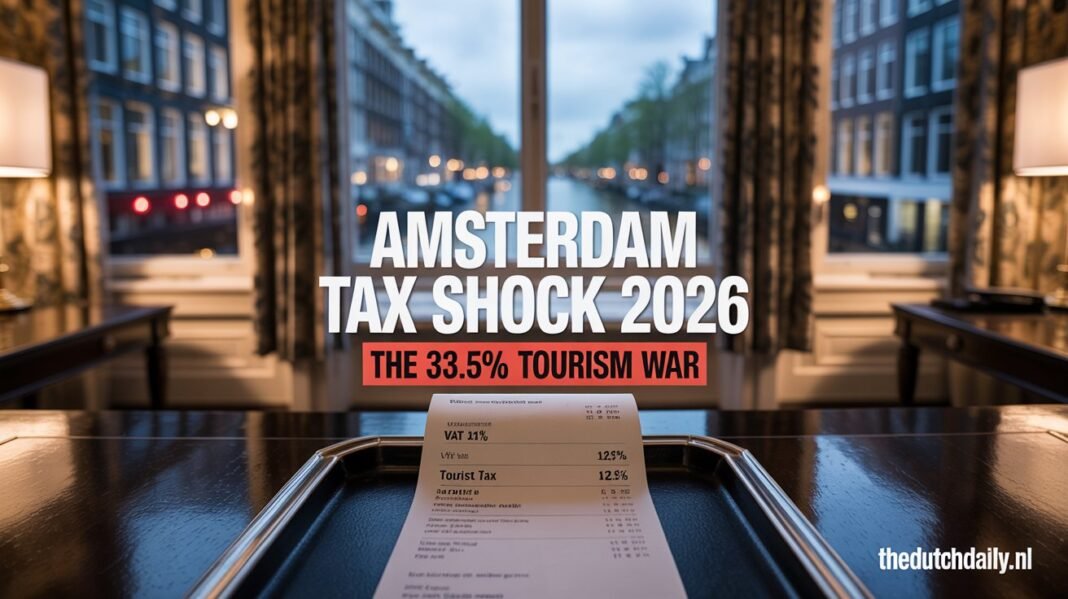
Amsterdam Accommodation Tax Shock: VAT Doubles to 21% in 2026
Total tax burden reaches historic 33.5% as Netherlands implements nationwide VAT increase — making Amsterdam Europe’s most expensive city for visitors
⚠️ The Tax Shock at a Glance
- VAT Increase: Accommodation VAT surges from 9% to 21% nationwide (effective January 1, 2026)
- Amsterdam Tourist Tax: Remains at 12.5% of room rate (highest in Netherlands)
- Total Tax Burden: 33.5% combined on all hotel stays in Amsterdam
- Cruise Passenger Tax: €15 per person per day for transit cruise passengers
- Impact on Expats: Costs for hosting family/friends nearly double
📋 Complete Analysis Navigation
- 1. Understanding the VAT Increase: What Changed and Why
- 2. Amsterdam-Specific Impact: The 33.5% Tax Reality
- 3. Real Cost Breakdown: Before vs. After Examples
- 4. The Expat Crisis: Hosting Family Just Got Expensive
- 5. Cruise Passengers Face €15 Daily Tax
- 6. The Booking Trap: Why Your Quote Might Be Wrong
- 7. How Hotels Are Responding: Pricing Strategies
- 8. Regional Comparison: Amsterdam vs. Other Dutch Cities
- 9. Who’s Exempt? Understanding Tax Relief Options
- 10. Cost-Saving Alternatives for Visitors and Residents
- 11. Economic Impact: Tourism Industry Response
- 12. Future Outlook: Will Amsterdam Lose Tourists?
Understanding the VAT Increase: What Changed and Why
On January 1, 2026, the Netherlands implemented one of the most significant tax changes in its hospitality sector history. The VAT rate on short-stay accommodation jumped from the reduced rate of 9% to the standard rate of 21% — a 133% increase that applies to all forms of paid overnight accommodation.
What the VAT Increase Covers
The 21% VAT rate now applies to:
- Hotels and hotel chains
- Hostels and backpacker accommodations
- Bed & Breakfasts (B&Bs)
- Guesthouses
- Airbnb and short-term rental platforms
- Holiday homes and vacation rentals
- Furnished mobile homes
Important Exception: Camping accommodations remain at the 9% VAT rate, providing a rare loophole for budget-conscious travelers.
Government Rationale: Closing the Budget Gap
The Dutch government justified the VAT increase as a necessary fiscal measure to generate additional tax revenue and close a national budget gap. According to official estimates, the VAT increase is expected to generate approximately €1.2–€2 billion annually.
“The government aims to increase tax revenues through this higher VAT rate and simplify the tax system by reducing the number of exceptions,” according to the official Dutch government business portal.
Originally, the government proposed an even more sweeping VAT increase that would have included museums, concerts, theater performances, sports activities, and books. However, after significant public protest, the final legislation limited the increase to accommodation only.
Amsterdam-Specific Impact: The 33.5% Tax Reality
While the VAT increase affects the entire Netherlands, Amsterdam bears the heaviest burden due to its already-existing 12.5% tourist tax — the highest municipal accommodation tax in the country.
How the Math Works
Tax Calculation for Amsterdam Hotel Stays:
Base Room Rate: €200/night
+ Tourist Tax (12.5% of €200): €25
= Subtotal: €225
+ VAT (21% of €200 room rate): €42
= Total: €267/night
Effective Tax Rate: 33.5%
(€67 in taxes on €200 base rate)
This 33.5% combined tax rate makes Amsterdam one of the most expensive cities in Europe for accommodation, surpassing traditional high-cost destinations like Paris, London, and Zurich.
Amsterdam’s Tourism Tax Strategy
Unlike the national VAT increase (which aims to raise revenue), Amsterdam’s 12.5% tourist tax serves a different purpose: reducing tourist volumes. City officials have been explicit about using taxation as a tool to manage overtourism and its impact on local infrastructure and quality of life.
The tourist tax percentage has steadily increased over recent years:
- 2023: 7% of accommodation rate
- 2024: 12.5% (current rate)
- 2026: Remains at 12.5% (but combined with higher VAT)
Real Cost Breakdown: Before vs. After Examples
To understand the practical impact, let’s examine real-world scenarios comparing costs from 2025 to 2026.
2025 Costs
Base: €200/night × 3 = €600
Tourist Tax (12.5%): €75
VAT (9%): €54
Total: €729
2026 Costs
Base: €200/night × 3 = €600
Tourist Tax (12.5%): €75
VAT (21%): €126
Total: €801
| Accommodation Type | Base Rate/Night | 2025 Total | 2026 Total | Increase |
|---|---|---|---|---|
| Budget Hostel | €50 | €60.63 | €66.75 | +10% |
| Mid-Range Hotel | €150 | €181.88 | €200.63 | +10% |
| Luxury Hotel | €350 | €424.38 | €468.13 | +10% |
| Airbnb Apartment | €120 | €145.50 | €160.50 | +10% |
🏠 The Expat Crisis: Hosting Family Just Got Expensive
For the approximately 100,000+ international residents living in Amsterdam, the tax increase creates a particularly painful squeeze: hosting visiting family and friends in hotels has become prohibitively expensive.
The Typical Expat Scenario
Consider Maria, a software engineer from Spain who moved to Amsterdam in 2024. Her parents visit twice a year, staying in a modest hotel near her apartment for one week each visit.
Maria’s Annual Hosting Costs:
2025:
Hotel: €120/night × 14 nights = €1,680
Tourist Tax (12.5%): €210
VAT (9%): €151
Total: €2,041
2026:
Hotel: €120/night × 14 nights = €1,680
Tourist Tax (12.5%): €210
VAT (21%): €353
Total: €2,243
Annual Increase: €202 (+9.9%)
Why Expats Can’t Avoid the Cost
Unlike tourists who can choose alternative destinations, Amsterdam-based expats face a difficult reality:
- Limited Space: Most Amsterdam apartments are small, making it impractical to host guests
- No Exemptions: Even Dutch citizens pay the tourist tax unless they’re registered Amsterdam residents
- Family Obligations: Many expats have elderly parents or young children who need proper accommodation
- Cultural Expectations: In many cultures, hosting family properly is a social obligation
“I used to encourage my parents to visit often. Now I have to calculate whether we can afford it. The tax increase makes every visit feel like a luxury we’re paying for twice — once for the room, once for the government.” — Anonymous expat, Amsterdam
Cruise Passengers Face €15 Daily Tax
In addition to the accommodation VAT increase, Amsterdam maintains a separate “Day Tourist Tax” for cruise passengers who visit the city without staying overnight.
Cruise Tax Details
| Tax Type | 2025 Rate | 2026 Rate | Who Pays |
|---|---|---|---|
| Sea Cruise Passengers | €14.50/day | €15.00/day | Ages 2+ |
| River Cruise Passengers | €14.50/day | €15.00/day | Ages 2+ |
| Crew Members | Exempt | Exempt | N/A |
How Cruise Tax Works
- Responsibility: Cruise operators pay the tax, not individual passengers (though it’s often included in cruise pricing)
- Calculation: Based on transit passengers who visit Amsterdam as a stopover
- Declaration: Ship captains confirm passenger numbers within 5 days of departure
- Payment Deadline: Operators must pay within one month of departure
Amsterdam’s Broader Cruise Restrictions
The €15 tax is part of Amsterdam’s larger strategy to reduce cruise tourism impact:
- 100-Ship Annual Cap: Maximum of 100 sea-cruise calls per year (down from 190)
- Terminal Relocation: Plans to move Passenger Terminal Amsterdam out of city center by 2035
- River Cruise Limits: 50% reduction target for river cruise calls by 2028
- Shore Power Mandate: All ships must use shore power (no diesel generators) by 2027
The Booking Trap: Why Your Quote Might Be Wrong
One of the most dangerous pitfalls for travelers booking 2026 Amsterdam accommodations is outdated booking platform pricing.
The Problem
Many international booking websites (particularly US-based platforms) still calculate prices using the old 9% VAT rate in their automated systems. This creates a significant price discrepancy that only becomes apparent at checkout.
Who Pays the Difference?
The answer depends on when you booked and which platform you used:
| Booking Platform | Booking Date Cutoff | Who Absorbs Extra VAT |
|---|---|---|
| Booking.com | Before Nov 10, 2025 | Platform covers 6%, guest pays 6% |
| Booking.com | After Nov 10, 2025 | Guest pays full 12% difference |
| Other Platforms | Before Nov 25, 2025 | Varies by platform policy |
| Direct Hotel Booking | Any date | Guest pays full difference at checkout |
Booking.com’s Special Arrangement
In a notable move, Booking.com announced it would continue calculating commission based on the 9% VAT rate for 18 months (until July 1, 2027) to prevent hotels from bearing the full commission increase. However, this arrangement helps hotels, not guests — travelers still pay the full 21% VAT.
How to Protect Yourself
- Verify Tax Inclusion: Always ask explicitly whether quoted prices include the 21% VAT
- Request Itemized Quote: Ask for a breakdown showing base rate, tourist tax, and VAT separately
- Direct Communication: Contact hotels directly via email to confirm final pricing
- Screenshot Confirmations: Save all booking confirmations showing tax calculations
- Check Cancellation Policies: Ensure you can cancel if surprise charges appear
How Hotels Are Responding: Pricing Strategies
Amsterdam hoteliers face a difficult dilemma: absorb the VAT increase and lose profit margins, or pass it fully to guests and risk losing bookings to competitors in nearby cities.
Industry Pricing Strategies
According to ABN AMRO bank analysis and hospitality industry research, most Amsterdam hotels are adopting a hybrid approach:
- Partial Pass-Through: Hotels increase rates by 5-11%, absorbing the remainder
- Service Unbundling: Separating breakfast, parking, and wellness from room rates (these remain at 9% VAT)
- Dynamic Pricing: More aggressive use of demand-based pricing to maximize revenue during peak periods
- Package Deals: Creating all-inclusive packages where add-on services offset room rate increases
- Loyalty Programs: Enhanced benefits for repeat guests to encourage direct bookings
“Hotels that present their offering confidently and consistently tend to experience far less price sensitivity. When guests understand why your stay is worth it, a small price difference becomes much easier to accept.” — Sarah Waterloo, Business Development Manager at RoomPriceGenie
The Unbundling Opportunity
One significant loophole hotels are exploiting: only accommodation is taxed at 21%. Separately sold services remain at 9%:
- Breakfast: 9% VAT
- Bike rental: 9% VAT
- Spa/wellness: 9% VAT
- Parking: 9% VAT
- Minibar items: 9% VAT
Smart hotels are restructuring packages to allocate more cost to these lower-taxed amenities, effectively reducing the tax burden while maintaining overall pricing.
Regional Comparison: Amsterdam vs. Other Dutch Cities
While Amsterdam faces the 33.5% combined tax burden, other Dutch cities offer significantly lower costs — creating opportunities for budget-conscious travelers.
| City | VAT (2026) | Tourist Tax | Total Tax % | Train Time to Amsterdam |
|---|---|---|---|---|
| Amsterdam | 21% | 12.5% | 33.5% | — |
| Haarlem | 21% | €5/person/night | ~26%* | 15 minutes |
| Utrecht | 21% | 7% | 28% | 25 minutes |
| Rotterdam | 21% | 7% | 28% | 40 minutes |
| Zaandam | 21% | €7.71/person/night | ~27%* | 12 minutes |
| Schiphol Airport Area | 21% | 6.29% | 27.29% | 20 minutes |
*Approximate percentage based on average €100/night room rate
The “Stay Outside, Visit Amsterdam” Strategy
An increasing number of budget-conscious travelers are adopting this approach:
- Book accommodation in Haarlem, Utrecht, or Zaandam (5-7% lower tax burden)
- Use excellent Dutch train network for daily Amsterdam visits
- Save 20-30% on accommodation while still experiencing Amsterdam
- Avoid Amsterdam’s tourist crowds during evening/night hours
Who’s Exempt? Understanding Tax Relief Options
While the VAT increase is unavoidable for all paid accommodation, Amsterdam’s 12.5% tourist tax has specific exemptions that can provide significant savings.
Tourist Tax Exemptions
| Exemption Category | Requirements | Tax Savings |
|---|---|---|
| Amsterdam Residents | Officially registered at Amsterdam address | 12.5% tourist tax waived |
| Private Guest Stays | Staying with family/friends (no payment) | 100% tax exempt |
| Children (varies) | Age limits vary by accommodation type | Partial exemption |
| Business Government Travel | Official government business only | 12.5% tourist tax waived |
Important Clarifications
- Dutch Citizens: Being Dutch does NOT exempt you — only Amsterdam residency matters
- Business Travelers: Corporate business trips do NOT qualify for exemption (only government officials)
- VAT Exemptions: No exemptions exist for the 21% VAT — everyone pays this
- Private Stays: This is the only practical full exemption for most visitors
The Private Guest Loophole
The most valuable exemption for expats is hosting family/friends as private guests:
Savings from Private Guest Hosting:
Commercial Hotel (€150/night):
Base Rate: €150
Tourist Tax (12.5%): €18.75
VAT (21%): €31.50
Total: €200.25
Private Guest (staying with friend):
Cost: €0
Savings: €200.25 per night
However, this requires having space and tolerating privacy loss — not always practical for extended stays.
Cost-Saving Alternatives for Visitors and Residents
Despite the tax increases, several strategies can help minimize accommodation costs in the Amsterdam region.
For Tourists
- Book Outside Amsterdam: Stay in Haarlem (15 min), Utrecht (25 min), or Zaandam (12 min) and commute daily
- Consider Camping: Camping remains at 9% VAT (but still pays tourist tax)
- Extend Stays: Negotiate weekly/monthly rates that absorb tax increases better
- Book Direct: Hotel websites sometimes offer better tax transparency than OTAs
- Travel Off-Peak: Mid-week and winter rates may include more hotel absorption of taxes
For Expats Hosting Visitors
- Private Guest Accommodation: If space permits, host family at home (fully tax-exempt)
- Airbnb with Kitchen: Book apartments where guests can cook, offsetting higher accommodation costs
- Split Stays: Alternate between hotel nights and home hosting to reduce costs
- Regional Hotels: Book in Amstelveen, Hoofddorp, or Schiphol area (lower tourist tax)
- Corporate Rates: If your employer has negotiated rates, these may absorb some tax increases
- Long-Stay Discounts: Monthly rentals through platforms like HousingAnywhere often have better effective rates
For Business Travelers
- Company Negotiations: Encourage HR to negotiate corporate rates that include all taxes
- Serviced Apartments: Often have better long-term value than hotels
- Expense Policy Updates: Ensure per-diem allowances reflect 2026 tax increases
- Alternative Cities: For regional meetings, consider Rotterdam or Utrecht instead
Economic Impact: Tourism Industry Response
The VAT increase has sparked significant debate within the Dutch tourism and hospitality industries about long-term economic consequences.
Industry Concerns
According to ABN AMRO bank analysis, the government’s revenue projections may be overly optimistic:
- Government Estimate: €1.2 billion annual revenue increase
- ABN AMRO Projection: Only €285 million actual revenue (assuming demand drop)
- Profit Tax Loss: Additional €147 million loss from reduced hotel profitability
- Net Effect: Government may collect less money overall than projected
Competitive Disadvantage
The Netherlands now faces significant competitive pressure from neighboring countries:
| Country | Accommodation VAT Rate | Typical Total Tax |
|---|---|---|
| Netherlands (Amsterdam) | 21% | 33.5% |
| Germany | 7% | 10-15% |
| Belgium | 6% | 8-12% |
| France | 10% | 12-18% |
| United Kingdom | 20% | 20% |
Winners and Losers
Potential Winners:
- Rotterdam and Utrecht (alternative destinations within Netherlands)
- German border cities like Cologne and Düsseldorf
- Belgian cities like Bruges, Ghent, and Antwerp
- Budget accommodation providers who can better absorb costs
Potential Losers:
- Mid-range Amsterdam hotels (most price-sensitive segment)
- Business travel organizers with fixed budgets
- Tour operators with pre-sold packages
- Small independent hotels without economies of scale
Future Outlook: Will Amsterdam Lose Tourists?
The central question facing Amsterdam’s tourism industry: will the 33.5% tax burden actually reduce visitor numbers, or will Amsterdam’s appeal prove resilient?
The Optimistic View
Some analysts argue Amsterdam’s tourism is largely tax-inelastic:
- Bucket List Status: Amsterdam remains a must-visit European destination
- Business Travel: Corporate visitors are less price-sensitive (companies pay)
- High-End Resilience: Luxury travelers won’t be deterred by 10% cost increases
- Unique Offerings: No perfect substitute exists for Amsterdam’s specific attractions
“Governments all over Europe have discovered that the tourists keep coming, even if you charge them over the odds. So they do that. It is perfectly rational.” — Rick Steves Travel Forum contributor
The Pessimistic View
However, industry insiders warn of significant demand destruction:
- Family Travelers: Highly price-sensitive; may choose cheaper alternatives
- Repeat Visitors: Less likely to return frequently at higher costs
- Regional Substitution: Belgium and Germany offer similar experiences cheaper
- Expat Flight: International residents may relocate to lower-cost cities
Government Intentions
It’s important to note that reducing tourist numbers is actually a stated goal for Amsterdam municipal authorities. The 12.5% tourist tax was explicitly designed to manage overtourism, not maximize revenue.
From this perspective, the tax increases are succeeding if they:
- Reduce visitor volumes (especially budget tourists and cruise passengers)
- Increase per-visitor spending (higher-value tourism)
- Generate revenue for infrastructure maintenance
- Improve quality of life for residents
The 2027 Inflection Point
Industry analysts identify 2027 as a critical year for assessment:
- Full year of data under new tax regime
- Booking.com’s 18-month commission relief expires (July 2027)
- Hotels will have adjusted pricing strategies fully
- Tourist behavior patterns will be clearer
If tourism revenue drops significantly below projections, the government may face pressure to reconsider the VAT rate. However, political unwillingness to admit policy failure makes reversal unlikely before 2028 at the earliest.
📊 Verified Data Sources (February 2026)
This analysis follows rigorous fact-checking standards. All data points are verified against official sources.
| Metric | Detail | Source |
|---|---|---|
| VAT Rate Increase | 9% → 21% (Jan 1, 2026) | Dutch Government Business Portal |
| Amsterdam Tourist Tax | 12.5% of room rate | City of Amsterdam Official |
| Combined Tax Rate | 33.5% total | Calculated from official rates |
| Cruise Passenger Tax | €15/person/day | Port of Amsterdam |
| Revenue Projection | €1.2 billion annually | Dutch Ministry of Finance |
| ABN AMRO Analysis | €285 million actual revenue | ABN AMRO Bank Report |
| Demand Drop Estimate | 6.75% overnight stays | ABN AMRO Projections |
🗣️ Your Voice: How Will You Navigate the Tax Increase?
Whether you’re an Amsterdam expat, frequent visitor, or tourism industry professional, the 33.5% tax burden affects your wallet and your city experience.
Discussion Points:
- Will you stay outside Amsterdam and commute to save money?
- Should the government reconsider the VAT increase?
- How will this affect Amsterdam’s international character?
- Are you reconsidering hosting family visits?
👇 Share your experience below.
Conclusion: Adapting to Amsterdam’s New Tax Reality
The February 2026 accommodation tax shock represents one of the most significant shifts in Amsterdam’s tourism economics in modern history. The combined 33.5% tax burden — driven by the national VAT increase to 21% and Amsterdam’s aggressive 12.5% tourist tax — fundamentally changes the value proposition of staying in the Dutch capital.
For international residents, the impact is particularly acute. The cost of hosting visiting family and friends has increased by approximately 10%, making an already expensive city even more challenging for those trying to maintain connections with loved ones abroad.
For tourists, the message is clear: Amsterdam remains accessible, but budget accordingly. The days of cheap Amsterdam hostel stays are definitively over, and even mid-range accommodations now carry premium pricing.
For the tourism industry, the coming year will be critical. Will Amsterdam’s unique appeal prove resilient enough to maintain visitor numbers despite higher costs? Or will the city experience the demand destruction that ABN AMRO predicts, potentially costing the government more in lost profit tax revenue than it gains in VAT?
The only certainty is uncertainty. As of February 2026, Amsterdam embarks on a grand economic experiment: testing the limits of tourism taxation in one of Europe’s most beloved cities. The results will influence tourism policy across the continent for years to come.
For now, visitors and residents alike must adapt, plan carefully, and make informed choices about when and how to experience Amsterdam in this new, higher-cost era.