



Africa Cup Chaos: Riot Police Clashes Erupt in Amsterdam & The Hague
Amsterdam / The Hague – What started as a night of sporting anticipation ended in flashes of blue lights and fireworks. Following the Africa Cup of Nations final on Sunday night, unrest broke out in major Dutch cities as disappointment turned into disorder.
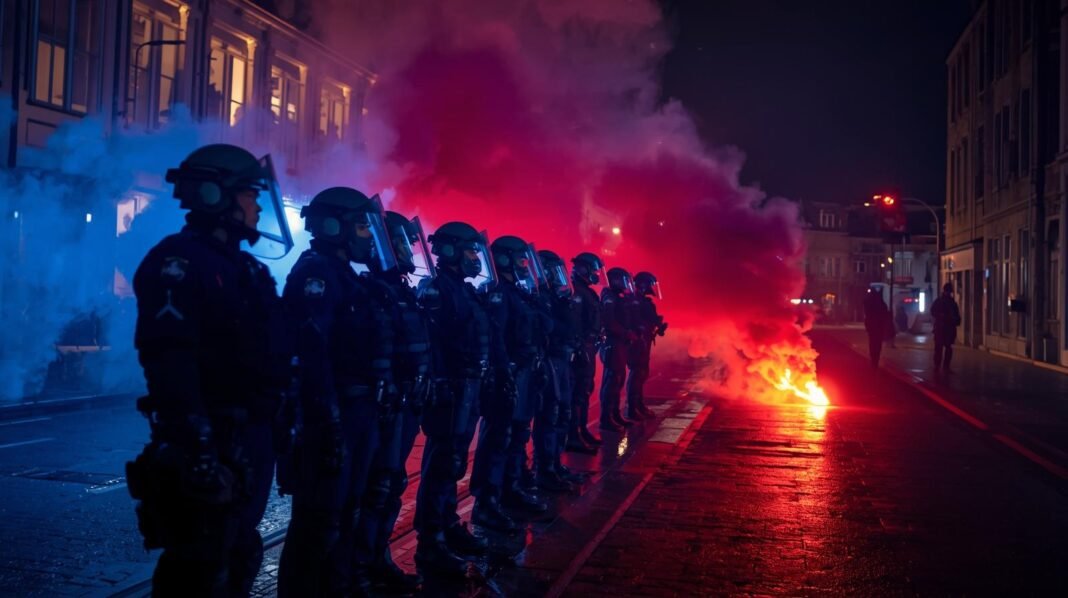
After Morocco’s narrow 1-0 defeat to Senegal, groups of disappointed fans clashed with police in Amsterdam-West and The Hague’s Schilderswijk. Riot police (ME) were deployed to disperse the crowds, resulting in multiple arrests.
Table of Contents
- The Hague: Fireworks Against Police
- Amsterdam: Plein ’40-’45 Lockdown
- Why Does This Keep Happening?
- Sociological Perspective
- Key Takeaways
- Dutch Learning Corner
- Community CTA
The Hague: Fireworks Against Police
The tension was highest in the Schilderswijk district of The Hague.
Immediately after the final whistle, a group of approximately 200 people gathered on the streets. According to police reports, the atmosphere quickly turned grim.
- The Incident: Heavy fireworks were thrown not only at officers but also at passing cyclists and bystanders.
- The Response: Riot police performed charges to clear the streets.
- The Result: 8 arrests were made for public violence and insulting officers.
Damage to street furniture was reported, though order was largely restored by 01:00 AM.
Amsterdam: Plein ’40-’45 Lockdown
Similar scenes unfolded in the capital, specifically in the Nieuw-West district.
Youngsters gathered at Plein ’40-’45, a frequent hotspot for post-match celebrations (and disturbances). When fireworks began targeting police vans, the authorities intervened.
Transport Disrupted:
The unrest forced the GVB (public transport) to reroute buses and trams, leaving passengers stranded in the area. 6 people were arrested in Amsterdam.
“It is a shame that a sporting event ends this way,” a police spokesperson told Het Parool. “We want to facilitate celebration, but violence against aid workers is a red line.”
Why Does This Keep Happening?
Post-match unrest is a recurring theme in the Netherlands, particularly involving the Moroccan-Dutch community during major tournaments.
Historically (like in 2022 World Cup), victories led to “celebratory riots,” while defeats lead to “frustration riots.”
Authorities point to a small group of “troublemakers” who use football as an excuse to confront the police, overshadowing the thousands of fans who watched the game peacefully in cafes and homes.
Sociological Perspective
Experts warn against simplifying the narrative.
“These incidents are a complex interplay of factors,” explain urban sociologists from the University of Amsterdam. “Disappointment over a loss is powerful when tied to national identity. However, these outbursts in neighborhoods like Schilderswijk and Nieuw-West are often symptomatic of deeper tensions—feelings of exclusion, unemployment, and a strained relationship with law enforcement.”
The pattern suggests that until these underlying community issues are addressed, football will continue to be the spark for broader unrest.
Key Takeaways
- The Trigger: Morocco’s loss in the Africa Cup final.
- The Locations: Schilderswijk (The Hague) and Nieuw-West (Amsterdam).
- The Arrests: Total of 14 people detained (8 in The Hague, 6 in Amsterdam).
- The Tactic: Riot police deployed to stop fireworks being thrown at officers.
Dutch Learning Corner
| Word | Pronun. (Eng) | Meaning | Context (NL + EN) |
|---|---|---|---|
| 🛡️ De Mobiele Eenheid (ME) | De Mo-bee-le Ayn-heyt | Riot Police | De ME moest ingrijpen. (The riot police had to intervene.) |
| 🔥 De Onrust | De On-rust | Unrest / Disturbance | Er was onrust in de stad. (There was unrest in the city.) |
| 👮 De Agent | De A-gent | Police Officer | De agent werd bekogeld met vuurwerk. (The officer was pelted with fireworks.) |
| 🏘️ De Wijk | De Weyk | District / Neighborhood | In deze wijk is het vaak onrustig. (It is often restless in this neighborhood.) |
Football or Frustration?
Do you think these riots are just about football hooliganism, or is there a deeper social issue at play in these neighborhoods? How should the police handle these recurring events?
Source / News: NOS & Het Parool.