




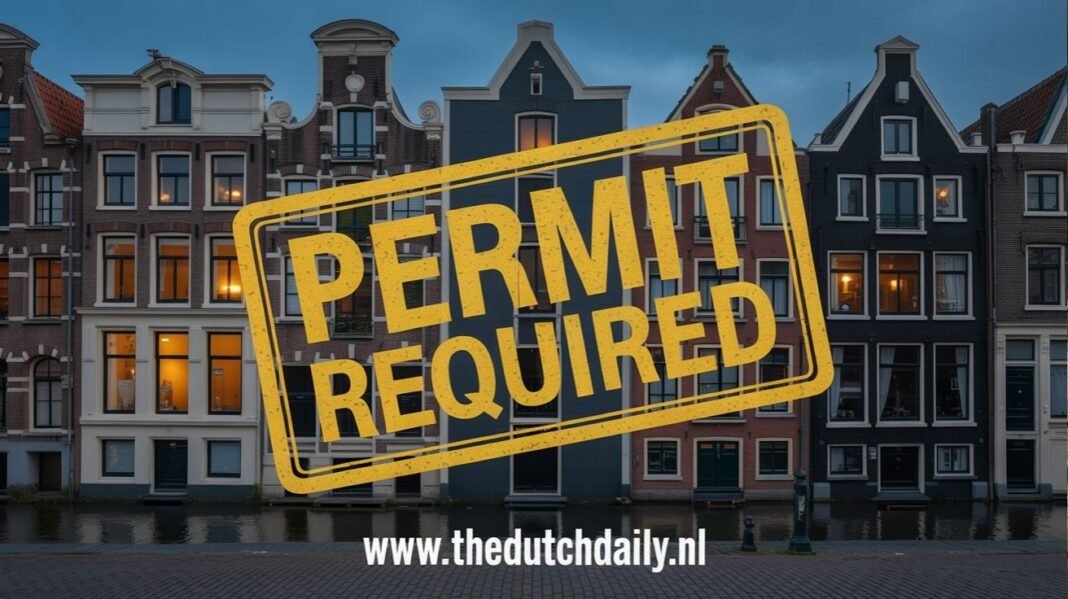
Amsterdam’s War on Vacancy: The End of the ‘Pied-à-Terre’?
Amsterdam – In a city where students wait years for a dorm room and families are pushed out to Almere due to lack of space, the sight of dark windows in luxury canal houses has long been a source of frustration. As of January 26, 2026, the Municipality of Amsterdam is finally acting on it.
The new Second Home Permit System is officially in force. The message from Deputy Mayor Zita Pels is clear: homes are for living in, not for parking cash. If you own a property in the capital that you do not use as your primary residence, the rules of the game have just changed drastically.
Table of Contents
- The New Law: No More ‘Empty’ Weekends
- Can You Get a Permit? (Strict Conditions)
- The Penalty: Fines and Forced Rental
- Will Rents Go Down?
- Key Takeaways
- Dutch Learning Corner
The New Law: No More ‘Empty’ Weekends
Until now, wealthy individuals (both Dutch and international) could buy an apartment in Amsterdam to use as a “pied-à-terre”—a crash pad for occasional city trips or work visits—while leaving it empty for the rest of the year.
The new regulation classifies this as “housing withdrawal” (woningonttrekking). To keep using a house this way, owners must now apply for a specific permit. Without this permit, the property MUST be occupied permanently (either by the owner or a tenant).
Can You Get a Permit? (Strict Conditions)
Getting this permit is intentionally difficult. The city wants to reduce the number of second homes, currently estimated at around 3,000 to 4,000 units. To qualify, you generally need to meet one of these criteria:
1. **Economic Tie:** You work in Amsterdam for at least 2 days a week but live elsewhere (and can prove it).
2. **Social Tie:** You provide essential care (mantelzorg) to a resident of Amsterdam for at least 8 hours a week.
3. **Prior Connection:** You have lived in Amsterdam for at least 3 continuous years immediately before applying.
If you are just an investor who likes to visit the Rijksmuseum once a month, you will likely be denied.
The Penalty: Fines and Forced Rental
What happens if you ignore the rule?
* **Administrative Fine:** The fines for unauthorized vacancy or housing withdrawal can reach up to **€22,500**.
* **Enforcement:** The city has deployed digital teams to monitor water and electricity usage data to identify “ghost homes.”
* **The Ultimatum:** If caught, you will be forced to either sell the property or rent it out on the regular market (often with rent controls applied).
Will Rents Go Down?
The city hopes that this measure will release thousands of homes back onto the market.
“Every home used as a pied-à-terre is a home that a teacher, a nurse, or a young family cannot live in,” Pels stated in a press briefing. However, real estate experts warn that many owners might simply sell these luxury properties, which—given their high value—will likely be bought by other wealthy individuals rather than solving the affordable housing crisis.
Key Takeaways
- Permit Required: Using a house as a secondary residence is now illegal without a permit.
- Strict Criteria: You must have a job or care duties in the city to qualify.
- Surveillance: Low utility usage can trigger an investigation into your property.
- Action: Owners have a grace period (usually 6 months to 1 year) to regularize their situation.
Dutch Learning Corner
| Word (Dutch) | Pronunciation | Meaning | Context |
|---|---|---|---|
| 🏠 De Woningonttrekking | Wo-ning-ont-trek-king | Housing Withdrawal | Een tweede huis wordt gezien als woningonttrekking. (A second home is seen as housing withdrawal.) |
| 👻 Het Spookhuis | Spoke-house | Ghost House (Empty) | De gemeente spoort spookhuizen op. (The municipality tracks down ghost houses.) |
| 📄 De Vergunning | Ver-gun-ning | Permit | Zonder vergunning krijg je een boete. (Without a permit, you get a fine.) |
Fair or Overreach?
Do you agree with the city interfering in how people use their own property? Or is housing a human right that supersedes ownership rights in a crisis? Discuss below!