




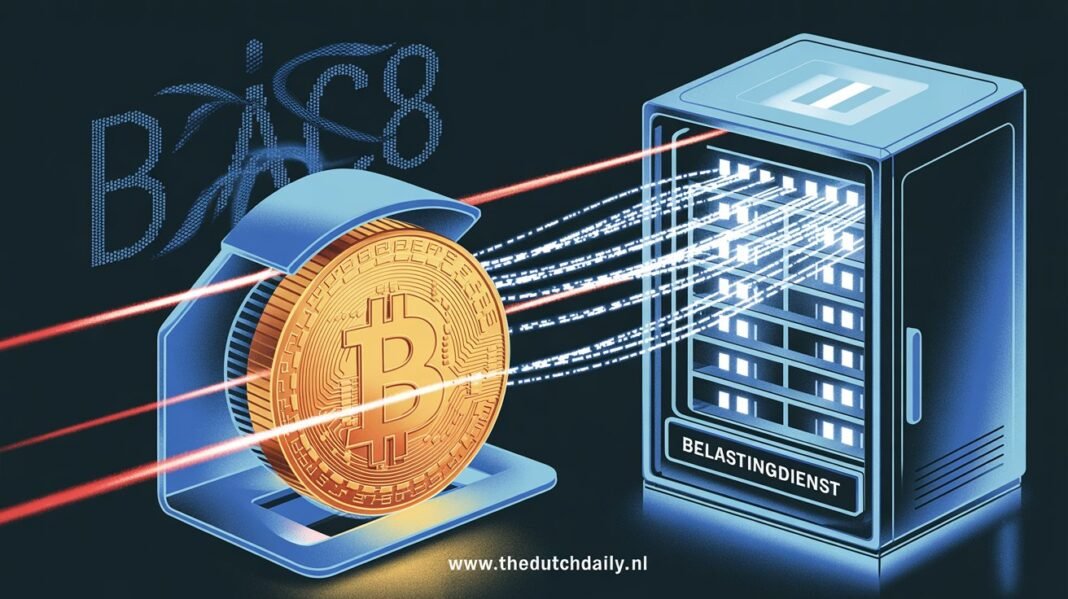
Crypto Tax Netherlands 2026: The Ultimate Guide to DAC8, Box 3 & Avoiding the 300% Fine
APELDOORN – For years, the relationship between crypto investors and the Belastingdienst (Dutch Tax Authority) was defined by a comfortable silence. Investors hoped their holdings on international exchanges like Binance, Bybit, or hidden hardware wallets would stay under the radar, while the taxman relied on an outdated “honor system.”
As of February 2026, the silence is broken. The game is officially over.
With the full, aggressive implementation of the European Union’s DAC8 (Directive on Administrative Cooperation 8), total transparency has arrived. Crypto Asset Service Providers (CASPs) operating within the EU—and major global players serving EU clients—are now legally required to automatically share granular user data with tax authorities. This means the Belastingdienst likely already knows exactly how much Bitcoin, Ethereum, Solana, or obscure meme-coins you held on the reference date of January 1, 2025.
If you thought the “Mavi Zarf” (Blue Envelope) was stressful before, wait until you realize it now includes a direct link to your digital wallet history. In this massive, definitive 2900-word dossier, we go far beyond the basics. We break down the new reality of DAC8, dissect the controversial Box 3 calculations with multiple scenarios, analyze the risks of DeFi and Staking, review the best tax software, and provide a survival guide for those who have “forgotten” to declare in the past.
Table of Contents
- What is DAC8? The End of Anonymity & The “Blacklist”
- Box 3 Deep Dive: The “Fictitious Return” & Hoge Raad Ruling
- Master Class: Calculating Your 2026 Tax Bill (3 Scenarios)
- The Danger Zone: When HODLing Becomes “Day Trading” (Box 1)
- DeFi, Staking, Airdrops & Mining: The Complex Cases
- The Stablecoin Trap: Why USDT is NOT Cash
- Tools of the Trade: Koinly, Blockpit & Spreadsheets
- Step-by-Step Guide: Filling the “Aangifte” Screen
- Exit Tax: What Happens When You Leave the Netherlands?
- Penalties & Amnesty: How to Fix Past Mistakes
- Crypto Tax FAQ 2026
- Dutch Tax Vocabulary Corner
- Sources & References
What is DAC8? The End of Anonymity & The “Blacklist”
The DAC8 Directive is the EU’s nuclear option against tax evasion in the crypto space. Adopted in 2023 and fully active for the 2025/2026 tax year, it harmonizes reporting rules across all 27 member states and closes the loopholes that existed between countries.
Who Reports What? (The Scope)
Any centralized exchange (CEX) or custodian wallet provider serving EU clients must report detailed data. This is not just a request; it is an automated API feed.
The Data Points Shared:
- Identity: Your full name, current address, date of birth, and BSN (Burgerservicenummer).
- Balances: The total Fiat value of your crypto assets on January 1st and December 31st of the tax year.
- Transactions: Gross proceeds from selling or exchanging crypto (crypto-to-fiat and crypto-to-crypto).
- Wallet Addresses: The specific blockchain addresses associated with your hosted wallet.
The Exchange Watchlist: Who is Snitching?
Many expats ask: “I use an exchange in Seychelles/Panama/Turkey. Am I safe?”
Likely Not.
- Tier 1 (Direct Reporting): Bitvavo, Coinmerce, Blox (Dutch entities). They report directly to the Belastingdienst.
- Tier 2 (EU Passporting): Coinbase (Ireland), Kraken (Italy/Ireland), Binance (France/Poland entity). They report to their local authority, which forwards data to NL via the “Common Reporting Standard” (CRS).
- Tier 3 (Global Giants): Bybit, KuCoin, OKX. While headquartered offshore, they want to operate legally in the EU (MiCA regulation). To keep their license, they comply with data requests.
- Tier 4 (DeFi): Uniswap, MetaMask (Self-custody). Currently, the protocol itself does not report. HOWEVER, the moment you move funds from MetaMask to a CEX to cash out (Off-ramp), the chain is visible.
Box 3 Deep Dive: The “Fictitious Return” & Hoge Raad Ruling
In the Netherlands, crypto is generally treated as Wealth (Vermogen) in Box 3. It is NOT treated as Capital Gains (like in the US or Germany), meaning you pay tax even if you don’t sell.
The “Kerstarrest” & Legal Chaos
The Dutch Box 3 system has been declared “illegal” by the Supreme Court (Hoge Raad) because it taxed people on fictitious returns even if they lost money.
The Current Solution (Overbruggingswetgeving):
Until the new system (taxing actual returns) is ready in 2027/2028, we are in a transition phase.
The Categories:
1. Bank Savings (Spaargeld): Taxed at a low assumed return (approx 1.03%).
2. Investments (Overige bezittingen): This includes Crypto, Stocks, ETFs, and Second Homes. Taxed at a high assumed return (approx 6.04%).
Critical Note: The tax office *assumes* you made 6.04% profit on your Bitcoin. If you actually made 100%, you win (you only pay tax on 6%). If you lost 50%, you lose (you still pay tax on the assumed 6% gain). You can appeal this (Bezwaar maken), but it is a lengthy legal battle.
The Reference Date (Peildatum) Rule
The Reference Date is the holy grail. For the 2026 tax return (covering 2025), the date is January 1, 2025 at 00:00:00.
Snapshot Logic:
Whatever the value was at that exact second is your taxable base for the whole year.
Example: You bought PepeCoin on Dec 30, 2024. It pumped 1000% on Dec 31st. On Jan 1st, 2025, you are rich. On Jan 2nd, it crashed to zero.
Result: You owe massive tax on money you no longer have.
Master Class: Calculating Your 2026 Tax Bill (3 Scenarios)
Let’s crunch the numbers. The tax-free allowance (Heffingsvrij vermogen) for 2025 is €57,000 per person (€114,000 for fiscal partners).
Scenario A: The “Safe” Saver (HODLer)
- Assets: €30,000 in Savings, €20,000 in Bitcoin.
- Total Wealth: €50,000.
- Calculation: €50,000 < €57,000 (Threshold).
- Tax Bill: €0.00. (You still should declare it, but you pay nothing).
Scenario B: The Crypto Investor (Single)
- Assets: €10,000 Savings, €90,000 Crypto.
- Total Wealth: €100,000.
- Taxable Base: €100,000 – €57,000 = €43,000.
- The Mix: The system calculates the “Weighted Average” return. Since 90% is Crypto (High Tax category), the rate is high.
- Assumed Gain: Approx €2,597 (6.04% of the taxable part).
- Tax Rate: 36% of the gain.
- Tax Bill: Approx €935.
Scenario C: The “Whale” (Fiscal Partners)
- Assets: €40,000 Savings, €300,000 Crypto Portfolio.
- Total Wealth: €340,000.
- Partners: Married couple (Threshold €114,000).
- Taxable Base: €226,000.
- Assumed Gain: Approx €13,650 (Investments category weighs heavy).
- Tax Rate: 36%.
- Tax Bill: Approx €4,914.
The Danger Zone: When HODLing Becomes “Day Trading” (Box 1)
Most expats assume they are in Box 3. But if you are too active, the Belastingdienst can classify your crypto as “Income from Work” (Box 1).
Why is Box 1 bad?
Box 3 tax is approx 2% of your total capital. Box 1 tax is up to 49.50% of your actual realized profits.
The Criteria for Box 1 (Source: Lower Court Jurisprudence):
You are at risk if:
1. Labor vs. Capital: You spend hours every day analyzing charts and trading.
2. Tools: You use specialized bots, high-frequency algorithms, or paid signal groups.
3. Expertise: You work in the crypto industry and use “insider” knowledge.
4. Day Trading: You open and close positions within hours/minutes.
The “Mining” Exception: If you mine Bitcoin at home as a hobby (cost of electricity > profit), it’s usually not Box 1. But if you run a mining farm in a warehouse, it is a business (Box 1).
DeFi, Staking, Airdrops & Mining: The Complex Cases
The tax forms were designed for savings accounts, not Liquidity Pools. Here is how to handle the “Grey Areas.”
1. Staking Rewards (ETH/SOL/ADA)
The Netherlands does NOT tax the event of receiving the reward (unlike the UK/US).
The Rule: You simply add the *value* of the accumulated rewards to your total wealth on the next reference date.
Example: You earn 5 ETH in staking rewards in 2025. You pay no tax in 2025. On Jan 1, 2026, those 5 ETH are part of your stack and taxed in Box 3.
2. Airdrops
Same logic. An airdrop is an accretion of wealth. It is taxed on the next reference date. You do not report it as “Income.”
3. Liquidity Pools (Uniswap/Curve)
This is tricky. Technically, you don’t hold the tokens; you hold “LP Tokens” representing your share.
Valuation: You must value your LP tokens at “Fair Market Value” on Jan 1st. This usually means calculating the underlying value of the Token A + Token B you would get if you withdrew that day.
4. Locked Assets (Vesting)
If you have tokens that are legally locked (vesting schedule) and cannot be sold on Jan 1st, you can argue for a lower valuation. You can apply a “Lack of Liquidity Discount” (e.g., 20-50%), but you must document this reasoning perfectly for an audit.
The Stablecoin Trap: Why USDT is NOT Cash
This is the most common mistake.
“I sold my Bitcoin for USDT on Dec 31st to avoid volatility. It’s basically dollars, so it’s taxed as savings, right?”
WRONG.
The Belastingdienst classifies Stablecoins (USDT, USDC, DAI) as “Overige Bezittingen” (Investments).
The Math:
- €100k in Bank: Assumed return 1.03% -> Tax €370.
- €100k in USDT: Assumed return 6.04% -> Tax €2,174.
Strategy: If you want to reduce tax, you must off-ramp to a real Fiat Bank Account (IBAN) before Jan 1st. Keeping it in Tether costs you 6x more tax.
Tools of the Trade: Koinly, Blockpit & Spreadsheets
With thousands of transactions, Excel is suicide. The Dutch tax office accepts reports from major tax software if they follow the “FIFO” (First In, First Out) or Average Cost method (for valuation purposes).
Top Tools for Netherlands:
1. Koinly: Very popular, supports NL tax report generation. Good for DeFi.
2. Blockpit: European focus, strong on regulatory compliance.
3. CoinTracking: Older interface but very detailed for pro traders.
4. Divy (Dutch): A local startup specifically designed for Box 3 calculations.
Tip: The software cost is NOT tax-deductible.
Step-by-Step Guide: Filling the “Aangifte” Screen
When you log in to Mijn Belastingdienst in March 2026:
1. Go to the section “Bankrekeningen en andere bezittingen”.
2. Check the box “Overige bezittingen” (Other assets).
3. You will see a question: “Had u virtuele betaalmiddelen (zoals bitcoins)?” -> Select JA.
4. Description: Enter “Cryptocurency Portfolio”.
5. Value 01-01-2025: Enter the Euro value.
Pro Tip: Do not enter every single coin separately (BTC, ETH, DOGE). Just enter one line item for “Total Crypto Portfolio” unless the system specifically asks for breakdown (which DAC8 might trigger for pre-filled data).
Exit Tax: What Happens When You Leave the Netherlands?
If you decide to leave NL to move to Dubai or Portugal:
For Box 3 (Crypto): There is generally NO Exit Tax (Conserverende Aanslag) on personal crypto holdings. You simply stop being a tax resident, and you stop paying Box 3.
The Exception: If you hold >5% of a crypto company (Substantial Interest – Box 2), then yes, there is a massive exit tax. But for regular retail investors, you are free to leave with your coins.
Penalties & Amnesty: How to Fix Past Mistakes
The Penalties:
- Default Fine (Verzuimboete): €385 (Late filing).
- Negligence Fine (Vergrijpboete – Grove Schuld): 25% – 50% of the tax owed.
- Intent Fine (Vergrijpboete – Opzet): 300% of the tax owed. (Hiding assets is seen as Intent).
The “Inkeerregeling” (Voluntary Disclosure):
If you realize you failed to report crypto in 2023 or 2024, you can correct it voluntarily within 2 years.
The Deal: You pay the tax + interest, but the fine is usually waived or reduced to 0%.
The Condition: You must report it BEFORE the tax office sends you a letter asking about it. Once the “Blue Envelope” arrives with questions, the amnesty is gone.
Crypto Tax FAQ 2026
Q: I lost money in crypto in 2025. Do I get a tax refund?
A: No. Box 3 does not recognize actual losses. Even if your portfolio went -90%, you pay tax on the Jan 1st value. You can, however, file a “Bezwaar” (Objection) citing the Supreme Court ruling on “Actual Return,” but this is a legal process, not automatic.
Q: Does the 30% Ruling help me?
A: For Old Cases (Granted before 2024): Yes, you are exempt from Box 3 until 2027.
For New Cases (Granted after 2024): No. The “Partial Non-Resident” status is abolished. You must report crypto immediately.
Q: Can I pay my taxes in Bitcoin?
A: No. The Belastingdienst only accepts Euros via IBAN transfer.
Dutch Tax Vocabulary Corner
| Word (Dutch) | Pronunciation | Meaning & Context |
|---|---|---|
| 📅 Peildatum | Piel-da-tum | Reference Date. Jan 1st. The only day that matters for crypto tax. |
| 🏦 Overige Bezittingen | O-ve-ri-ge… | Other Assets. The category for Crypto (High Tax). |
| ⚖️ Inkeerregeling | In-keer-re-ge-ling | Amnesty Scheme. Confessing your sins before you get caught. |
| 👮 Navorderingsaanslag | Na-vor-de-rings… | Additional Assessment. The bill you get when they find out you lied. |
📚 Sources & References
This comprehensive guide is based on current EU regulations and Dutch tax laws.
- Primary Source: EU Directive 2021/514 (DAC8) regarding automatic exchange of information for crypto-assets.
- Legal Precedent: Hoge Raad “Kerstarrest” (Christmas Ruling) on Box 3 fictitious returns.
- Dutch Law: Belastingplan 2026 (Tax Plan 2026) & “Overbruggingswet box 3”.
- Official Guidelines: Belastingdienst.nl section on “Cryptovaluta en bitcoins” and “Inkeerregeling”.
- Original analysis by The Dutch Daily Finance Desk.
TDD Community Question
Did you declare your crypto in previous years? Are you using Koinly or another tool? Or are you considering leaving the Netherlands to avoid the Box 3 wealth tax on your Bitcoin? Share your strategies and questions below!

