



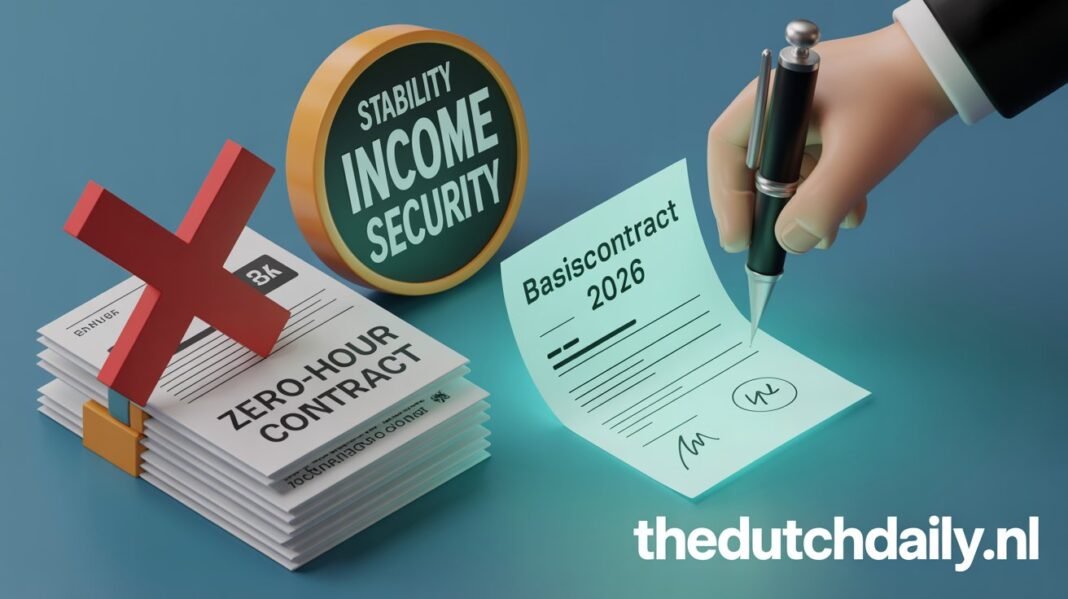
Dutch Basiscontract 2026: The infamous “Zero-Hour Contract” (Nulurencontract), which has defined the Dutch gig economy for over two decades, is officially being consigned to history. Following intense negotiations, the new coalition has finalized the “Labor Market Balance Act,” replacing precarious flexibility with the mandatory “Basiscontract” (Basic Contract).
📋 In This Comprehensive Guide:
- 1. The Death of the Nulurencontract
- 2. The “Bandwidth Model” (130% Rule) Explained
- 3. The 12-Month “Legal Upgrade” Right
- 4. Scheduling and the “4-Day Protection” Rule
- 5. 2026 Minimum Wage & Pension: The Real Math
- 6. The “Right to Disconnect”: Reclaiming Your Freedom
- 7. Sick Pay and the “Wachtdagen” Trap
- 8. Dismissal Protection: No More Silent Firing
- 9. Mortgage Opportunities for Basiscontract Holders
- 10. FAQ: Common Expat Questions
- 11. Final Action Plan for Expats
1. The Death of the “Nulurencontract”
Under the old system, a zero-hour contract was a dream for employers and a nightmare for employees. It meant you were officially employed, but had no guarantee of work. If the business was slow, the employer simply didn’t call you. You received zero pay, had zero predictability, and were unable to apply for a mortgage or even a standard rental apartment because you lacked a stable payslip.
The Dutch government has recognized that this extreme flexibility created a “precariat” class—workers who are legally employed but financially destitute. The 2026 Rule: These contracts are now strictly banned for structural work. They are being replaced by the Basiscontract, which mandates that an employer must offer a fixed number of hours that reflect the actual work history of the employee.
2. The “Bandwidth Model” (130% Rule) Explained
The Basic Contract introduces a sophisticated “Bandwidth Model” to replace zero-hour flexibility. This is the most technical part of the new law that every expat must understand to avoid being exploited.
Under this model, you and your employer agree on a minimum number of hours per month. The employer can only ask you to work up to 130% of those hours.
Example: If your Basiscontract is for 20 hours a week, your employer can only force you to work up to 26 hours. They can no longer demand you stay for 40 hours one week and 0 hours the next. Any hours beyond the 130% must be strictly voluntary and often come with overtime premiums.
3. The 12-Month “Legal Upgrade” Right
This is your strongest weapon as an employee. If you have been working through an agency (Uitzendbureau) or directly for a company for 12 months, the employer must offer you a fixed-hour contract based on your average hours over that year.
If your average was 24 hours a week, but they only want to give you a contract for 10 hours, they are in direct violation of the Ketenregeling (Chain Rule) and the new 2026 amendments. You have the right to demand the higher average, and if they refuse, you are entitled to “Loonvordering” (Wage Claim) for the missing hours, often backdated with interest.
4. Scheduling and the “4-Day Protection” Rule
The days of your boss texting you “Don’t come in today” two hours before your shift are over. The psychological stress of “waiting for the text” has been cited by healthcare professionals as a leading cause of burnout among flex-workers.
Employers must now provide your schedule at least 4 days (96 hours) in advance. If they cancel or change your shift within this 4-day window, they are legally required to pay you the full amount for that shift as if you had worked it. This applies even if you didn’t set foot in the building.
5. 2026 Minimum Wage & Pension: The Real Math
The legal hourly minimum wage has seen a massive adjustment to combat inflation in cities like Amsterdam and Utrecht. As of 2026, the age-based salary system has been simplified to provide more dignity to younger workers.
| Employee Age | Hourly Rate (Gross) | Monthly (Full Time – 36h) | Monthly (Full Time – 40h) |
|---|---|---|---|
| 21 Years and Older | €14.71 | €2,295.40 | €2,549.73 |
| 20 Years Old | €11.77 | €1,836.32 | €2,039.78 |
| 19 Years Old | €8.83 | €1,377.24 | €1,529.84 |
Crucial Detail: In 2026, the STiPP Pension Fund has abolished the waiting period. From your first hour on a Basiscontract, you are building a pension. This is a massive shift for expats who previously left the Netherlands with zero retirement savings.
6. The “Right to Disconnect”: Reclaiming Your Freedom
For the first time, Dutch law officially recognizes the “Right to Disconnect” (Recht op onbereikbaarheid). In the zero-hour era, workers feared that missing a call or a WhatsApp message would result in being “blacklisted” for future shifts.
Under the Basiscontract, you are only required to be responsive during your agreed-upon “availability bandwidth.” If your employer contacts you outside these hours, you are under no legal obligation to respond. Furthermore, any retaliation—such as reduced shifts or “ghosting”—is now a punishable offense by the Labor Inspectorate.
7. Sick Pay and the “Wachtdagen” Trap
With the Basiscontract, your right to Ziektewet (Sick Pay) is finally secure. Even on a flexible contract, if you fall ill, your employer must pay at least 70% of your wages for the duration of your contract.
Check your contract for “Wachtdagen”: Most contracts have 1 or 2 “waiting days” where you aren’t paid when you get sick. However, from the 3rd day onwards, the law is strictly on your side. If your employer claims “no work, no pay,” they are breaking the law.
8. Dismissal Protection: No More Silent Firing
In the past, employers “fired” zero-hour workers by simply not giving them any more shifts. This is called “Silent Dismissal” (Stil ontslag).
In 2026, this is considered a legal breach. If you have an established work pattern, the employer must go through official dismissal procedures (UWV or Court) to stop giving you hours. If they stop calling you, you can sue for your average wages.
Furthermore, you are entitled to a Transitievergoeding (Severance pay) from day one of your employment. This is calculated as 1/3 of your monthly salary per year worked.
9. Mortgage Opportunities for Basiscontract Holders
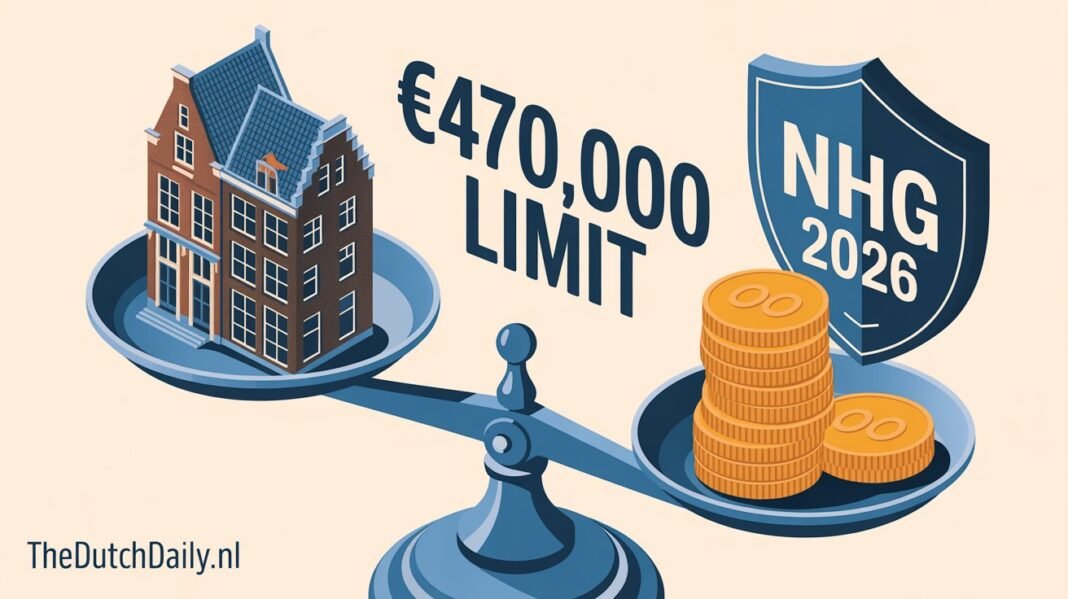
One of the biggest wins for expats is financial credibility. Banks previously rejected zero-hour workers for mortgages because their income was seen as “incidental.” Now, with a Basiscontract and an “Employer’s Statement” (Werkgeversverklaring), banks are treating this income as “stable.” This opens the door for many expats to finally enter the Dutch housing market using the new 2026 NHG limits.
10. FAQ: Common Expat Questions
Q: What if my employer refuses to upgrade me to a Basiscontract?
A: They are breaking the law. You can send a “Loonvorderingsbrief” (Letter for wage claim). If that fails, the Juridisch Loket or a union like FNV can take them to court for free or low cost.
Q: Can I keep my Zero-Hour contract if I want to?
A: In most cases, no. The law is designed to protect you. Only very specific seasonal roles (like harvesting or specific festival work) are exempt from the Basiscontract mandate.
Q: How does this affect my 30% Ruling?
A: A Basiscontract makes your income predictable, which helps ensure you consistently stay above the salary threshold required to keep your tax benefit.
11. Final Action Plan for Expats
- Audit: Calculate your average weekly hours from the last 12 months. This is your “Legal Target.”
- Negotiate: Schedule a meeting with HR to sign your new Basiscontract. Ensure the “bandwidth” is not too wide (max 130%).
- Monitor: Check your payslips for pension (STiPP) and holiday pay (Vakantiegeld) contributions.
- Report: If your boss cancels a shift at the last minute without pay, report it to the Arbeidsinspectie.
🇳🇱 Work & Law Vocabulary
| Dutch Term | Meaning |
|---|---|
| Basiscontract | The new standard contract with fixed hours. |
| Oproeptermijn | The 4-day notice period for shifts. |
| Transitievergoeding | Severance pay (Even for flex workers!). |
| Recht op onbereikbaarheid | Right to disconnect (No work emails after hours). |
📊 Official Verification
| Source | Document |
|---|---|
| Rijksoverheid | Wet Arbeidsmarkt in Balans 2026. |
| UWV | Flex-worker Sick Pay Guidelines. |
| FNV Union | International Workers’ Rights Handbook. |