



The Changing Face of Smuggling: Cocaine Seizures Drop as Cannabis Floods the Dutch Borders
Rotterdam / Vlissingen – The Dutch customs authority (Douane) has released its highly anticipated annual drug seizure report for 2024, revealing a dramatic shift in the underworld’s logistics. In a year marked by intensified port security and unprecedented international cooperation, cocaine interceptions have plummeted by over 30%, while cannabis shipments have seen a staggering fourfold increase.
According to Customs Director Nanette van Schelven, the 24.5 tonnes of cocaine seized in 2024—down from nearly 60 tonnes just two years ago—indicates that major South American cartels are rerouting their “white gold” to smaller, less-guarded European entry points. However, the vacuum in the Dutch logistical chain is being rapidly filled by a surge in high-grade cannabis originating from legal markets in North America and Southeast Asia, presenting a new set of challenges for the Schoof administration.
Table of Contents
- The Cocaine Decline: Victory or Strategic Rerouting?
- The Cannabis Paradox: The Legal-to-Illegal Pipeline
- Tactical Evolution: The Sea ‘Drop-Off’ Method
- Port Focus: Rotterdam vs. Vlissingen Security
- Technological Warfare: AI Scanning and Narkos-Dogs
- International Cooperation: The ‘Latin Connection’
- Expert Analysis: Redirection of Criminal Assets
- Key Takeaways
- Dutch Learning Corner
- Community Discussion
The Cocaine Decline: Victory or Strategic Rerouting?
In 2022, Dutch ports were under siege, with nearly 60 tonnes of cocaine intercepted. By 2023, that number dropped to 38 tonnes, and in 2024, it hit a significant low of 24.5 tonnes. While politicians might be tempted to claim a total victory in the “War on Drugs,” customs officials and criminologists are offering a more nuanced explanation.
The decrease in Rotterdam (down to 11.5 tonnes from 25) suggests that the “Mainport” has become too high-risk for major criminal networks. Enhanced scanning technology and the mandatory “anti-corruption” screening of all port employees (the ‘Vertrouwen-scan’) have made it difficult for smugglers to maintain internal contacts. Analysts believe the trade hasn’t diminished; it has simply migrated. Cartels are now favoring smaller ports in Spain, Italy, and West Africa, where security infrastructure is less sophisticated, before moving the goods into the Netherlands by land.
The Cannabis Paradox: The Legal-to-Illegal Pipeline
The most shocking statistic in the 2024 report is the 65.5 tonnes of cannabis seized—a quadruple increase compared to previous years. Paradoxically, much of this illegal supply originates from countries where cultivation is legal or regulated, such as Canada, Thailand, and several US states.
Smugglers are exploiting industrialized, high-quality production in these nations to supply the Dutch black market. Although the Netherlands is currently conducting its own “Wietexperiment” (regulated cannabis trial), the demand for exotic, high-potency strains remains high. These shipments are arriving not just in maritime containers, but increasingly through Schiphol Airport and postal services, often hidden in seemingly innocent commercial cargo like high-end furniture, electronics, or industrial machinery.
Tactical Evolution: The Sea ‘Drop-Off’ Method
As port security tightens, criminal networks are returning to a risky but effective high-seas tactic known as the “drop-off” method. Instead of attempting to dock at a heavily guarded terminal, smugglers dump waterproof, GPS-tracked drug packages into the North Sea from cargo ships. These packages are then left to drift with the currents toward the Dutch coastline or are picked up by smaller, high-speed ‘Go-Fast’ boats in international waters.
This trend was highlighted just over a week ago when residents on the Wadden Island of Terschelling discovered large packages of narcotics washed up on the dunes. This method creates a massive logistical headache for the Dutch Coast Guard (Kustwacht), as it moves the “front line” of drug enforcement from the secure docks to hundreds of kilometers of open coastline.
Port Focus: Rotterdam vs. Vlissingen Security
Vlissingen has emerged as a critical secondary front in the drug war. In 2024, seven tonnes of cocaine were seized there, a slight drop from 9.6 tonnes in 2023. The port has seen a massive increase in the presence of ‘Hit Teams’ and specialized sniffer dogs, targeting fruit shipments from South America—a traditional favorite for drug concealment due to the perishable nature of the goods.
The synergy between the Rotterdam and Vlissingen authorities, under the unified ‘Port Security’ protocol, has effectively squeezed the traditional routes. However, gümrük (customs) officials warn that as long as the demand in the European hinterland remains high, smugglers will continue to test the “water resistance” of these defenses by constantly shifting their logistical hubs.
Technological Warfare: AI Scanning and Narkos-Dogs
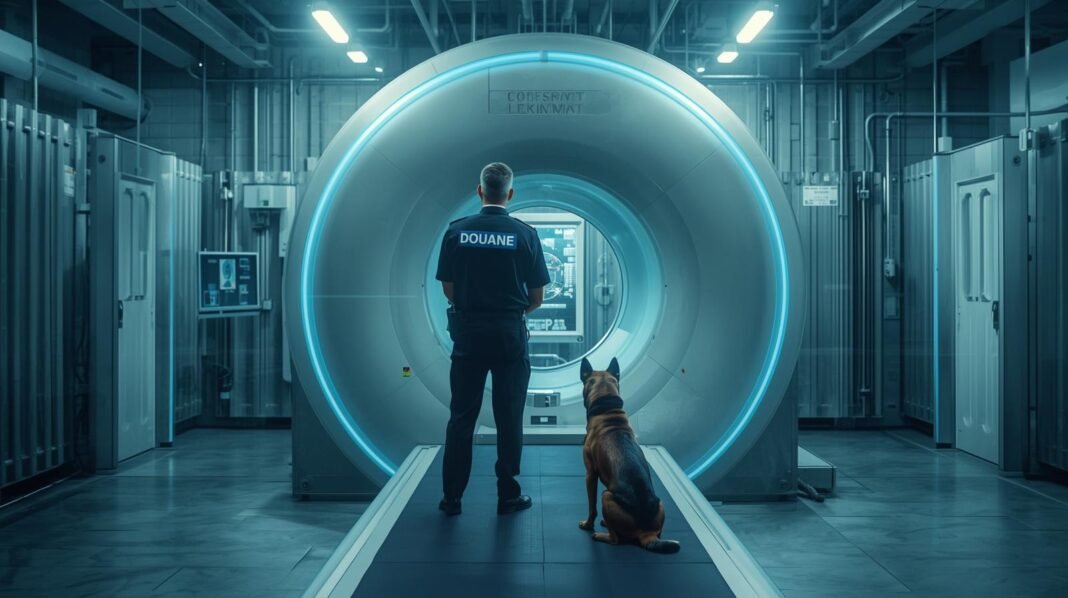
The 2024 results are partly credited to the deployment of Artificial Intelligence in scanning processes. AI algorithms can now analyze X-ray images of thousands of containers per hour, flagging anomalies in density that the human eye might miss. Combined with an increased “canine force”—sniffer dogs trained specifically to detect synthetic masking odors used to hide cocaine—the Dutch customs are becoming a world leader in non-intrusive inspection.
Yet, technology is a double-edged sword. Criminal organizations are now experimenting with ‘stealth’ packaging that mimics the chemical signature of legitimate polymers, making detection nearly impossible for traditional sensors. It is a constant arms race between the state and organized crime.
International Cooperation: The ‘Latin Connection’
Dutch law enforcement has also intensified its presence in source countries. By placing liaison officers in Ecuador, Brazil, and Colombia, the Netherlands is now receiving real-time intelligence on high-risk containers before they even leave South American shores. This “pre-arrival” strategy has been a game-changer, allowing customs to prepare “hot-checks” the moment a ship enters Dutch territorial waters. The cooperation with the Belgian authorities at the Port of Antwerp—the other major gateway for cocaine—has also closed many of the loopholes that smugglers previously exploited.
Expert Analysis: Redirection of Criminal Assets
Criminology analysts suggest that we are witnessing a “redirection” rather than a reduction of criminal activity. “The drop in cocaine seizures doesn’t mean the cartels are losing money; it means they are diversifying,” says a senior researcher at the Clingendael Institute. “The surge in cannabis shows that criminal networks are shifting their capital toward lower-risk, high-volume products where the legal status in other countries creates a grey area they can exploit.”
Key Takeaways
- The Core Trend: Cocaine seizures dropped by 30% in 2024, while cannabis seizures quadrupled to 65.5 tonnes.
- The ‘Drop-Off’ Danger: Smugglers are increasingly dumping GPS-tracked drugs at sea to bypass port scanners.
- Geopolitics: Legal markets in Thailand and Canada are inadvertently feeding the Dutch illicit market.
- Technology: AI-driven scanning is the primary weapon in the modern Dutch customs arsenal.
Dutch Learning Corner
| Word (Dutch) | Pronun. (Eng) | Meaning | Context (NL + EN) |
|---|---|---|---|
| 👮♂️ De Douane | De Dow-ah-neh | Customs | De douane controleert de lading. (Customs is checking the cargo.) |
| 📦 Inbeslagname | In-beh-slahg-nah-muh | Seizure / Confiscation | Er was een grote inbeslagname in de haven. (There was a large seizure in the port.) |
| 🚤 Smokkelen | Smok-keh-len | To smuggle | Criminele bendes smokkelen drugs. (Criminal gangs smuggle drugs.) |
| ⚓ De Haven | De Hah-ven | The Port / Harbor | Rotterdam is de grootste haven. (Rotterdam is the largest port.) |
Is the War on Drugs Shifting in the Wrong Direction?
As legal cannabis production in North America fuels illegal exports to the Netherlands, should we rethink our international trade treaties? Does the drop in cocaine seizures mean security is working, or are we just pushing the problem to our neighbors? Share your perspective in the comments below.
Source / Enforcement Data: Belastingdienst/Douane (Official 2024 Report) & Ministry of Justice and Security.