




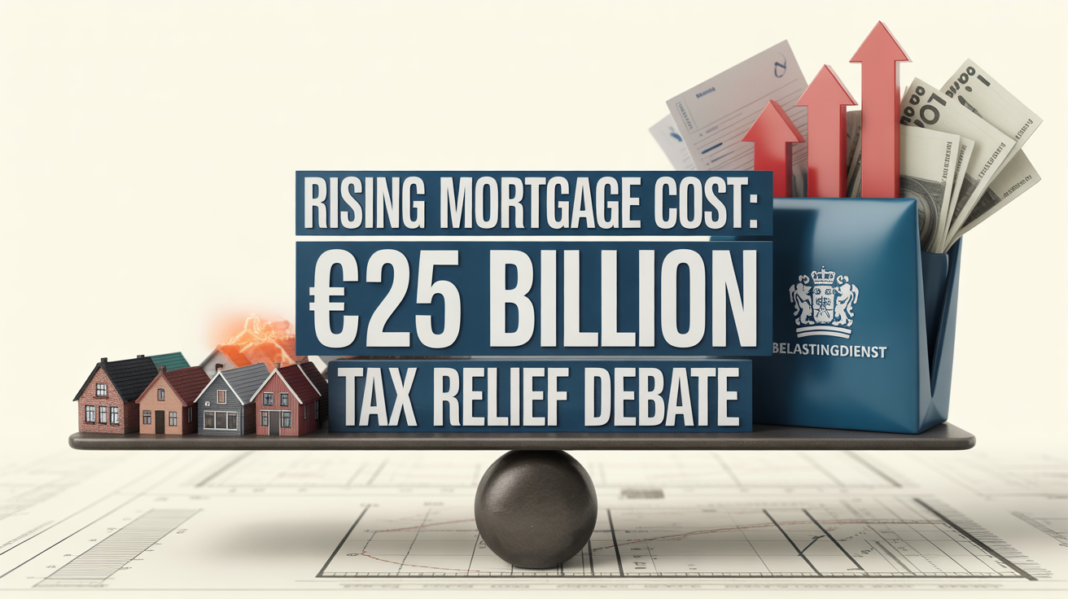
The €25 Billion Question: Mortgage Tax Relief Costs Soar as Housing Market Heats Up
The Hague / Heerlen – The controversial “Hypotheekrenteaftrek” (mortgage interest deduction) has once again become a hot potato in Dutch politics. New figures released by the national statistics agency CBS on Friday reveal that Dutch homeowners deducted a staggering €24.8 billion from their taxable income in 2024—a sharp 7% increase from the previous year.
This surge marks the second consecutive year of rising costs for the state, driven primarily by higher interest rates on new mortgages. As the deduction bill grows, so does the debate: Is this a necessary support for the middle class, or an unsustainable subsidy that inflates housing prices and benefits the wealthy?
Table of Contents
- Breaking Down the Bill: €24.8 Billion
- Who Benefits? The Rich vs. The Rest
- The Counter-Tax: Understanding ‘Eigenwoningforfait’
- Coalition Talks: To Cut or Not to Cut?
- Impact on Housing Prices: The Subsidy Trap
- Expert Analysis: ABN Amro on Affordability
- Key Takeaways
- Dutch Learning Corner
- Community Discussion
Breaking Down the Bill: €24.8 Billion
The CBS report provides a detailed autopsy of the deduction. Of the total €24.8 billion deducted, **94%** came directly from mortgage interest payments. The remaining 6% is attributed to the “Wet Hillen” rebate (a diminishing benefit for those who have paid off their mortgage entirely).
The primary driver of this increase is the end of the “zero-interest era.” As homeowners refinance their fixed-term mortgages at current rates (now hovering around 3.5% – 4%), their monthly interest payments rise, leading to larger tax deductions. This mechanism effectively transfers a portion of the interest rate risk from the homeowner to the Dutch Treasury.
Who Benefits? The Rich vs. The Rest
The distribution of this tax relief is a study in contrasts.
* **Absolute Terms:** The top 20% of earners claimed nearly **half (49%)** of the total deduction amount (€9.5 billion). This fuels the argument that the scheme disproportionately subsidizes the wealthy, who buy more expensive homes with larger loans.
* **Relative Terms:** However, the CBS data offers a surprising counter-point. For lower-income homeowners, the deduction reduced their total tax bill by **27%**, whereas for the highest earners, the reduction was only **5%**.
This creates a political paradox: cutting the scheme would hurt the *wallets* of the rich the most in euros, but it would hurt the *budgets* of lower-income families the most in percentage terms.
The Counter-Tax: Understanding ‘Eigenwoningforfait’
It is impossible to discuss the deduction without mentioning its twin: the **Eigenwoningforfait**. This is a tax added to your income based on the “WOZ-waarde” (official value) of your home. It effectively acts as a tax on the “imputed rent” or the benefit of living in your own house.
The mortgage interest deduction is meant to offset this. However, as house prices (and thus WOZ values) have skyrocketed, the Eigenwoningforfait has also risen, eating into the net benefit of the interest deduction for many. For those who have paid off their mortgage, the “Wet Hillen” previously canceled out this tax, but that exemption is being phased out over 30 years, adding a new tax burden to debt-free retirees.
Coalition Talks: To Cut or Not to Cut?
The future of the Hypotheekrenteaftrek is a central sticking point in the current formation talks in The Hague.
* **Reformists:** Parties like NSC and GL-PvdA argue that the €25 billion cost is fiscally unsustainable and that the money should be used to lower income tax for everyone or build social housing.
* **Defenders:** The VVD and BBB have traditionally defended homeownership subsidies, arguing that scrapping them would crash the housing market and leave recent buyers with “underwater” mortgages (negative equity).
Currently, the maximum deduction rate is capped at **36.97%** (2026 rate), regardless of your tax bracket. Further reductions are politically perilous but economically tempting for a budget-conscious government.
Impact on Housing Prices: The Subsidy Trap
Economists at **De Nederlandsche Bank (DNB)** have long criticized the scheme. Their argument is simple: if you give people more money to spend on mortgages (via tax breaks), they simply bid up the price of the limited supply of houses.
Instead of making homes affordable, the subsidy gets capitalized into higher house prices, benefiting existing sellers rather than new buyers. Phasing it out could cool the market, but doing so too quickly could trigger a price collapse.
Expert Analysis: ABN Amro on Affordability
A recent stress test by **ABN Amro** suggests that most Dutch households are resilient. “The shock of removing the deduction would be manageable for the majority, provided it is done gradually,” the bank’s analysts noted. “However, the psychological impact on consumer confidence could be severe. The housing market runs on sentiment as much as it runs on interest rates.”
Key Takeaways
- The Cost: The state lost €24.8 billion in tax revenue due to home deductions in 2024.
- The Driver: Rising mortgage interest rates are directly increasing the deduction amount.
- The Inequality: The richest 20% receive half the money, but the poor get a larger relative tax break.
- The Future: Coalition parties are split on whether to cap, cut, or keep the scheme.
Dutch Learning Corner
| Word (Dutch) | Pronun. (Eng) | Meaning | Context (NL + EN) |
|---|---|---|---|
| 🏠 De Hypotheek | De Hee-po-tayk | The Mortgage | De hypotheekrente is gestegen. (The mortgage interest has risen.) |
| 📉 De Aftrek | De Af-trek | The Deduction | Hypotheekrenteaftrek is belangrijk. (Mortgage interest deduction is important.) |
| 📄 De Belastingaangifte | De Buh-las-ting-aan… | Tax Return | Het is tijd voor de belastingaangifte. (It is time for the tax return.) |
| 💰 De Eigenwoningforfait | De Eye-ghen-wo-ning… | Imputed Rent Tax | De eigenwoningforfait is afhankelijk van de WOZ. (The imputed rent tax depends on the WOZ.) |
Fair Support or Rich Subsidy?
Is the €25 billion mortgage deduction the only thing keeping Dutch housing affordable, or is it the reason houses are so expensive in the first place? Would you vote to keep it or scrap it? Share your opinion in the comments.
Source / Financial Data: CBS (Statistics Netherlands) & De Nederlandsche Bank (DNB).