



The Dutch School System: Is Your Child’s Future Decided at Age 12?
Amsterdam – For most international parents, the Dutch education system feels like a high-stakes puzzle. In your home country, children might stay in a general education stream until they are 16 or 18. But in the Netherlands, the “Great Divide” happens much earlier. At age 11 or 12, during Group 8 of primary school (Basisschool), children receive a recommendation that dictates their path for the next several years.
This moment creates immense pressure for expat families. You might hear terms like “VMBO-T,” “HAVO,” or “Gymnasium” and feel like you are deciphering a secret code. Is it true that a “low” recommendation at age 12 prevents your child from ever going to university? (Spoiler: No, but it makes the path longer).
In this 1500-word definitive guide, we break down the structure of Dutch secondary education, the role of the 2026 Cito tests, and the strategic choices expat parents must make to ensure their children thrive in the Dutch system.
Table of Contents
- The Pyramid: Understanding VMBO, HAVO, and VWO
- The Gatekeeper: The Cito Test & Teacher Recommendation
- The Transition: From Group 8 to Bridge Year
- International vs. Dutch Schools: The 2026 Verdict
- The “Loting”: The School Placement Lottery in Cities
- Climbing the Ladder: Can You Switch Levels Later?
- Language Support: NT2 and Kopklas
- Expat Strategy: How to Support Your Child
- Dutch Education Vocabulary Corner
The Pyramid: Understanding VMBO, HAVO, and VWO
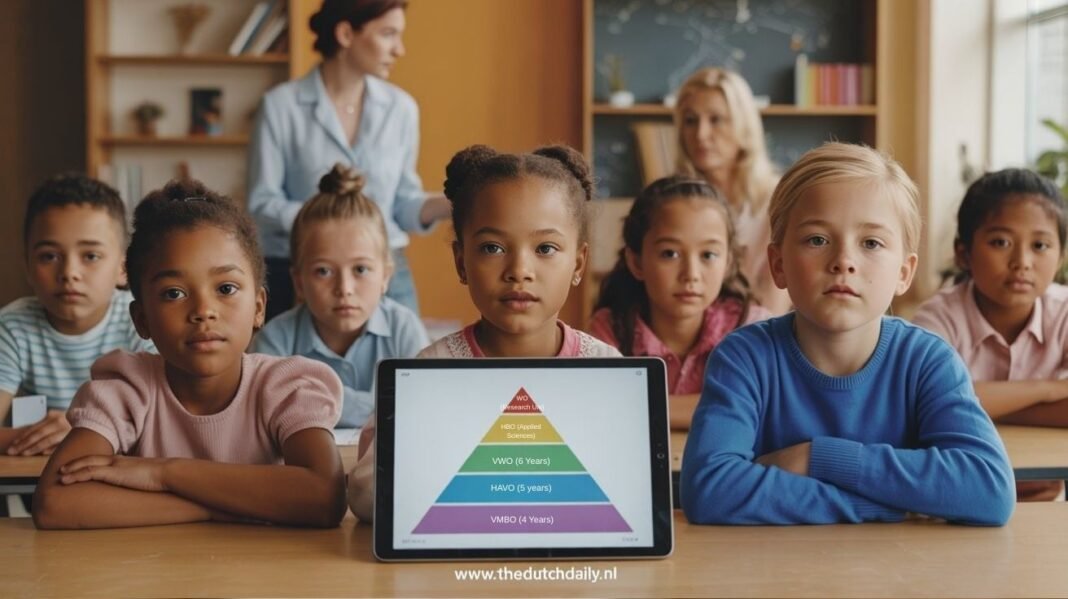
The Dutch secondary system is “streamed.” After primary school, children are divided into three main tracks based on their academic level and learning style. Understanding these acronyms is the first step for any parent.
1. VMBO (Voorbereidend Middelbaar Beroepsonderwijs)
VMBO lasts 4 years and is intended for students who learn better by “doing” rather than just “reading.” It is divided into four sub-levels:
- VMBO-B and VMBO-K: Focused on vocational training (technicians, chefs, healthcare assistants).
- VMBO-T (MAVO): The highest level of VMBO. It provides a solid theoretical foundation and allows students to move up to HAVO after graduation.
2. HAVO (Hoger Algemeen Voortgezet Onderwijs)
HAVO lasts 5 years. It is designed to prepare students for “Hoger Beroepsonderwijs” (HBO)—Universities of Applied Sciences. This is a very common track for students who want a professional career in business, nursing, or engineering without the heavy academic research focus of a traditional university.
3. VWO (Voorbereidend Wetenschappelijk Onderwijs)
VWO lasts 6 years and is the only direct ticket to a Research University (WO).
- Atheneum: Standard high-level academic track.
- Gymnasium: Same as Atheneum but includes Latin and Ancient Greek. It is often seen as the most prestigious track in the country.
The Gatekeeper: The Cito Test & Teacher Recommendation
In 2026, the transition process is more holistic than it was a decade ago, but the Teacher’s Recommendation (Schooladvies) is still king.
In February of Group 8, your child’s teacher issues a recommendation based on the child’s performance from Group 6 onwards. Shortly after, the children take a national test (often called the Cito, though other providers like IEP are now common).
The 2026 Rule: If the Cito test score is higher than the teacher’s recommendation, the school must reconsider and potentially upgrade the advice. If the test score is lower, the teacher’s original (higher) advice stands. This protects the child from having “one bad day” at the exam.
The Transition: From Group 8 to Bridge Year
Most Dutch secondary schools start with a Brugklas (Bridge Year). Some schools offer “Double Levels” like a HAVO/VWO bridge class. This gives the child an extra year to prove which level suits them best before a final decision is made at the end of the first year of high school.
International vs. Dutch Schools: The 2026 Verdict
Many expats struggle with this choice. In 2026, the cost of International Schools in the Netherlands has risen to an average of €18,000 – €24,000 per year.
The Dutch Choice: If you plan to stay in the Netherlands for more than 5 years, the Dutch system is often better for long-term integration. Dutch “Bilingual Schools” (TTO) are a popular middle ground, where 50% of subjects are taught in English, but the diploma is Dutch (HAVO or VWO).
The “Loting”: The School Placement Lottery
In cities like Amsterdam and Utrecht, knowing which level your child is in is only half the battle. You then have to get into the school you want.
Because some schools are more popular than others, a Central Lottery System (Loting) is used. Parents submit a list of 10-15 schools. If a school is oversubscribed, a computer randomly assigns spots. This can be devastating for expat families who live next door to a school but are assigned to one 5km away. Always have a diverse list of “safety” schools.
Climbing the Ladder: Can You Switch Levels Later?
One of the biggest myths is that the 12-year-old decision is final. The Dutch system is actually like a “Lego set.”
Stacking (Stapelen):
- A student can finish VMBO-T, then do 2 years of HAVO.
- A student can finish HAVO, then do 2 years of VWO.
- A student can finish HAVO, go to an HBO for one year (Propedeuse), and then switch to a Research University.
Many of the most successful professionals in the Netherlands started in VMBO and “stacked” their way to a Master’s degree. It takes longer, but the door is never truly closed.
Language Support: NT2 and Kopklas
If your child moved to the Netherlands recently, the “Language Gap” might make them score lower on tests than their actual intelligence suggests.
The Kopklas: This is a special “Year 0” between primary and secondary school for bright children who just need to master Dutch. It focuses 80% on language, allowing the child to enter a higher level (like HAVO or VWO) the following year.
Expat Strategy: How to Support Your Child
- Start in Group 6: Don’t wait until Group 8. Monitor the “Leerlingvolgsysteem” (LVS) reports early.
- Don’t Obsess over VWO: The Dutch labor market values HBO (HAVO track) graduates very highly. Sometimes a “happy HAVO student” is better than a “stressed VWO student.”
- Visit Open Days: In January and February, schools hold “Open Dagen.” Take your child. Feel the atmosphere. Is it a “Mega-school” or a “Small-scale” (Kleinschalig) school?
Dutch Education Vocabulary Corner
| Word (Dutch) | Pronunciation | Meaning | Context |
|---|---|---|---|
| 🏫 Basisschool | Ba-sis-shool | Primary School | Ages 4 to 12. |
| 📖 Schooladvies | Shool-ad-vees | Teacher’s Advice | The most important document in the transition. |
| 🎲 De Loting | De Lo-ting | The Lottery | The random placement system for schools. |
| 🎓 Middelbare School | Mid-del-ba-re Shool | High School | Starts from Group 8 graduation. |
TDD Community Question
Are you going through the Group 8 stress right now? What was your child’s recommendation? Are you happy with it, or are you planning to appeal? Let’s help each other in the comments!