




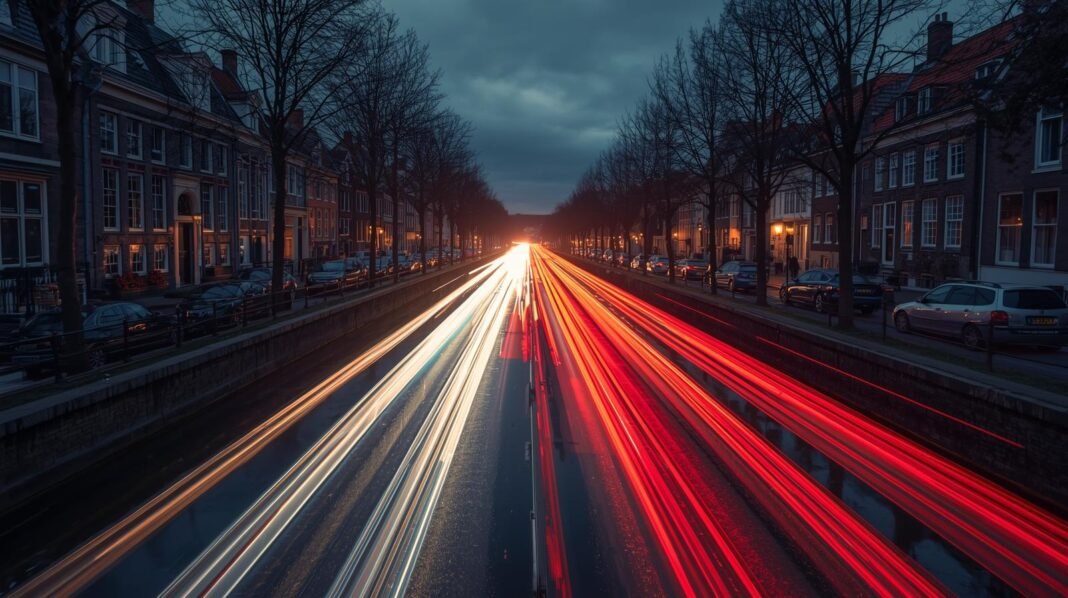
Traffic Paradox: Why The Hague Has the Worst Jams While Amsterdam Stays the Slowest
The Hague / Amsterdam – The results are in, and the crown for the Netherlands’ most congested city has shifted. According to the latest 2024-2025 TomTom Traffic Index, The Hague has officially overtaken the rest of the country in terms of delay intensity. However, if you are looking for the city where time stands still, Amsterdam remains the undisputed champion of slowness.
For motorists in the political capital, a simple 10-kilometre commute now takes 51% longer than it should, fueled by a perfect storm of international summits and chronic roadworks. As we enter early 2026, these figures are forcing a nationwide debate on whether the Dutch “Randstad” is reaching its physical limit for car travel.
Table of Contents
- The Hague: The 51% Delay Nightmare
- Amsterdam: Why 23 km/h is the New Normal
- The 2027 Warning: The IJ-Tunnel Closure
- Groningen: The Only Success Story
- The Netherlands in the European Context
- Infrastructure Vulnerability: The Arnhem Sinkhole
- Key Takeaways
- Dutch Learning Corner
- Community CTA
The Hague: The 51% Delay Nightmare
In 2024, The Hague became the epicentre of Dutch traffic misery. A 10-kilometre trip in the city took an average of 8 minutes longer than in free-flow conditions—a 51% increase.
The NATO Effect:
A significant portion of this spike was attributed to the massive security measures surrounding the NATO summit and high-profile diplomatic events. Combined with the ongoing renovation of the Utrechtsebaan (A12) and various inner-city roadworks, the city’s artery system essentially suffered a “cardiac arrest” during the summer months. For commuters, this translated to nearly 90 hours of life lost per year just sitting in traffic.
Amsterdam: Why 23 km/h is the New Normal
While The Hague has the “worst” jams, Amsterdam is technically “slower.” The city’s average speed during rush hour is a mere 23 kilometres per hour.
This is not an accident; it is policy. Amsterdam’s widespread implementation of the 30 km/h speed limit on most urban roads has successfully lowered the average speed. While this has improved road safety and reduced noise pollution, it means that a 10-kilometre trip during the spitsuur (rush hour) takes a predictable but painful 32 minutes. Unlike The Hague, Amsterdam’s traffic isn’t surging—it’s just consistently, reliably slow.
The 2027 Warning: The IJ-Tunnel Closure
Traffic analysts warn that Amsterdam’s “slow but stable” status is about to face a catastrophic test. In 2027, the IJ-tunnel—a vital lifeline connecting Amsterdam North to the city centre—is scheduled to close for 16 months of essential maintenance.
This closure is expected to reroute over 50,000 vehicles daily toward the Zeeburgertunnel and the Coentunnel, likely creating a permanent gridlock in the northern Randstad. Businesses are already being urged to adopt “Remote-First” or “Cycle-First” policies before the first barricades go up.
Groningen: The Only Success Story
In a report filled with red numbers, Groningen stood out as the only city where traffic conditions actually improved. This was not due to fewer cars, but better engineering.
The completion of the massive “Aanpak Ring Zuid” project and the redesign of the Julianaplein junction have proven that structural investment works. By moving traffic more efficiently around the city rather than through it, Groningen managed to shave precious minutes off the average commute, proving that there is light at the end of the tunnel for other Dutch cities.
The Netherlands in the European Context
On the European stage, the Netherlands holds the 8th spot for the most congested country. While we often complain about files (traffic jams) on the A1 and A12, we are still faring better than countries like Malta or Greece. However, compared to our neighbors in Germany, the Dutch density means that when one road closes (like the Arnhem sinkhole incident on the A12), the entire national network feels the ripple effect within minutes.
Infrastructure Vulnerability: The Arnhem Sinkhole
The report also highlighted the fragility of the Dutch network. The October 23rd sinkhole in Arnhem, which paralyzed the A12, serves as a warning. As our infrastructure ages and extreme weather events (heavy rain) increase, these “black swan” events are becoming more frequent. ProRail and Rijkswaterstaat are under immense pressure to move from “reactive repairs” to “predictive maintenance.”
Key Takeaways
- The Hague: Highest delay percentage (51%) due to summits and roadworks.
- Amsterdam: Slowest average speed (23 km/h) due to 30 km/h zones.
- Success: Groningen proves that ring-road investments successfully reduce congestion.
- Future Risk: The 2027 IJ-tunnel closure is the next major threat to Dutch mobility.
Dutch Learning Corner
| Word (Dutch) | Pronun. (Eng) | Meaning | Context (NL + EN) |
|---|---|---|---|
| 🚗 De File | De Fee-luh | Traffic Jam | Er staat een lange file op de A12. (There is a long traffic jam on the A12.) |
| ⏳ Het Spitsuur | Het Spits-oor | Rush Hour | Ik mijd de stad tijdens het spitsuur. (I avoid the city during rush hour.) |
| 🚧 De Omleiding | De Om-lei-ding | Diversion / Detour | Volg de gele borden voor de omleiding. (Follow the yellow signs for the diversion.) |
| 🚲 De Fietsstrook | De Feets-strok | Cycle Lane | De fietsstrook is veiliger voor fietsers. (The cycle lane is safer for cyclists.) |
Is the 30 km/h Limit Worth the Delay?
Amsterdam’s slower traffic is a direct result of safety-first policies. Do you prefer a city that moves at 23 km/h but is safer for cyclists and pedestrians, or do you miss the efficiency of faster urban transit? Share your “spitsuur” stories in the comments below.
Source / Data Analysis: TomTom Traffic Index 2024/2025 & Rijkswaterstaat.

