




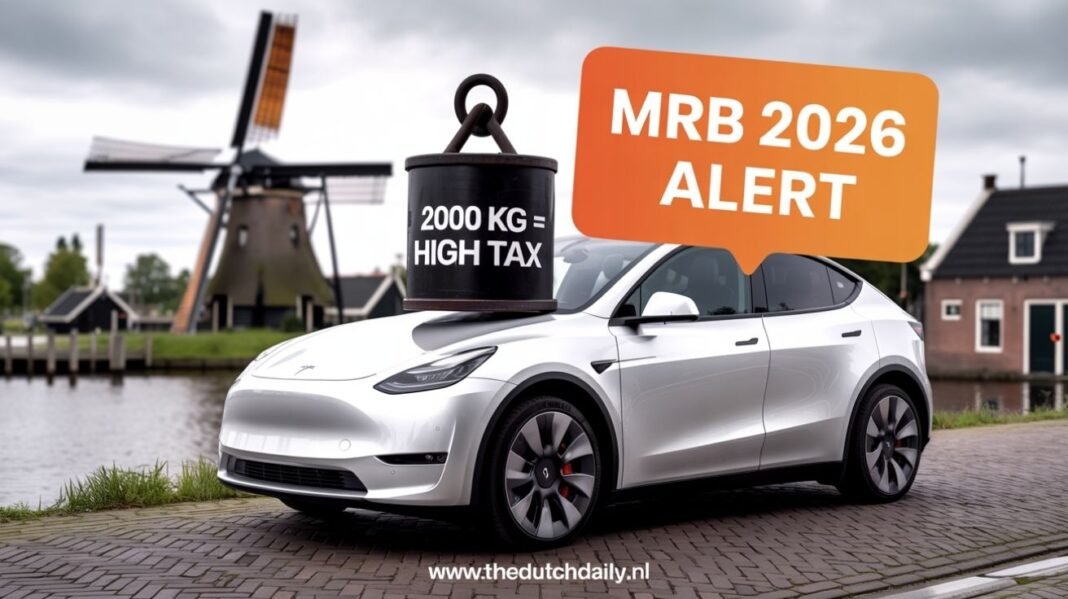
EV Road Tax in Netherlands 2026: The ‘Tesla Tax’ Shock Explained
Amsterdam – For years, driving an electric vehicle (EV) in the Netherlands felt like a financial cheat code. You saved the planet, you enjoyed free parking in some cities, and most importantly, the Dutch government rewarded you with a €0 road tax bill. Those days are officially over.
As of January 2026, the gradual phase-out of tax exemptions for electric cars has hit a critical tipping point. Due to the unique way the Road Tax in Netherlands (Motorrijtuigenbelasting – MRB) is calculated, EV owners are waking up to a harsh reality: your “green” car is extremely heavy, and the government is about to make you pay for every kilogram of it. This policy shift is causing panic in the second-hand market and forcing thousands of expats to rethink their vehicle choices.
In this comprehensive guide, The Dutch Daily analyzes the new rates, the “Weight Correction” mechanism, and why your neighbor with the old petrol Volkswagen might soon be paying less tax than you.
Table of Contents
- The Weight Trap: Why Heaviness Costs Money
- The ‘Weight Correction’: Is It Enough?
- Detailed Comparison: EV vs. Petrol vs. Hybrid
- The Biggest Loser: Plug-in Hybrids (PHEV)
- Location Matters: Provincial Surcharges
- Impact on Second-Hand Prices
- Key Takeaways
- Dutch Learning Corner
The Weight Trap: Why Heaviness Costs Money
To understand the panic, you must understand the Dutch tax logic. The Road Tax (MRB) in the Netherlands is not based on CO2 emissions or horsepower, but primarily on one factor: Vehicle Weight (Massa Ledig Voertuig).
The historical logic was simple: Heavier cars damage the asphalt more, so they should contribute more to road maintenance.
The EV Problem: Electric cars are essentially massive batteries on wheels. A lithium-ion battery pack alone can weigh between 400kg and 700kg. This makes an electric car significantly heavier than a comparable petrol car.
For example, a petrol Volkswagen Golf weighs about 1,250 kg. Its electric cousin, the VW ID.3, weighs over 1,700 kg. Under the standard tax rules, the “cleaner” ID.3 would fall into a much higher tax bracket, costing hundreds of euros more per year than the “polluting” Golf.
The ‘Weight Correction’: Is It Enough?
The government is aware that taxing EVs fully by weight would kill the electric transition instantly. To prevent a mass sell-off, they introduced a temporary mechanism called the “Weight Correction” (Gewichtscorrectie).
This mechanism allows the tax authority (Belastingdienst) to subtract a fixed amount (currently roughly 400kg) from the car’s official weight before calculating the tax. However, this is not a permanent fix. It is a sliding scale that is disappearing fast:
- 2025: EV owners paid 25% of the calculated tax (75% discount).
- 2026 (Now): The discount is reduced. You are now paying a significant portion of the base rate.
- 2029: The discount effectively vanishes.
- 2030: Full weight taxation applies (unless the new “Pay-per-kilometer” system is ready).
Critics, including the ANWB and BOVAG, argue that the phase-out is happening too quickly, punishing early adopters who bought these cars under the promise of long-term savings.
Detailed Comparison: EV vs. Petrol vs. Hybrid
Let’s look at the financial reality for a resident in the province of North Holland (tax rates vary by province).
(Note: Figures are estimates based on the 2026 transitional rates).
| Vehicle Type | Model Example | Weight | 2026 Annual Tax (Est.) |
|---|---|---|---|
| Petrol (Benzine) | VW Golf | ~ 1,250 kg | € 650 |
| Electric (EV) | Tesla Model Y | ~ 1,980 kg | € 1,150* |
| Plug-in Hybrid | Volvo XC60 | ~ 2,150 kg | € 1,350* |
*Assuming the reduction in weight correction continues as planned. Without any correction, the Tesla bill would exceed €1,400.
The Biggest Loser: Plug-in Hybrids (PHEV)
While Tesla owners are vocal about their complaints, the real victims of the 2026 tax update are the owners of Plug-in Hybrid Electric Vehicles (PHEV).
These cars carry the “worst of both worlds” regarding weight: they have a heavy internal combustion engine AND a heavy battery pack. A Volvo XC90 T8 or a Mitsubishi Outlander PHEV can easily weigh over 2,200 kg.
In previous years, they enjoyed a 50% tax cut. As that cut disappears, PHEV owners are facing the highest road tax bills in the country—sometimes exceeding €120 per month—for a car that might only drive 30km on electricity.
Location Matters: Provincial Surcharges
A detail often overlooked by expats is that the MRB consists of two parts: the national tax and the “Provincial Surcharges” (Provinciale Opcenten).
This means the cost of owning a Tesla depends on your address:
* North Holland (Amsterdam/Haarlem): Traditionally has the lowest surcharges.
* South Holland (Rotterdam/The Hague) & Gelderland: These provinces charge significantly higher percentages.
If you live in The Hague and drive a heavy EV, your bill will be noticeably higher than your colleague living in Amsterdam driving the exact same car.
Impact on Second-Hand Prices
The tax hike is sending shockwaves through the second-hand car market (Occasionmarkt).
Dealers are reporting a slowdown in sales for heavy used EVs, particularly the older Model S and Model X units, which are extremely heavy. Potential buyers are calculating the monthly MRB cost and realizing that the fuel savings might not cover the tax difference anymore.
Buyer Beware: If you are looking for a bargain used EV in 2026, be extremely careful. A “cheap” heavy electric SUV could turn into a monthly tax liability. Always check the license plate (kenteken) on the RDW website to see the exact “Massa Ledig Voertuig” and calculate the tax before buying.
Key Takeaways
- The Honeymoon is Over: The era of tax-free EV driving has ended. Budget for a substantial monthly bill.
- Weight is King: When buying a car in 2026, weight is the single most important factor for your fixed costs. Lighter EVs (like a Fiat 500e) are much safer investments than heavy SUVs.
- Hybrid Warning: Avoid heavy Plug-in Hybrids unless your employer pays the lease; the private tax burden is becoming unsustainable.
- Check Your Province: Moving from Amsterdam to Rotterdam? Your car tax will go up.
Dutch Learning Corner
| Word (Dutch) | Pronunciation | Meaning | Context |
|---|---|---|---|
| 🚗 De Wegenbelasting | We-ghen-be-las-ting | Road Tax | Hoeveel wegenbelasting betaal je in Nederland? (How much road tax do you pay in Netherlands?) |
| ⚖️ De Gewichtscorrectie | Ge-vikhts-cor-rec-sie | Weight Correction | De gewichtscorrectie is helaas tijdelijk. (The weight correction is unfortunately temporary.) |
| 🔌 De Stekkerauto | Stek-ker-ow-to | Plug-in Car (EV/PHEV) | Stekkerauto’s worden zwaarder belast. (Plug-in cars are being taxed more heavily.) |
Are You Selling Your EV?
Does the new road tax in the Netherlands make you regret buying an electric car? Or do the fuel savings still outweigh the tax hike? Have you considered switching back to a small petrol car? Join the debate in the comments.