




Inburgering Speaking Exam (Spreken) 2026: The Ultimate Survival Guide
For many expats living in the Netherlands, the Inburgering Speaking Exam (Spreken) is the single most nerve-wracking hurdle between them and a Dutch passport. The idea of sitting in a silent room, wearing a headset, and recording answers while a digital timer ticks down is enough to make anyone nervous.
But here is the truth that language schools often don’t tell you: You do not need to speak perfect Dutch to pass. You simply need to be understood.
Whether you are rushing to complete your integration under the 2013 law (A2 level) or facing the stricter 2021 law (B1 level), strategy is just as important as vocabulary. In this comprehensive guide, we break down the 2026 exam format, reveal the secret grading criteria, and provide you with a “Cheat Sheet” of phrases that will save you when your mind goes blank.
Table of Contents
- The Exam Format: What Exactly Happens?
- The Secret Grading Criteria: How to Score Points
- 5 Fatal Mistakes (And How to Avoid Them)
- Part 1 Strategy: Speaking & Recording
- Part 2 Strategy: Multiple Choice
- Real Exam Scenarios & Sample Answers
- The “Cheat Sheet” (Memorize This!)
- Frequently Asked Questions (FAQ)
- Dutch Learning Corner
The Exam Format: What Exactly Happens?
The Inburgering Speaking Exam takes approximately 35 minutes. It is conducted entirely on a computer at a DUO testing location (such as Amsterdam, Rijswijk, or Eindhoven). You will not speak to a human examiner during the test; everything is recorded and graded later by two independent human graders.
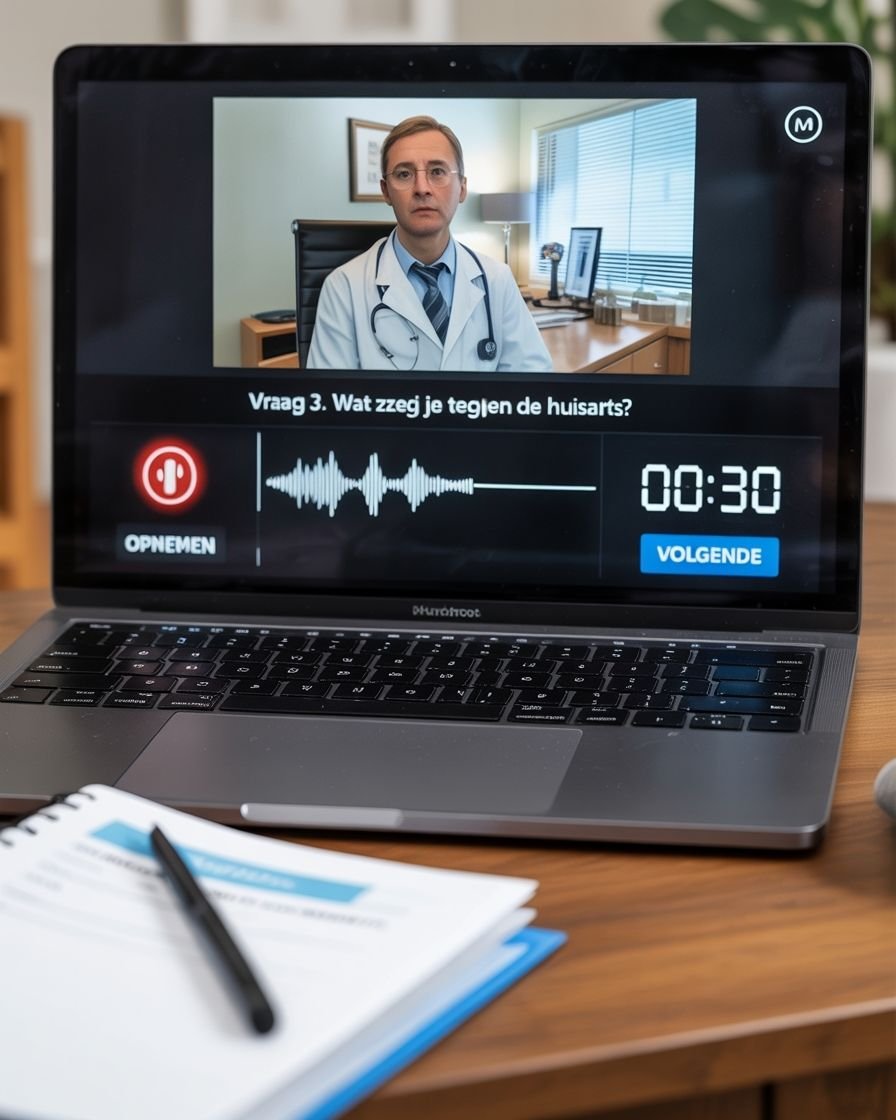
The exam consists of two distinct parts:
- Part 1 (Spreken): You hear a question and must record an answer. (~12 Questions)
- Part 2 (Luisteren en Reageren): You watch a video scenario and choose the best response from a multiple-choice list. (~12 Questions)
The Secret Grading Criteria: How to Score Points
Many candidates fail because they focus on the wrong things. They obsess over perfect grammar (De/Het mistakes) and forget to actually answer the question.
The examiners grade you based on Intelligibility (Verstaanbaarheid) and Relevance.
The Golden Rule: If you say, “Ik heb de huis gekocht” (Wrong article, should be het), you will likely PASS because the meaning is clear.
If you say, “Uhhh… house… buy… yes,” you will FAIL because the sentence structure is broken.
5 Fatal Mistakes (And How to Avoid Them)
Before we look at what to do, let’s look at what not to do.
1. The “English” Panic Button
Never, under any circumstances, use an English word if you forget the Dutch one. If you say “Ik ga naar de… market,” you get zero points for that question.
Fix: Describe the word. If you forget “market,” say “de plek waar ik eten koop” (the place where I buy food).
2. The Long Silence
The recording time is short. If you stay silent for 5 seconds thinking, the recording might stop or you’ll run out of time.
Fix: Use filler words like “Ehmmm, even denken…” (Umm, let me think) to buy time while keeping the flow.
3. Over-Complicating Answers
Don’t try to be a philosopher. If the question is “Do you like rain?”, the answer is “Nee, ik hou niet van regen.” Do not explain the hydrological cycle.
4. Speaking Too Softly
Testing centers can be noisy with other people talking. If you whisper, the recording will be bad. Speak loudly and clearly.
5. Ignoring the “Why” (Waarom)
If a question asks “Do you like your job AND WHY?”, and you only say “Yes, I like it,” you fail. You missed the second half.
Fix: Always use “omdat” or “want”.
Part 1 Strategy: Speaking & Recording
In this section, you see a picture or video. You hear a voice ask a question. You have a few seconds to think, then a “beep” sounds, and you record.
Strategy: Subject + Verb + Rest.
Keep this structure in your head.
Question: “Wat doe je in het weekend?”
Structure: Ik (Subject) + ga (Verb) + naar het park (Rest).
Part 2 Strategy: Multiple Choice
This part tests your social awareness. You watch a video, e.g., a boss talking to an employee. The video freezes. You must choose the correct response from A, B, or C.
Tip: Look for the polite answer. Dutch culture is direct but professional.
Scenario: Your boss says you are late.
Option A: “Nou en?” (So what?) – Too rude.
Option B: “Sorry, de trein was te laat.” (Sorry, the train was late.) – Correct.
Option C: “Ik ga naar huis.” (I am going home.) – Irrelevant.
Real Exam Scenarios & Sample Answers
Here are three common scenarios that appear frequently in the Inburgering Speaking Exam.
Scenario 1: The Doctor (De Huisarts)
Question: “Je bent ziek. Bel de huisarts en maak een afspraak.” (You are sick. Call the GP and make an appointment.)
Weak Answer: “Hallo doctor. Ik ben ziek. Afspraak?” (Too broken).
Strong Answer: “Goedemorgen. Ik voel me niet goed en ik heb koorts. Kan ik vandaag langskomen voor een afspraak?” (Good morning. I don’t feel well and I have a fever. Can I come by today for an appointment?)
Scenario 2: The School (De School)
Question: “Je kind is ziek. Bel de school.” (Your child is sick. Call the school.)
Strong Answer: “Hallo, met [Name]. Mijn zoon is vandaag ziek. Hij komt niet naar school.”
Scenario 3: The Job (Het Werk)
Question: “Waarom wil je deze baan?” (Why do you want this job?)
Strong Answer: “Ik wil deze baan want ik vind werken met mensen leuk.” (I want this job because I like working with people.)
The “Cheat Sheet” (Memorize This!)
Want to sound fluent instantly? Memorize these connector words. They allow you to build longer sentences without advanced grammar.
| Word | Meaning | Example Sentence |
|---|---|---|
| Omdat | Because | Ik ga niet naar buiten, omdat het regent. (Verb to the end!) |
| Want | Because | Ik ga niet naar buiten, want het regent. (Easier, no word order change!) |
| Maar | But | Ik wil werken, maar ik ben ziek. |
| Dus | So | Het is koud, dus ik draag een jas. |
Frequently Asked Questions (FAQ)
Can I replay the question?
Yes, but usually only once. Look for the “Herhalen” button on the screen.
What if I make a mistake while recording?
Don’t stop! Just say “Sorry, ik bedoel…” and correct yourself. The recording continues, and self-correction is seen as a positive skill.
Is the exam A2 or B1?
Currently, for most people under the 2013 law, it is A2. However, under the 2021 law, the goal is B1. Check your “Mijn Inburgering” portal to be sure.
Dutch Learning Corner
| Word (Dutch) | Pronunciation | Meaning | Context |
|---|---|---|---|
| 🎧 De Koptelefoon | De Kop-te-le-foon | Headphones | Zet je koptelefoon op. (Put your headphones on.) |
| 🎙️ Opnemen | Op-nay-men | To record | De computer neemt je antwoord op. (The computer records your answer.) |
| 🗣️ Duidelijk | Doy-de-lik | Clear / Clearly | Spreek rustig en duidelijk. (Speak calmly and clearly.) |
TDD Community Question
Are you practicing for the A2 or B1 exam? What is the hardest Dutch sound for you to pronounce (is it the ‘G’ or the ‘UI’)? Share your struggles in the comments!