



The Dutch AI Boom 2026: Jobs, Salaries & The Rise of “Silicon Polder”
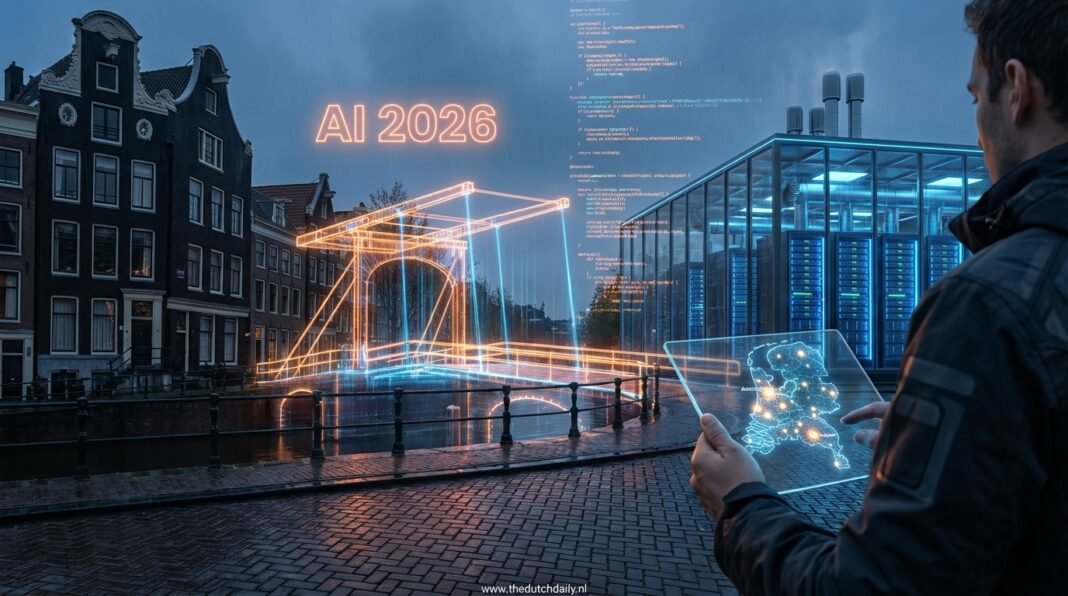
Eindhoven/Amsterdam – For decades, ambitious expats moved to London for finance or Berlin for startups. But in 2026, the technological axis of Europe has shifted. With the explosive growth of ASML in Veldhoven (now widely considered the most important tech company in the world) and the AI-driven transformation of Amsterdam’s fintech sector, the Netherlands is aggressively rebranding itself as the “Silicon Polder.”
But this tech utopia comes with serious questions. While salaries for AI specialists are hitting all-time highs, the housing market in tech hubs is overheating to the point of crisis. Furthermore, the Dutch government’s aggressive use of AI in taxation (memories of the Toeslagenaffaire still linger) raises ethical concerns for privacy-conscious residents. Is the high salary worth the high cost of living?
Are you a developer, data scientist, or tech enthusiast looking to make a move? In this massive, definitive guide, we decode the Dutch tech landscape of 2026. We break down the real salaries, the “Kennismigrant” visa hacks, the freelance (ZZP) goldmine, the brutal reality of the interview process, and the ethical minefields you need to navigate.
Table of Contents
- The Two Hubs: Amsterdam vs. Brainport Eindhoven
- The 2026 Salary Guide: What is Your Code Worth?
- Reality Check: Net Salary vs. Cost of Living
- The Dutch Tech Interview: Survival Guide
- The “Kennismigrant” Scheme: The Golden Ticket
- The 30% Ruling in 2026: Still a Dealbreaker?
- Remote Work & “Workation” Rules: The Tax Trap
- ZZP & Contracting: The €125/Hour Reality
- Reskilling: Bootcamps vs. Universities
- Women in Tech: Grants & Communities
- Government AI: The “SyRI” Legacy and GDPR
- Dutch Tech Culture: “Flat Hierarchy” Myth or Reality?
- Dutch Tech Vocabulary Corner
The Two Hubs: Amsterdam vs. Brainport Eindhoven
In 2026, the Dutch tech scene is bipolar—in a good way. It is split between two massive gravitational centers, each offering a completely different lifestyle and career path. Choosing the right city is as important as choosing the right stack.
1. Amsterdam: The Software & Fintech Capital
Amsterdam remains the playground for “Soft Tech” and SaaS. This is the home of Adyen (payments), Booking.com (travel), Mollie, and a thriving startup ecosystem centered around the TNW City hub.
The Vibe: International, fast-paced, marketing-heavy. English is the default language; you can work here for 10 years without speaking a word of Dutch.
The Downside: Rent. An apartment within the Ring A10 now averages €2,300+, forcing many tech workers to commute from Almere, Haarlem, or even Utrecht.
2. Brainport Eindhoven: The Hardware & Deep Tech King
Drive 90 minutes south, and you enter a different world. Eindhoven is the home of ASML (the chip machinery giant) and Philips.
The Vibe: Engineering-focused, serious, academic. This is “Deep Tech”—chips, photonics, and medical robotics. The culture is less about “growth hacking” and more about precision physics and PhDs.
The Upside: Housing is roughly 20% cheaper than Amsterdam (though the gap is closing fast in 2026 due to the ASML expansion), and the ecosystem is tightly connected to the Technical University of Eindhoven (TU/e).
The 2026 Salary Guide: What is Your Code Worth?
Inflation has been high, but tech salaries have largely kept pace due to the severe “Talent Shortage” (Krapte op de arbeidsmarkt). Below are the average gross annual salaries (including holiday allowance) for 2026 based on data from Payscale and Glassdoor NL.
| Role (Senior Level) | Amsterdam Range | Eindhoven Range | Key Skill 2026 |
|---|---|---|---|
| Machine Learning Engineer | €95k – €135k | €90k – €125k | LLM Fine-tuning & RAG |
| Data Scientist | €85k – €115k | €80k – €105k | Predictive Analytics |
| Full Stack Dev (Java/Python) | €75k – €100k | €70k – €95k | Cloud Architecture (AWS/Azure) |
| Embedded Systems Eng. | €70k – €90k | €85k – €120k | C++, FPGA, Rust |
Reality Check: Net Salary vs. Cost of Living
A €100k salary sounds huge, but what lands in your bank account?
The Calculation (With 30% Ruling): On €100k gross, you take home approx. €6,200 net/month.
The Calculation (Without 30% Ruling): On €100k gross, you take home approx. €4,800 net/month.
The Costs:
- Rent (2-bed, good area): €2,300
- Health Insurance (Family of 2): €350
- Groceries: €600
- Utilities & Internet: €250
Verdict: Without the 30% ruling, a single income of €100k in Amsterdam provides a comfortable but not “wealthy” lifestyle for a family. In Eindhoven, that same money buys you a house with a garden.
The Dutch Tech Interview: Survival Guide
The interview process in the Netherlands differs significantly from the US or UK. It is less about “selling yourself” and more about “proving competence without arrogance.”
- The “Culture Fit” Screen: This is usually the first call. They check if you are “gezellig” (agreeable) and direct. Arrogance is the #1 killer of applications here. Do not brag; state facts.
- The Technical Assessment: Dutch companies prefer “Take-Home Assignments” over live whiteboard coding. They want to see clean, documented, production-ready code, not just a quick algorithm solution. Tip: Write unit tests. If you submit a take-home test without tests, you will likely be rejected.
- The “Direct” Feedback: During the code review interview, they will criticize your code bluntly. Do not get defensive. They are testing how you handle feedback. Say: “That’s a good point, I optimized for X, but I see how Y is better.”
The “Kennismigrant” Scheme: The Golden Ticket
For non-EU citizens, the Netherlands offers one of the most streamlined visa processes in the world: the Highly Skilled Migrant (Kennismigrant) visa.
The Rules in 2026: You do not need a lottery. You just need a job offer from a “Recognized Sponsor” (Erkende Referent) meeting specific salary criteria.
- Under 30 years old: Minimum salary approx. €3,900 gross/month.
- Over 30 years old: Minimum salary approx. €5,300 gross/month.
Pro Tip: If you graduate from a top 200 world university (check the rankings!), you can apply for the “Zoekjaar” (Orientation Year) visa. This gives you 12 months to find a job in NL, with a significantly lower salary threshold requirement (€2,800). This is the #1 backdoor for fresh graduates from the US, India, or Turkey.
The 30% Ruling in 2026: Still a Dealbreaker?
The 30% Ruling (the tax break that allows you to earn 30% of your salary tax-free) has survived the political storms of 2024-2025, but it has been “sobered up.”
The New Reality:
1. Cap Limit: The tax break is now capped at the “Balkenende-norm” (public sector pay cap), roughly €233,000.
2. The 20-Month Step Down: For new applicants in 2026, the benefit is often structured as 30% for the first 20 months, 20% for the next 20, and 10% for the final 20.
TDD Verdict: Even with the cuts, it remains a massive financial boost. It effectively turns a €70k salary into the net equivalent of a €90k salary.
Remote Work & “Workation” Rules: The Tax Trap
In 2026, “Hybrid” is the law of the land. Most companies mandate 2 or 3 days in the office. But what about working from Spain for a month?
The “40-Day Rule”: Many Dutch companies now have a strict policy allowing roughly 40 to 60 days of “Work from Anywhere” per year.
The Tax Trap: If you stay in another country (like Portugal) for more than 183 days, you become a tax resident there, creating a nightmare for your employer’s HR department.
The “Frontier Worker” Issue: If you live in Belgium or Germany and work in NL, the tax rules are complex. 2026 has seen new bilateral agreements, but generally, you pay tax where you physically work. If you work 3 days at home in Antwerp, Belgium claims the tax rights on those days.
ZZP & Contracting: The €125/Hour Reality
Why work for a boss when you can be a ZZP’er (Self-employed)? In the Dutch AI sector, contracting is booming.
The Rates: A senior AI engineer in 2026 charges between €110 and €160 per hour.
The “Schijnzelfstandigheid” Trap: The Tax Authority (Belastingdienst) is actively cracking down on “fake freelancers” (people who act like employees but bill like companies).
The 2026 Solution: To be safe, ensure you have multiple clients, use your own hardware, and have a clear project-based contract (Modelovereenkomst). If you navigate this correctly, your net income can be double that of a salaried employee.
Reskilling: Bootcamps vs. Universities
What if you want to switch careers into AI?
1. The Academic Route: A Masters in AI from UvA (University of Amsterdam) or TU Delft is the gold standard. It takes 2 years and is heavy on math.
2. The Bootcamp Route: Providers like Codam (tuition-free!) or Ironhack offer 3-6 month intensive courses. In 2026, Dutch employers are increasingly open to hiring bootcamp grads, provided they have a strong GitHub portfolio. A certificate alone is no longer enough; you need to show you have built deployed agents or apps.
Women in Tech: Grants & Communities
The Dutch tech scene is historically male-dominated, but 2026 is seeing a push for change.
The Gender Pay Gap: Unfortunately, it still exists, hovering around 13% in the tech sector.
Initiatives:
- RightBrains: A platform dedicated to getting more women into digital leadership.
- TechMeUp: A fund that provides interest-free loans for education to underrepresented groups in tech.
- Codeam: Offers specific cohorts aimed at increasing gender diversity.
Companies like Booking.com and Adyen now have strict quotas for interviewing female candidates for senior roles. If you are a woman in tech, demand the top end of the salary bracket—you are in high demand.
Government AI: The “SyRI” Legacy and GDPR
You cannot talk about tech in NL without talking about privacy. The Dutch are famously protective of their data.
The Trauma: The “SyRI” scandal (where an algorithm wrongly accused thousands of dual-national families of fraud) has made the public very skeptical of government AI.
The EU AI Act 2026: The Netherlands is a strict enforcer of the new EU AI Act. This means companies here are hiring massive “AI Ethics” and “Compliance” teams. If you have a background in Law + Tech, you are a unicorn in this market right now.
Expat Warning: Be aware that the government does link databases. Your municipality (Gemeente) data talks to the tax office. If you forget to deregister when you move, the algorithms will find you.
Dutch Tech Culture: “Flat Hierarchy” Myth or Reality?
Working in a Dutch tech team is a unique social experiment.
The “Poldermodel”: Decisions take long because everyone must agree. You might spend 3 weeks in meetings just to decide on a database architecture. This is feature, not a bug.
Directness: Your junior developer will tell you, the CTO, that your code “sucks” in front of everyone. This is not disrespect; this is efficiency. Expats from high-context cultures (Asia, LatAm, Southern Europe) often struggle with this initially.
Work-Life Balance: It is sacred. At 17:00, the office empties. Answering Slack messages on weekends is actively discouraged in many Dutch tech firms. Burnout prevention is taken very seriously.
Dutch Tech Vocabulary Corner
| Word (Dutch) | Pronunciation | Meaning & Context |
|---|---|---|
| 💼 Kennismigrant | Ken-nis-mi-grant | Highly Skilled Migrant. The specific visa status for tech workers. |
| 💰 Vakantiegeld | Va-kan-tie-geld | Holiday Allowance. An extra 8% of your annual salary paid in May. Always check if this is included in your offer! |
| 🤝 Relatiebeding | Re-la-tie-be-ding | Non-Solicitation Clause. Critical to check before you quit to become a freelancer. |
| 📄 Vast Contract | Vast Con-tract | Permanent Contract. The holy grail of employment, making it very hard to fire you. |
TDD Community Question
Are you working in Dutch tech? Have you navigated the “30% ruling” cuts or successfully negotiated a “Work from Anywhere” clause? Share your salary negotiation tips and experiences below!