




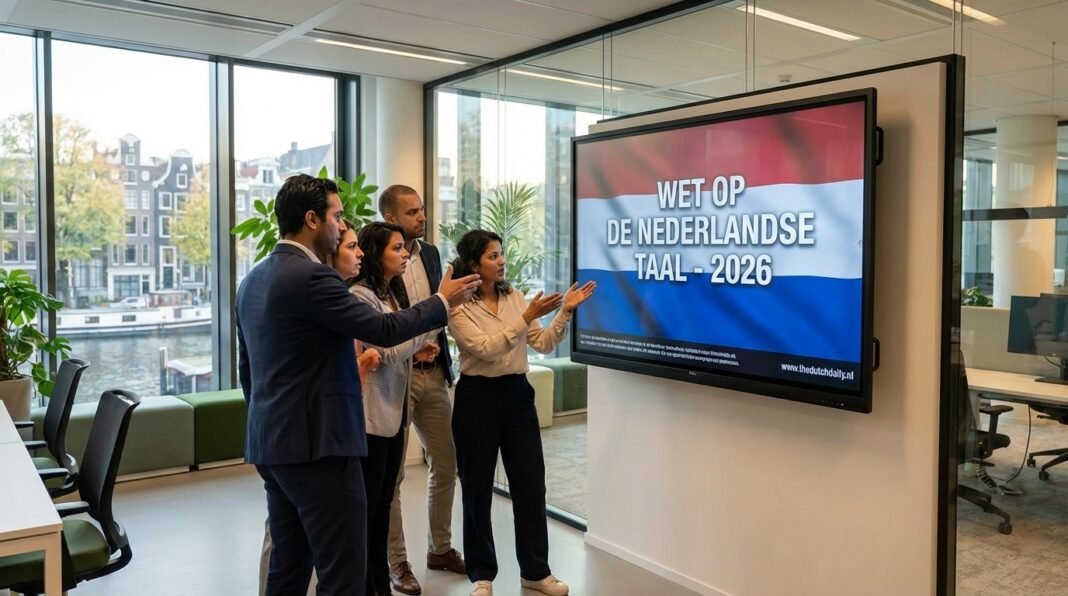
The End of the English-Only Bubble? The 2026 Dutch Language Law Explained
The Hague – For the last two decades, the Netherlands has positioned itself as the premier destination for global talent. The “deal” was simple: Bring your high-level skills in engineering, finance, or AI, and in exchange, the country will welcome you into an English-speaking business environment. In cities like Amsterdam and Eindhoven, English became more than a tool; it became the de facto official language of the corporate world. Expats could effectively navigate their entire professional lives without ever mastering a sentence beyond “Een biertje, alstublieft.”
However, as of February 2026, that social contract is being fundamentally rewritten. The Dutch Parliament (Tweede Kamer) has just passed the “Wet op de Nederlandse Taal in het Bedrijfsleven” (Act on the Dutch Language in Business). This isn’t just a political statement; it is a legally binding shift that could alter the career paths of hundreds of thousands of international professionals living in the Randstad and the Brainport regions.
Is your job at risk? Will you be forced to pass a State Exam (Inburgeringsexamen) to keep your office chair? Will your 30% ruling be affected by your language skills? In this definitive 1600-word guide, we deconstruct every clause of the 2026 law, examine the legal loopholes for multinationals, and explain how you can use this crisis to secure your future in the Netherlands.
Table of Contents
- The Core Principles: Why the Shift in 2026?
- Pillar 1: Safety and the “Language of the Floor”
- Pillar 2: Corporate Transparency & HR Documentation
- The “Right to Learn”: Mandatory Training Vouchers
- The Multilingual Loophole: Who is Exempt?
- Impact on the Tech Hub: Amsterdam and Eindhoven
- Can You Be Fired for Not Speaking Dutch?
- The ZZP Dilemma: Does the Law Apply to Freelancers?
- The 30% Ruling Connection: A New Requirement?
- Hiring Trends: The Rise of “Dutch-Intermediate”
- Strategic Advice for Expats: How to Respond
- Dutch Learning Corner: Essential Business Vocabulary
The Core Principles: Why the Shift in 2026?
To understand why this law was passed in 2026, we have to look at the political landscape of the last three years. Following a series of elections where national identity and “over-internationalization” were key themes, the government came under pressure to protect the Dutch language. The argument is that the dominance of English in major cities has led to a “dual society” (parallelle samenleving) where locals feel excluded from their own economic and social centers.

The new law establishes that Dutch is the primary language of the Netherlands, and this must be reflected in all organizations operating on Dutch soil. It’s not a ban on English, but a restoration of Dutch as the “default setting” (standaardinstelling). This means that while you can still speak English, the burden of proof has shifted: companies must now justify why they are using English instead of Dutch.
Pillar 1: Safety and the “Language of the Floor”
The most immediate and strictly enforced part of the 2026 law concerns Workplace Safety (Veiligheid op de Werkvloer). Data from the Labor Inspectorate (Arbeidsinspectie) showed that between 2022 and 2025, accidents in warehouses, construction sites, and factories where English, Polish, or Turkish were the main languages were significantly more frequent than in Dutch-speaking environments.
The 2026 Enforcement: For any role involving physical labor, heavy machinery, or hazardous materials, all instructions MUST be provided in Dutch as the primary language. Employers must also prove that employees understand these instructions. This is a massive financial risk: if a company fails to provide a Dutch safety manual and an accident occurs, their liability insurance will be automatically voided under the new regulations. This is causing a scramble in the logistics hubs of Venlo and the Port of Rotterdam to hire Dutch-speaking floor managers.
Pillar 2: Corporate Transparency & HR Documentation
For office workers—the “White Collar” expats—the changes are more administrative but just as significant. Previously, many start-ups and international firms operated entirely in English—from their internal Slack channels to their employment contracts. The 2026 law targets this “internal internationalization.”
The New Documentation Standard:
- Employment Contracts: Every employee now has the legal right to a Dutch version of their contract. If there is a dispute, the Dutch text takes precedence in a labor court.
- HR Handbooks: Policies regarding maternity leave, sick pay, burnout prevention, and dismissal must be available in Dutch for companies with more than 50 employees.
- Works Councils (Ondernemingsraad): Official company-wide announcements must be summarized in Dutch. This ensures that the 10-20% of Dutch staff in an “expat-heavy” company are not excluded from decision-making.
The “Right to Learn”: Mandatory Training Vouchers
There is a silver lining for expats. The law places the financial burden of integration on the Employer. As part of the 2026 labor reforms, every international employee on a long-term contract has the right to a Taalontwikkelingsbudget (Language Development Budget).
Employers are required to provide “Language Vouchers” or reimburse certified Dutch courses (NT2) up to a B1 level. This is no longer a “nice-to-have” benefit; it is a statutory right. If your employer refuses to fund your Dutch lessons while simultaneously demanding you speak the language, they are in violation of the new Labor Act. This is a critical point for negotiation during your next performance review.
The Multilingual Loophole: Who is Exempt?
The Dutch economy is built on global trade. If every company was forced to speak Dutch tomorrow, the Port of Rotterdam and the Zuidas would grind to a halt. Therefore, the 2026 law includes Section 4.2: The International Exemption.
Who qualifies?
- High-Tech Exception: Companies engaged in global R&D with international patents (like ASML or NXP) can apply for an “English-primary status” for their engineering departments.
- Global Headquarters: If more than 70% of a company’s staff is recruited globally and their primary market is outside the Benelux, they can maintain English as the Voertaal (working language).
- Aviation & Maritime: These sectors remain English-dominant due to international treaties.
However, even these companies must now offer Dutch courses to their international staff to “prevent social isolation” outside the office. The “bubble” is being burst from the outside in.
Impact on the Tech Hub: Amsterdam and Eindhoven
In Amsterdam’s Zuidas (financial district), the shift is cultural. Banks are now encouraging their Dutch employees to speak Dutch in the elevators and canteens—something that was considered “impolite” just five years ago when expats were present. In Eindhoven (Brainport), the focus is on “Dual Language.” The goal is for everyone to reach a “passive understanding” of Dutch. This means your boss might speak Dutch in a meeting, but you are allowed to respond in English. This hybrid model (Luistertaal) is the compromise of 2026 that allows the tech sector to keep its talent while following the letter of the law.
Can You Be Fired for Not Speaking Dutch?
The short answer is: No, not directly and not immediately. Dutch labor law still protects you from arbitrary dismissal. An employer cannot simply fire you for not knowing Dutch if the language requirement was not in your original contract and wasn’t essential for the job when you were hired.
However, the new law allows employers to include “Language Progression Clauses” in new contracts. If you sign a new contract in 2026 that says you must reach B1 level within two years, and you fail to do so, the employer may have grounds for “non-performance” (disfunctioneren). Furthermore, during restructuring (reorganisatie), “Language Versatility” is now a valid criterion for deciding which employees to keep.
The ZZP Dilemma: Does the Law Apply to Freelancers?
For the thousands of ZZP (freelance) expats, the law is a gray area. Since you are your own “employer,” you are not required to give yourself a language voucher. However, your clients are now more likely to demand Dutch skills. Why? Because the “Embedding” (Inbedding) criteria for ZZP workers (discussed in our previous ZZP guide) now includes cultural and language integration. If you don’t speak a word of Dutch, it’s easier for the Tax Authority to argue you are an outside contractor—but it might also make you the first person to be cut during budget reviews.
The 30% Ruling Connection: A New Requirement?
There are whispers in the Hague about linking the 30% Ruling to language proficiency in 2027. While not yet law, the 2026 Language Act provides the framework for this. The proposal suggests that to extend the 30% ruling beyond the initial 20 months, an expat must show a “Basic Command” (A2 level) of Dutch. This would transform the 30% ruling from a pure tax break into an integration incentive. If you are currently on the 30% ruling, learning Dutch is no longer just about social life; it’s about protecting your net income.
Hiring Trends: The Rise of “Dutch-Intermediate”
Recruitment agencies in the Randstad are reporting a massive shift. In 2023, 40% of IT roles were “English-only.” In early 2026, that has dropped to 15%. Most ads now list “Dutch language skills (B1/B2) or willingness to learn” as a top-tier requirement. Companies are “future-proofing” their workforce. If two candidates have the same Python skills, but one speaks A2 Dutch, the A2 candidate wins 100% of the time in the current market.
Strategic Advice for Expats: How to Respond
If you are an expat in the Netherlands in 2026, your strategy should be Proactive Adaptation. Don’t wait for a warning letter from HR.
- Claim Your Voucher: Every company has a budget for this now. Ask for it tomorrow.
- Use the “Luistertaal” Method: Tell your Dutch colleagues: “Please speak Dutch to me, I will respond in English.” This builds the passive vocabulary you need to survive meetings.
- Diversify Your Social Circle: The law is designed to break the “Expat Bubble.” Join a local sportclub or “Vereniging.” It’s the fastest way to learn the Werkvloer slang that isn’t taught in books.
Dutch Learning Corner: Business Vocabulary
| Dutch Word | Pronunciation | Professional Context |
|---|---|---|
| 💼 De Voertaal | Voor-taal | The working language. “Engels is de voertaal in dit team.” |
| 📜 Naleving | Na-le-ving | Compliance. Companies are audited on their naleving of the language law. |
| 🏗️ De Werkvloer | Werk-vloer | The workplace floor. Where the actual work happens. |
| 🗣️ Taaleis | Taal-eis | Language requirement. A new term frequently appearing in job ads. |
TDD Community Question
Is your company already making the switch? Are you worried about your “English-only” job, or do you see this as a chance to finally learn the language for free? Let’s discuss in the comments below!