




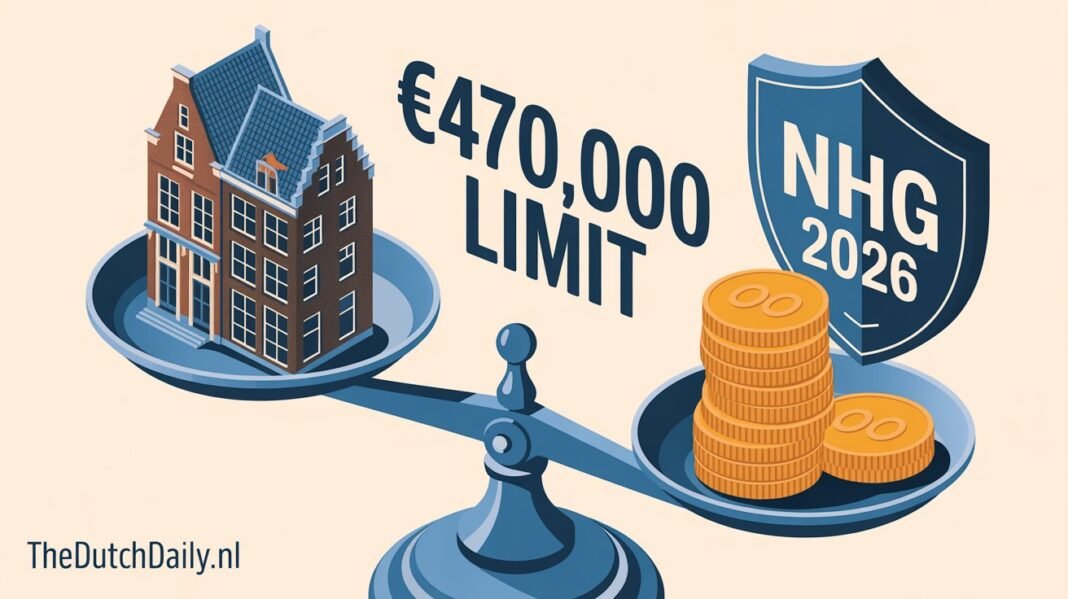
NHG Limit 2026: For expats navigating the notorious Dutch housing market, the start of 2026 brings a significant financial update that could be the difference between renting forever and finally owning a home. The National Mortgage Guarantee (Nationale Hypotheek Garantie – NHG) has officially raised its limit to €470,000.
The “Magic Numbers” for 2026
Effective immediately, the safety net has been widened. If you are signing a purchase agreement in 2026, the new limits are strictly defined. This limit determines whether you qualify for the state-backed guarantee that protects you if you default on your mortgage due to unemployment, divorce, or disability.
- Standard NHG Limit: €470,000 (Up from €450,000 in 2025).
- With Energy Saving Measures (EBV): €498,200.
The “Bouwdepot” Secret: How to Get the Extra €28,000
The jump to nearly €500,000 for energy-efficient homes is the real headline here. The Dutch government allows you to borrow up to 106% of the property value (instead of the standard 100%) if that extra 6% is strictly spent on sustainability measures.
Many expats assume this money is deposited into their bank account as cash. It is not. It goes into a “Bouwdepot” (Construction Deposit).
How the Bouwdepot works in practice:
- Approval: You tell the bank you want to spend €28,000 on solar panels and insulation. They approve this as part of the mortgage.
- The Account: The bank holds this money in a separate, blocked account. Interestingly, this money often earns interest for you while it sits there!
- The Invoices: You hire a contractor. They install the heat pump. You send the invoice to the bank via an app.
- Payment: The bank pays the contractor directly (or reimburses you if you paid upfront).
Strategy: Use this for expensive structural items (HR++ glass, Heat Pumps) rather than small DIY tasks, as the paperwork is strict.
Interest Rate Math: Why NHG is Cheaper
Many expats misunderstand NHG as just “unemployment insurance.” While it does protect you if you lose your job, its immediate value is the interest rate discount.
Banks love NHG mortgages because the government (via the Homeownership Guarantee Fund) covers the risk. If you default and the house is sold at a loss, the fund covers the difference. Because the risk is zero for the bank, they offer significantly lower interest rates.
| Metric | Without NHG (Market Rate) | With NHG (2026 Rate) |
|---|---|---|
| Interest Rate (10 Year Fixed) | Approx. 3.9% – 4.1% | Approx. 3.4% – 3.5% |
| Monthly Payment (Gross) | €2,122 | €1,995 |
| Monthly Saving | – | ~ €127 / month |
| 30-Year Saving | – | ~ €45,000+ |
*Calculation based on a €450,000 annuity mortgage. Note that “Net” payments will be lower due to tax deduction (Hypotheekrenteaftrek).
The 0% Transfer Tax Trap (Startersvrijstelling)
This is where it gets confusing. There are two “Limits” you need to watch: the NHG limit (€470k) and the Transfer Tax Exemption Limit.
If you are under 35 years old and buying your first home, you pay 0% Transfer Tax (instead of 2%). This saves you roughly €9,000.
However, this exemption has its own cap. For 2026, this cap sits at €525,000.
The Interaction:
- House Price €460,000: You get NHG rate AND 0% tax. (The Jackpot).
- House Price €500,000: You do NOT get NHG (unless you use the energy budget trick), but you DO get 0% tax.
- House Price €530,000: You get NO NHG and pay full 2% tax (€10,600).
Advice: Be extremely careful bidding around the €525k mark. Bidding €1,000 over the limit could cost you €10,000 in taxes!
The Cost: Is the “Borgtochtprovisie” Worth It?
Accessing the NHG club isn’t free. You must pay a one-time fee called the Borgtochtprovisie.
In 2026, this fee remains at 0.6% of the total mortgage amount.
The ROI Calculation:
On a maxed-out €470,000 mortgage, you pay €2,820 upfront to the notary.
Is it worth it?
Since this fee is tax-deductible (Box 1) and you save roughly €120-€150 per month on interest payments, the “Break-Even Point” is usually between 18 to 24 months. After two years, every month is pure profit compared to a non-NHG mortgage.
Bidding Strategy: Does NHG Make Me Look Weak?
In the heated markets of Amsterdam or Utrecht, sellers prefer “certainty.”
An NHG mortgage always requires a strict valuation report (taxatie) and strict income checks. Some sellers fear the deal might collapse if the bank rejects the loan.
How to win with NHG:
- The “Funding Clause” (Voorbehoud van Financiering): Never waive this if you need a mortgage. But, make it specific. Instead of saying “Subject to finance,” say “Subject to NHG finance of €470,000.”
- The Advisor’s Note: Have your mortgage advisor (Hypotheekadviseur) attach a letter to your bid saying: “We have pre-screened the client’s income and they are fully eligible for this amount.” This removes the seller’s fear.
The Investor Tax Cut: A Double-Edged Sword
The new coalition has also tweaked the Transfer Tax (Overdrachtsbelasting) for investors (buy-to-let) from 10.4% to 8%.
What this means for you: While 8% is still high, it signals that investors might return to the market. For expats looking to buy their first home in the €350k – €450k range (the typical starter apartment), this means you might face slightly more competition from small-scale investors bidding on compact apartments, a segment that had quieted down significantly in 2025.
Conclusion: The “Sweet Spot” Strategy
The Dutch housing market in 2026 remains competitive, but the expanded NHG limit creates a clear “Sweet Spot” between €400,000 and €498,000.
Properties in this price range now offer the best financial value due to the interest rate subsidies and renovation budgets. If you are house hunting this year, aiming for this bracket—and utilizing the energy-saving budget—is the smartest financial move you can make.
🇳🇱 Mortgage Vocabulary
Essential terms for talking to your hypotheekadviseur.
| Dutch Term | Pronunciation | Meaning |
|---|---|---|
| Nationale Hypotheek Garantie (NHG) | Na-sio-na-le Hi-po-teek Ga-ran-sie | National Mortgage Guarantee. |
| Bouwdepot | Bouw-de-po | Construction Deposit (Blocked account for renovation). |
| Startersvrijstelling | Star-ters-vray-stel-ling | Starter Exemption (0% Tax for under 35s). |
| Voorbehoud van financiering | Voor-be-houd van fi-nan-sie-ring | Subject to finance (The clause that protects your deposit). |
📊 Official Verification
| Source | Relevance |
|---|---|
| NHG.nl | Official publication of “Voorwaarden en Normen 2026”. |
| Rijksoverheid | Tax rules for Startersvrijstelling 2026 (€525k cap). |
| Nibud | Calculations on mortgage borrowing capacity for 2026. |