





Social Trust in Netherlands 2026: Are the Dutch Rude or Just Direct? (Deep Dive)
The Hague – Ask any expat who has just moved to Amsterdam or Rotterdam about their first impression, and you will likely hear the word “rude.” Ask someone living in a village in Drenthe or Limburg, and they will tell you the Dutch are the most open and trusting people on earth.
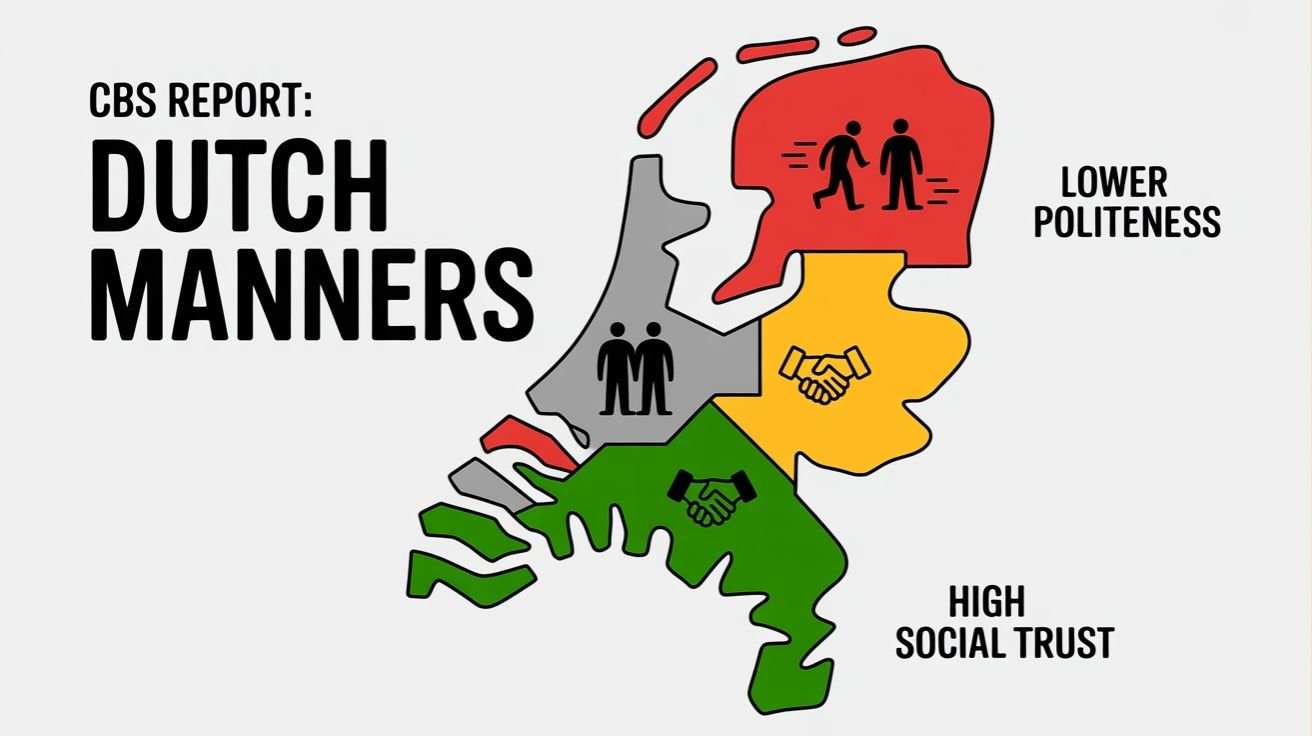
A new, comprehensive report by Statistics Netherlands (CBS) for 2026 confirms this massive divide. While the Netherlands retains one of the highest levels of “Social Trust” in the world—meaning people generally trust their neighbors, institutions, and even strangers—the perception of “politeness” (omgangsvormen) is plummeting in urban areas. Is the famous Dutch tolerance disappearing, or is this simply a clash of cultural expectations?

In this extensive analysis, The Dutch Daily breaks down the numbers, the psychology of “Dutch Directness,” and why your waiter in Amsterdam might seem to hate you (spoiler: he doesn’t).
Table of Contents
- The Paradox: High Trust, Low Manners?
- The Randstad Bubble: Density Breeds Aggression
- The Friendly East & South: Where ‘Naoberschap’ Lives
- The ‘Directness’ Defense: Honesty as Respect
- The Service Sector Shock: “I Am Not Your Servant”
- Digital Trust: The Tikkie Phenomenon
- Key Takeaways
- Dutch Learning Corner
The Paradox: High Trust, Low Manners?
To understand the Netherlands, you must distinguish between “Trust” and “Politeness.” They are not the same thing.
According to the 2026 CBS figures, approximately 65% to 70% of the Dutch population indicates they have trust in their fellow human beings. This is exceptionally high compared to the global average (often below 40%) and even higher than neighbors like France or the UK.
The Wallet Test:
If you drop your wallet in a Dutch street, there is a statistically high probability it will be returned to you intact. This is “Social Trust.” However, the person returning it might not say “Have a nice day” or smile. They might simply say, “Je hebt dit laten vallen” (You dropped this) and walk away. This lack of “wrapping paper” is often mistaken for rudeness.
The Randstad Bubble: Density Breeds Aggression
The CBS report highlights a sharp decline in the perception of manners specifically in the Randstad (Amsterdam, Rotterdam, The Hague, Utrecht).
Residents here report a spike in “anti-social behavior” (hufterigheid), particularly in traffic and public transport.
The Urban Factors:
1. Hyper-Density: The Netherlands is one of the most densely populated countries in the world. In the Randstad, personal space is non-existent.
2. Anonymity: In Amsterdam, you are anonymous. The social control that exists in a village (“Don’t be rude, your grandma knows my grandma”) is gone.
3. The Hurry Syndrome: The “time is money” Calvinist mindset is on steroids in the cities. Stopping to hold a door or say hello is seen as inefficiency.
The Friendly East & South: Where ‘Naoberschap’ Lives
Move outside the Ring A10, and you enter a different country. The provinces of Overijssel, Gelderland, Drenthe, and Limburg score significantly higher on the “Politeness Index.”
Here, the ancient concept of ‘Naoberschap’ (neighborliness) still dictates social rules.
* The Greeting Rule: If you walk your dog in a village, you must greet everyone you pass. Failing to do so is seen as arrogant.
* Social Safety: People look out for each other. If your curtains stay closed too long, a neighbor will check on you.
For expats struggling with loneliness in Amsterdam, moving to cities like Zwolle, Arnhem, or Maastricht often solves the problem instantly.
The ‘Directness’ Defense: Honesty as Respect
The report also touches on the eternal struggle of internationals: Dutch Directness (Bespreekbaarheid).
In many cultures (British, American, Asian), politeness means “saving face” or softening bad news. In Dutch culture, honesty is the highest form of respect.
* The Scenario: You propose a bad idea at work.
* The Anglo Response: “That’s interesting, maybe we can consider other angles.”
* The Dutch Response: “Dat gaat niet werken” (That won’t work).
The Dutch colleague thinks they are being helpful by not wasting your time. The expat thinks the colleague is a monster. The CBS data suggests this cultural friction is growing as the expat population booms.
The Service Sector Shock: “I Am Not Your Servant”
A major point of complaint in the report is the “Customer Service” experience. Why are Dutch waiters often perceived as indifferent or slow?
This links back to the “Doe Normaal” (Act Normal) egalitarian culture.
In the Netherlands, hierarchies are flat. A waiter considers themselves equal to the customer. They are doing a job, not serving a master.
* The Mindset: “I will help you when I have time, but you are not more important than me just because you are paying.”
* The Reality: If you snap your fingers or act entitled, you will be ignored. If you make a joke and treat them as an equal, you will get the best service of your life.
Digital Trust: The Tikkie Phenomenon
Interestingly, while face-to-face politeness in cities is dropping, “Digital Trust” remains sky-high.The Netherlands is the land of
This creates a paradox: A Dutchman might not hold the elevator door for you (Low Politeness), but he will trust that you will pay him back the €3.50 for the coffee he bought you (High Trust).
Key Takeaways
- Trust vs. Manners: Dutch people trust you not to steal, but they might not smile at you. Distinguish the two.
- Geography Matters: If you want warmth and greetings, leave the Randstad. The East and South are culturally distinct.
- Don’t Be Offended: Directness is efficient, not malicious. A “No” is just a “No,” not a rejection of you as a person.
- Equality Rule: Treat service staff as equals, not subordinates, to unlock better interactions.
Dutch Learning Corner
| Word (Dutch) | Pronunciation | Meaning | Context |
|---|---|---|---|
| 🤝 Het Vertrouwen | Ver-trow-en | Trust | Nederland is een samenleving met veel vertrouwen. (The Netherlands is a high-trust society.) |
| 🤐 De Directheid | Di-rect-hide | Directness | Nederlandse directheid kan even wennen zijn. (Dutch directness can take some getting used to.) |
| 🏡 Het Naoberschap | Now-ber-schap | Neighborliness | In het oosten is naoberschap nog belangrijk. (In the east, neighborliness is still important.) |
Rude or Efficient?
What has been your biggest “Culture Shock” regarding Dutch manners? Did you find the directness refreshing or hurtful? Do you trust your neighbors? Join the debate in the comments.

