



Solar Panels in Netherlands 2026: The End of Easy Money & The Rise of Dynamic Pricing
Amsterdam – For the past decade, installing solar panels (zonnepanelen) on a Dutch roof was the ultimate “no-brainer” investment. Thanks to the generous Net Metering Scheme (Salderingsregeling), households could treat the national power grid as a free, infinite battery—feeding in summer surplus to wipe out winter costs.
But in 2026, the party is officially over. The rules of the renewable game have shifted dramatically. With the phase-out of net metering now in full swing and energy companies introducing aggressive “Return Delivery Costs” (Terugleverkosten), the math has changed. Is solar still worth it? Or is the new secret weapon the “Dynamic Energy Contract”?
In this deep dive, The Dutch Daily breaks down the 2026 profitability of solar, the hidden penalties you need to watch out for, and how to survive the transition.
Table of Contents
- The Phase-Out: Saldering is Disappearing
- The New Penalty: ‘Terugleverkosten’ Explained
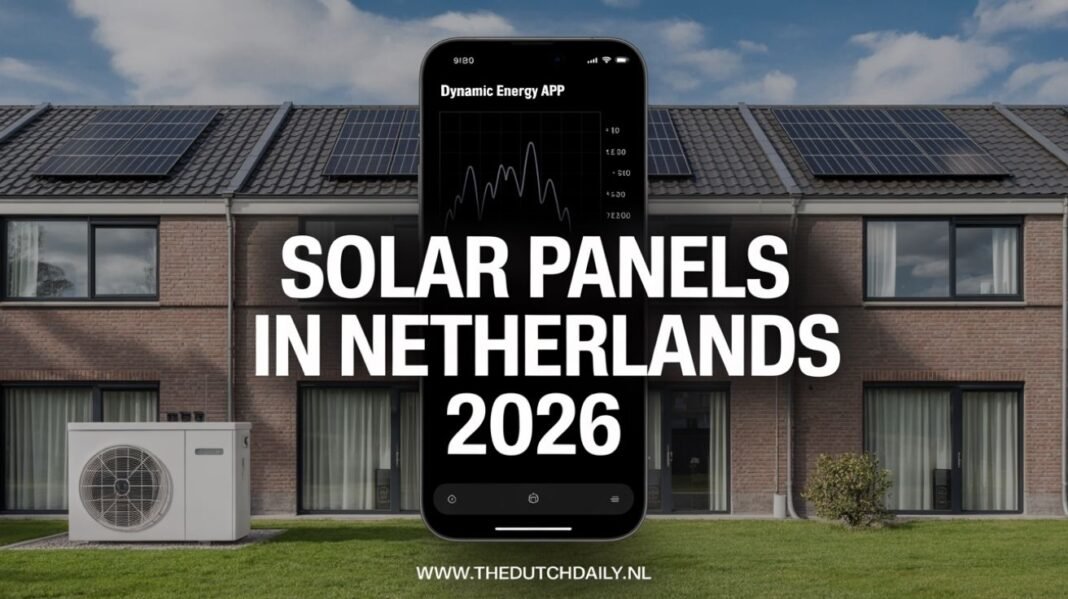
- The Solution: Dynamic Energy Contracts
- Is It Still Worth It? (New ROI Calculation)
- Batteries & Heat Pumps: The Holy Trinity
- What About Renters?
- Key Takeaways
- Dutch Learning Corner
The Phase-Out: Saldering is Disappearing
The “Salderingsregeling” allowed you to offset 100% of your usage against your generation.
Old Scenario: You use 3,000 kWh/year. You generate 3,000 kWh/year. Your final bill was €0.
The 2026 Reality: The government has activated the “afbouwpad” (phase-out path).
Starting this year, you can only offset a reduced percentage (e.g., roughly 64% depending on the exact parliamentary year status) of your electricity. For the remaining excess energy you feed back, you receive only a “reasonable compensation” (redelijke vergoeding), which is roughly €0.04 – €0.08 per kWh, far below the market price of €0.25+ that you pay to buy it.
The New Penalty: ‘Terugleverkosten’ Penalty
While the government reduces the benefit, energy providers (Vattenfall, Eneco, Budget Energie, etc.) have dealt a second blow: Fixed Return Delivery Costs (Vaste Terugleverkosten).
Companies argue that processing your unstable solar energy costs them money in grid balancing. Therefore, if you own panels, you are now charged a monthly “penalty fee” based on how much you feed back into the grid.
The Financial Hit:
Some households are shocked to find extra charges of €20 to €50 per month on their bills just for having panels. This fee alone can wipe out 30-40% of your annual solar savings.
The Solution: Dynamic Energy Contracts
As traditional fixed contracts become hostile to solar owners, a new trend is exploding: Dynamic Energy Contracts (offered by providers like Tibber, ANWB, Frank Energie).
In a dynamic contract, you pay the actual hourly spot price.
* The Strategy: When the sun is shining and wind is blowing, prices can drop to near zero or even become negative.
* The Risk: You pay more during peak evening hours (17:00 – 20:00).
For solar owners with a home battery or an EV, dynamic contracts are often the only way to avoid “Terugleverkosten” and actually profit from market fluctuations.
Is It Still Worth It? (New ROI Calculation)
Does this mean solar is a bad investment in 2026? No, but the “Get Rich Quick” era is gone.
| Metric | 2022 Era | 2026 Era |
|---|---|---|
| Payback Period | 4 – 5 Years | 7 – 9 Years |
| VAT (BTW) on Purchase | 0% | 0% (Still Valid!) |
| Annual Return | ~20% | ~6-8% |
A 7-year payback period is still significantly better than any savings account interest rate. Plus, the 0% VAT rule remains in place, keeping the upfront installation cost 21% cheaper than other home renovations.
Batteries & Heat Pumps: The Holy Trinity
In 2026, solar panels should not be viewed in isolation. They are now part of an ecosystem.
1. The Home Battery (Thuisbatterij): Since selling power is worthless, you must store it. Batteries allow you to keep your free afternoon solar power for your evening TV time.
2. The Hybrid Heat Pump (Hybride Warmtepomp): With gas prices rising, using your “free” solar electricity to power a heat pump is the most efficient way to heat your home, reducing your gas bill drastically.
What About Renters?
If you don’t own your roof, you aren’t entirely left out.
* Housing Corporations: Many corporations (Woningcorporaties) are aggressively installing panels. You usually pay a small increase in “service costs” (e.g., €20/month) but save €40/month on energy.
* Portable Panels: While balcony solar kits are popular in Germany, Dutch regulations are stricter regarding grid connection. Check with your landlord before plugging one in.
Key Takeaways
- Consume Immediately: The new golden rule is “Wash when the sun shines.” Use timers on dishwashers and washing machines.
- Check Contracts: If you have panels, avoid providers with high “Terugleverkosten.” Compare fixed vs. dynamic pricing.
- Long Game: Don’t look at monthly returns; look at the 25-year lifespan of the system. It remains a solid hedge against inflation.
- VAT is 0%: The government still subsidizes the purchase by charging no VAT.
Dutch Learning Corner
| Word (Dutch) | Pronunciation | Meaning | Context |
|---|---|---|---|
| ☀️ De Zonnepanelen | Zon-ne-pa-ne-len | Solar Panels | Zonnepanelen zijn nog steeds rendabel. (Solar panels are still profitable.) |
| ⚡ Dynamisch Contract | Dy-na-mies Con-tract | Dynamic Contract | Met een dynamisch contract betaal je de marktprijs. (With a dynamic contract, you pay the market price.) |
| 🔋 De Thuisbatterij | Thow-s-bat-te-ray | Home Battery | Een thuisbatterij slaat overtollige stroom op. (A home battery stores excess power.) |
Are You Switching to Dynamic?
Have you been hit by the “Terugleverkosten” from your traditional provider? Are you considering switching to a dynamic provider like Tibber or ANWB? Share your experience in the comments!