



Space Warfare 2026: Russian “Stalker” Satellites Target Europe & The Risk to Dutch Networks
Noordwijk/Berlin – The war for Europe is no longer just being fought on the ground or in the cyber trenches; it has ascended to the heavens. European security experts and military officials have issued a Code Red warning: Space Warfare has begun.
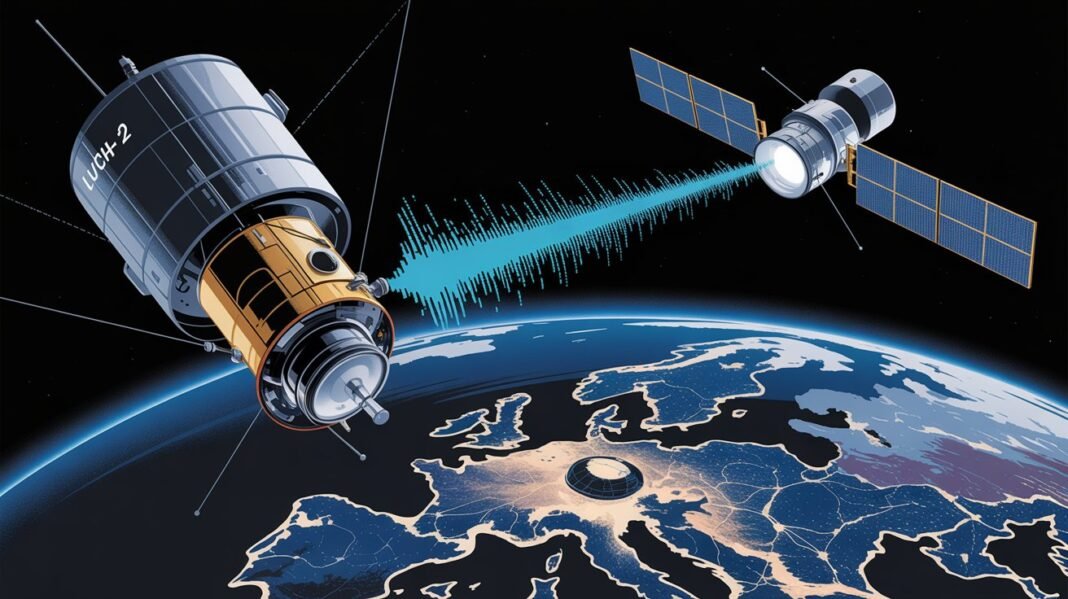
According to alarming new intelligence reports, two Russian spy spacecraft, identified as Luch-1 and Luch-2, are actively “stalking” critical European satellites. These “Inspector Satellites” are not just watching; they are intercepting sensitive data, penetrating unencrypted command chains, and performing dangerous maneuvers that could lead to deliberate orbital collisions.
For the Netherlands, home to the European Space Agency (ESA) ESTEC in Noordwijk and a hub for global telecommunications, the threat is existential. If these satellites are hijacked or destroyed, the result would be catastrophic: banking systems could freeze, GPS navigation could fail, and the internet backbone could snap. In this detailed security dossier, we break down how Russia is weaponizing space and what it means for your digital safety.
Table of Contents
- The “Stalker” Satellites: What are Luch-1 and Luch-2?
- The Great Hack: Hijacking the Command Chain
- The “Kessler” Risk: Kinetic Impact & Debris Fields
- The Dutch Connection: Why Noordwijk is a Target
- Expat Impact: What Happens if GPS & Banking Fail?
- “Achilles Heel”: The Political & Military Response
- Hybrid Warfare: From Undersea Cables to Orbit
- Defense & Space Vocabulary Corner
- Source & References
The “Stalker” Satellites: What are Luch-1 and Luch-2?
Unlike traditional satellites that sit in a fixed orbit to beam TV signals or monitor weather, the Russian Luch (Olymp) class vehicles are designed for maneuverability and espionage.
The Stalking Behavior:
Western space authorities have tracked Luch-2 (launched in 2023) performing suspicious maneuvers. It drifts intentionally close—sometimes within mere kilometers—of satellites serving the UK, France, Germany, and the Middle East.
The Objective:
According to German Major General Michael Traut (Head of Space Command), these satellites act as “Signal Vacuums.” By parking next to a European satellite, they can intercept the uplink and downlink signals that carry everything from military orders to your encrypted WhatsApp messages.
The Great Hack: Hijacking the Command Chain
The most terrifying aspect of this report is not just that Russia is listening, but that they might be taking control.
The Encryption Failure:
Many European commercial satellites launched 10-15 years ago were designed in a simpler era. They lack advanced military-grade encryption on their “Command and Control” (C2) links.
The “Replay” Attack:
Intelligence officials warn that Luch satellites can record the command codes sent from Earth ground stations. Once recorded, Moscow can “replay” these commands later.
The Consequence:
Russia could theoretically send a command to a European satellite to:
- Shut down its transponders (Blackout).
- Fire its thrusters to push it out of orbit (De-orbiting).
- Crash it intentionally into another satellite (Kamikaze attack).
“We are seeing a capability that goes beyond espionage. This is preparation for sabotage,” a senior European intelligence official stated.
The “Kessler” Risk: Kinetic Impact & Debris Fields
If Russia decides to turn a “cold” space war into a “hot” one, the physical risks are immense.
The Collision Threat:
By manipulating orbits, Russia can cause collisions. A collision in Geostationary Orbit (36,000 km up) is permanent.
The Kessler Syndrome:
One collision creates thousands of pieces of shrapnel. These pieces hit other satellites, creating a chain reaction. This could render Low Earth Orbit unusable for generations, destroying the global economy’s ability to use space.
The Dutch Connection: Why Noordwijk is a Target
Why should an expat in Amsterdam care? Because the Netherlands is the technical heart of European space.
ESA ESTEC (Noordwijk):
The European Space Research and Technology Centre is located on the Dutch coast. It is where most European satellites are designed and tested. Disruption in orbit directly impacts operations here.
NATO Communications:
The Netherlands hosts critical NATO communications infrastructure (Brunssum). Disabling satellite links is a primary goal for Russia to sever communication between European allies and the US in a conflict scenario.
Expat Impact: What Happens if GPS & Banking Fail?
We often forget how much our daily Dutch life depends on these metal boxes in the sky. If the Luch satellites initiate an attack, here is the timeline of chaos:
- GPS Failure (Galileo System): Uber stops working. Thuisbezorgd drivers get lost. More critically, the Dutch logistics network (Port of Rotterdam) grinds to a halt as automated container cranes lose precision.
- Banking Blackout: Financial transactions rely on satellite timing signals for timestamps. ATMs and PIN terminals (Albert Heijn) could go offline or suffer massive latency.
- Remote Work Collapse: If internet backbone satellites are targeted, international Zoom calls and VPN connections to HQs in London or New York will fail.
“Achilles Heel”: The Political & Military Response
The political rhetoric is sharpening.
Boris Pistorius (German Defense Minister):
He recently described satellite networks as the “Achilles Heel of modern society.” He warned that Russia’s activities are a fundamental threat that can no longer be ignored.
The Response Strategy:
Europe is rushing to launch the IRIS² (Infrastructure for Resilience, Interconnectivity and Security by Satellite) constellation—a new, highly encrypted satellite network designed to resist exactly this kind of Russian interference. But it won’t be fully operational until 2027.
Hybrid Warfare: From Undersea Cables to Orbit
This space aggression is not isolated. It is part of a “Hybrid Warfare” strategy.
The Pattern:
While Luch-2 stalks satellites in the sky, Russian “research vessels” are mapping wind farms and data cables in the North Sea. The goal is clear: Multi-Domain Pressure. Moscow wants to demonstrate that it can switch off the lights and the internet in Europe whenever it chooses, creating panic without firing a single missile on the ground.
Defense & Space Vocabulary Corner
| Word (English) | Context | Meaning |
|---|---|---|
| 🛰️ Signal Intelligence (SIGINT) | Military | Gathering intelligence by intercepting signals (what Luch-2 is doing). |
| 📡 Telemetry | Tech | Data sent from the satellite about its health (battery, position). |
| 🛡️ Hybrid Warfare | Geopolitics | Warfare that blends conventional force with cyberattacks, disinformation, and sabotage. |
| 💥 Kinetic Attack | Warfare | Physical destruction (smashing one satellite into another). |
📚 Sources & References
The information in this article is based on recent intelligence disclosures and public statements by European defense officials.
- Primary Intelligence: Reports from German Space Command (Weltraumkommando) and European Intelligence Officials regarding Luch-1/Luch-2 maneuvers.
- Official Statements: Comments by Boris Pistorius (German Defense Minister) and Major General Michael Traut regarding the “Achilles Heel” of European infrastructure.
- Contextual Data: ESA and NATO public records on satellite security vulnerabilities.
- Original reporting via International Defense Wires / The Times / Spiegel.
TDD Community Question
Does the threat of Space Warfare worry you? How reliant are you on GPS and digital banking? Do you think the Netherlands is doing enough to protect its space assets in Noordwijk? Share your thoughts below.