




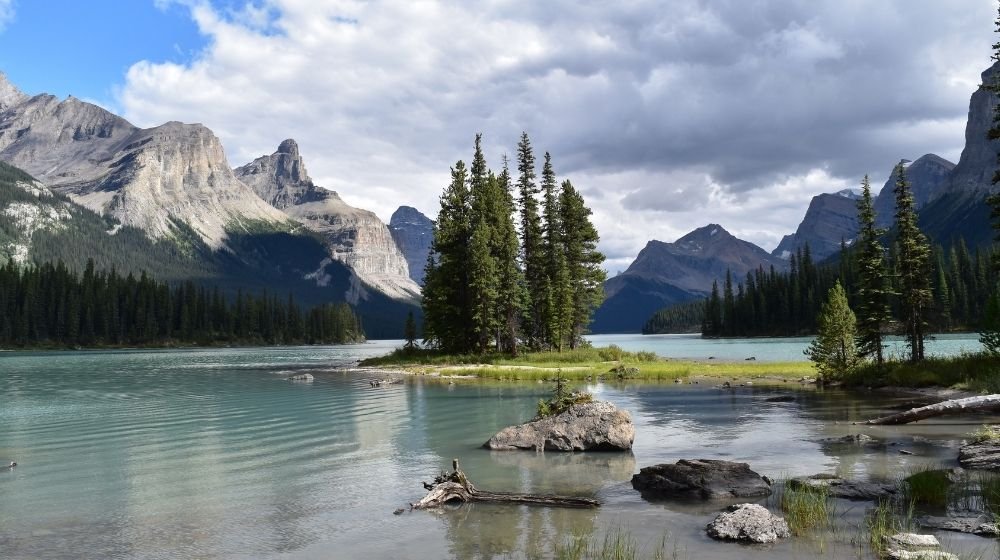
Forbidden Paradise: Why You Can Look But Never Touch Canada’s “Spirit Island”
Jasper, Alberta – You have likely seen it before. It was the wallpaper on millions of Apple iPads, featured in Kodak advertisements, and plastered across travel brochures. Spirit Island, located in the glacial waters of Maligne Lake, is one of the most photographed spots on Earth. Yet, for the millions of tourists who flock to the Canadian Rockies, it remains a “look, don’t touch” destination.
While tour boats can circle its shores, setting foot on the island is strictly illegal for the general public. Access is reserved exclusively for one group: the Stoney Nakoda First Nation, the original custodians of this sacred land.
Table of Contents
- The Legend of Chaba Imne
- The 1907 Eviction: A Dark History
- The Rules: Why You Can’t Step Off the Boat
- The Healing Waters and Modern Ceremony
- Key Takeaways
- Dutch Learning Corner
- Community CTA
The Legend of Chaba Imne
To the geographers, Spirit Island is a “tied island”—connected to the mainland by a thin strip of land that disappears when the snow melts and water levels rise in the summer.
But to the Stoney Nakoda people, it is Chaba Imne (Beaver Lake). It is not just a geological formation; it is a cathedral of nature.
According to Barry Wesley, a Stoney Nakoda Knowledge Keeper, the island is the physical heart of their spiritual world. “For thousands of years, our ancestors came here to conduct healing ceremonies,” Wesley explains. “The Creator gave us the responsibility to protect this island. It is where the physical and spiritual worlds meet.”
The 1907 Eviction: A Dark History
The pristine wilderness visitors admire today has a painful backstory. When Jasper National Park was established in 1907, the Canadian government enforced a policy common at the time: the removal of Indigenous peoples to create “uninhabited” parks for tourists.
The Stoney Nakoda were forcibly removed from their ancestral hunting grounds and pushed to reserves hundreds of kilometers away. For decades, they were barred from entering the park gates to hunt, gather, or pray at their sacred sites.
“The history of Canada’s National Parks is often romanticized,” note Indigenous history scholars. “But for the First Nations, the creation of these parks meant exile from their own homes.” It wasn’t until recent reconciliation efforts that the Stoney Nakoda were officially welcomed back to steward the land.
The Rules: Why You Can’t Step Off the Boat
Today, Spirit Island is a protected sanctuary.
Tourists can take the famous boat cruise across Maligne Lake. The boat stops near the island, allowing visitors to take photos from a specific viewing platform or the boat itself. However, creating content for Instagram stops at the water’s edge.
The Rules are Strict:
- No Landing: Canoers and kayakers are prohibited from docking on the island.
- No Hiking: There are no trails on the island, and trespassing carries heavy fines.
- Exclusive Rights: Only members of the Stoney Nakoda First Nation may hold ceremonies, walk on the soil, or harvest traditional medicines there.
This policy ensures that the fragile ecosystem is not trampled by millions of boots and that the spiritual sanctity of the site is respected.
The Healing Waters and Modern Ceremony
The return of the Stoney Nakoda to Spirit Island is not just symbolic; it is active.
In recent years, tribal elders have resumed annual pilgrimages to Chaba Imne. They believe the cold, glacial waters surrounding the island possess potent healing properties. During these private ceremonies, the island returns to its original purpose: a place of prayer, not a photo op.
This arrangement represents a new model of conservation in Canada—one where Indigenous sovereignty coexists with public tourism. It teaches visitors a valuable lesson: Some places are not meant to be conquered, only admired.
Key Takeaways
- Sacred Ground: Spirit Island is a holy site for the Stoney Nakoda people.
- Restricted Access: Tourists can view it, but strictly cannot step onto the island.
- Historical Context: The tribe was evicted in 1907 but has regained access rights.
- Responsible Tourism: The restrictions protect both the spiritual integrity and fragile nature.
Dutch Learning Corner
| Word | Pronun. (Eng) | Meaning | Context (NL + EN) |
|---|---|---|---|
| ⛔ Verboden | Ver-bo-den | Forbidden / Prohibited | Het is verboden om op het eiland te lopen. (It is forbidden to walk on the island.) |
| 🏝️ Het Eiland | Het Eye-lahnd | The Island | Het eiland is heilig. (The island is sacred.) |
| ⛺ De Stam | De Stahm | The Tribe | De stam beschermt de natuur. (The tribe protects nature.) |
| 🙏 Heilig | High-ligh | Sacred / Holy | Dit is heilige grond. (This is sacred ground.) |
Have You Visited the Rockies?
Canada is a dream destination for many Dutch travelers. Have you seen Spirit Island? Did you know about its sacred history, or did you just see a beautiful photo spot? Share your travel stories below.
Source / History: Parks Canada & Stoney Nakoda Nations.

