




The Fatbike Crackdown: Why the “Terror on Tyres” Era is Ending in 2026
Amsterdam – Walk down any street in Amsterdam, Utrecht, or Eindhoven today, and you will encounter them. They are silent, they have tires as thick as a tractor’s, and they zoom past you at 40 km/h, often ridden by two teenagers holding smartphones. They are Fatbikes.
What started as a trendy, tough-looking alternative to the traditional “Omafiets” has turned into a national safety crisis. Emergency rooms are filling up with young victims of fatbike accidents, and the public outcry has reached a boiling point. The Dutch government, usually slow to regulate cycling, is finally hitting the brakes.
As of 2026, the “Wild West” era of electric biking is over. New regulations are being rolled out to distinguish these speed monsters from regular e-bikes. If you own one, or—more importantly—if your child is begging you to buy one, read this guide first. It might save you a €300 fine or, worse, a confiscated bike.
Table of Contents
- Why Everyone Hates Fatbikes (The Statistics)
- The New Rules 2026: Helmets & Age Limits
- Legal vs. Illegal: The “Throttle” Trap
- The “Rollerbank” Returns: Police Checks
- The Insurance Boycott: Uninsurable Assets?
- A Warning to Parents: Don’t Buy It
- Safe Alternatives for Teenagers
- Dutch Learning Corner
Why Everyone Hates Fatbikes (The Statistics)
To understand the crackdown, look at the numbers. According to VeiligheidNL, the number of e-bike accidents involving minors has quadrupled in the last two years.
The core problem is the “Pimped” Motor. A legal e-bike stops assisting at 25 km/h. However, many fatbikes imported cheaply from China can easily be “unlocked” with a simple app code to reach speeds of 45 km/h or even 50 km/h. When you put a 14-year-old with no driver’s license and no helmet on a vehicle that goes 45 km/h, disaster is inevitable.
Elderly cyclists are terrified. Pedestrians are angry. And the political pressure to “ban the nuisance” is higher than ever.
The New Rules 2026: Helmets & Age Limits
The Ministry of Infrastructure represents a turning point. While regular e-bikes remain unregulated, a new category is effectively being created for these heavier, faster machines.
1. The Minimum Age Debate (14+ or 16+?)
Currently, a 10-year-old can legally ride an e-bike. This is changing. A nationwide motion is pushing to set a minimum age of 14 for any e-bike with “fat tires” (tires wider than 50mm). Some municipalities want to push this to 16, aligning it with scooter laws.
2. The Helmet Mandate
The days of wind-in-your-hair freedom are numbered. Just as the government mandated helmets for “Snorfietsen” (blue plate scooters) in 2023, the same logic is now being applied to fatbikes. If it looks like a moped and drives like a moped, you must wear a helmet.
Legal vs. Illegal: The “Throttle” Trap
This is where most expats get scammed. You buy a cool-looking bike online, thinking it’s legal. It’s not.
🛑 Checklist: Is Your Fatbike Illegal?
If your bike has ANY of the following, it is illegal to ride on public roads:
- A Throttle (Gashendel): If you can move without pedaling, it is NOT an e-bike. It is an illegal moped.
- Motor > 250 Watt: Legal limit is 250W. Many fatbikes have 500W or 750W motors.
- Speed > 25 km/h: If the motor assists you past 25 km/h, it is illegal.
- Foldable Footrests: Often a sign that it’s designed for a passenger, making it unstable.
The “Rollerbank” Returns: Police Checks
If you lived in the Netherlands in the 2000s, you remember the “Rollerbank”—the mobile treadmill police used to test scooters. They are back.
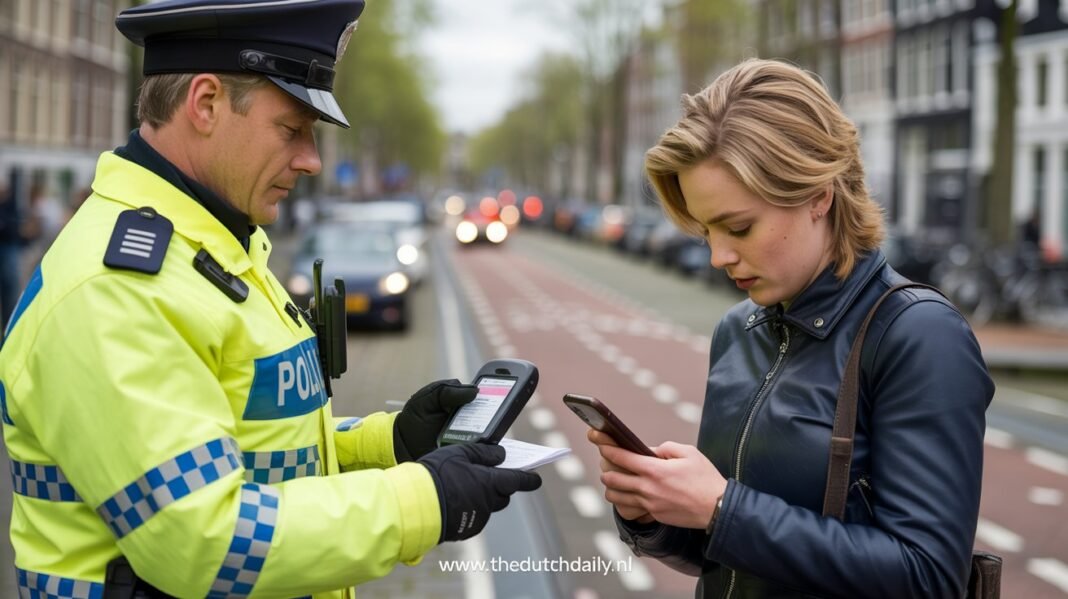
Police in Amsterdam, Rotterdam, and The Hague are now deploying E-bike Rollerbanks. They stop cyclists randomly.
The Consequence:
1. They put the bike on the stand.
2. They test the max speed.
3. If it goes too fast, you get a €290 fine.
4. Repeat Offenders: If caught twice, the bike is seized (in beslag genomen) and destroyed. You do not get it back.
The Insurance Boycott: Uninsurable Assets?
Here is a financial warning: Most Dutch insurers (ANWB, Univé, Interpolis) have stopped insuring fatbikes.
Why? The theft rate is astronomical. In some cities, there is a 90% chance a fatbike will be stolen within a year.
The Trap: Even if you find an insurer, they often require a specific GPS tracker and an ART-2 certified lock. But here is the kicker: If your bike has been modified (illegal speed), your insurance is VOID.
Imagine your child hits a pedestrian while riding a tuned fatbike. The insurance pays nothing. You are personally liable for tens of thousands of euros in medical costs.
A Warning to Parents: Don’t Buy It
Peer pressure is real. Your teenager says, “But everyone at school has a Knaap or a Super73!”
As an expat parent, you might think it’s a good way for them to integrate. Think twice.
- Theft Magnet: Your child becomes a target for street robberies. Kids are being threatened with knives for these bikes.
- Safety: Fatbikes handle poorly in corners due to the heavy tires.
- Cost: A decent fatbike costs €2,000+. It is a massive investment that can vanish in seconds.
Safe Alternatives for Teenagers
So, how does your kid get to school (Middelbare School) if not on a fatbike?
| Option | Pros | Cons |
|---|---|---|
| Traditional Dutch Bike (Cortina/Gazelle) | Indestructible, cheap, safe | “Not cool” according to teenagers |
| Regular E-Bike (Bosch Motor) | Reliable, insurable, legal | Expensive (€2,500+) |
| Public Transport (Bus/Tram) | Warm, dry, safe | Costs money every day |
Dutch Learning Corner
| Word (Dutch) | Pronunciation | Meaning | Context |
|---|---|---|---|
| 🚲 Opgevoerd | Op-he-voerd | Souped-up / Modified (Speed) | Zijn fiets is opgevoerd en gaat 50 km/u. (His bike is modified and goes 50 km/h.) |
| 👮 In beslag nemen | In be-slag ne-men | To Confiscate / Seize | De politie kan je fiets in beslag nemen. (The police can seize your bike.) |
| 🛑 De Gashendel | De Has-hen-del | Throttle | Een gashendel is verboden op een e-bike. (A throttle is forbidden on an e-bike.) |
TDD Community Question
Are you “Team Ban It” or “Team Freedom”? Do you think Fatbikes should be completely banned for under-16s, or is it the parents’ responsibility? Debate in the comments below!