



10 Hours Became 1 Hour: The Train That Makes Flying Obsolete
Beijing – While we in the Netherlands are often happy if the Intercity from Utrecht to Amsterdam arrives on time, engineers in China have just redefined the concept of “fast.”
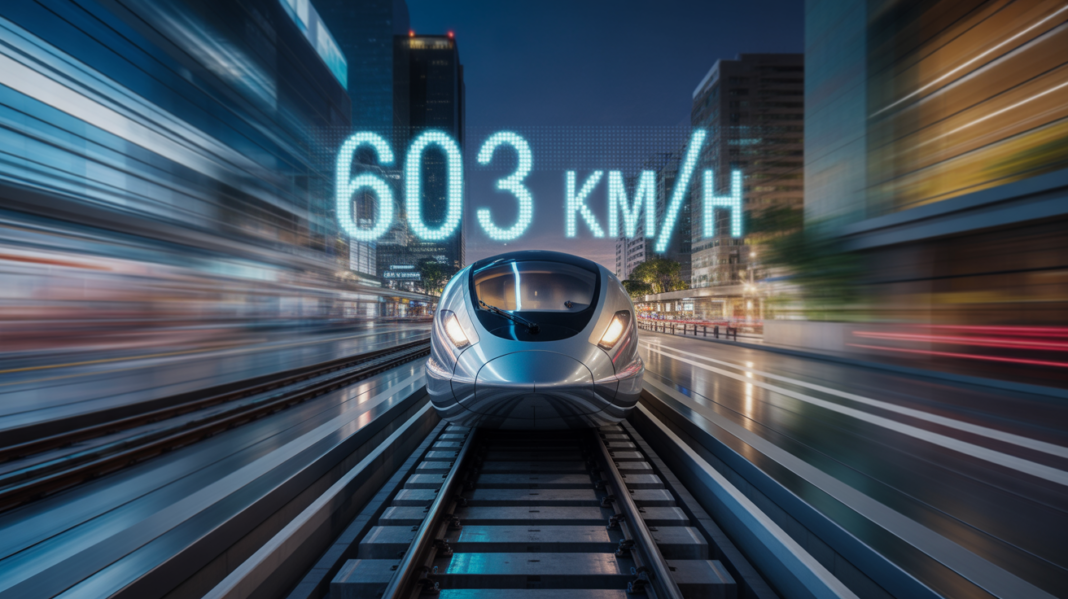
A new high-speed magnetic levitation (maglev) train has successfully clocked speeds of **603 km/h** (375 mph). To put that into perspective, that is nearly double the top speed of the Eurostar and faster than many propeller planes. The project’s boldest claim? It aims to slash a journey that typically takes 10 hours by conventional transport down to just **1 hour**.
Table of Contents
- How Does It Work? (Zero Friction)
- The Numbers: 603 km/h Explained
- Maglev vs. Dutch Trains vs. Planes
- Could We See This in Europe?
- Key Takeaways
- Dutch Learning Corner
- Community Discussion
How Does It Work? (Zero Friction)
The secret behind this blistering speed is **Magnetic Levitation** (Maglev). Unlike traditional trains (like the NS Sprinter), this train has no wheels.
It uses powerful electromagnets to lift the train carriages off the track and propel them forward. Because the train literally “floats” on a cushion of air, there is **zero friction** between the vehicle and the rails. No friction means less drag, less noise, and the ability to reach speeds that were previously thought impossible for ground transport.
The Numbers: 603 km/h Explained
The China Aerospace Science and Industry Corporation (CASIC), the state-owned giant behind the project, announced the breakthrough during recent tests in Datong, Shanxi province.
* Top Speed: Reached 603 km/h during testing.
* Target Speed: Future phases aim for 1,000 km/h in low-vacuum tubes (similar to the Hyperloop concept).
* The Goal: To create “mega-city clusters” where commuting between cities 1,000 km apart takes less time than commuting from Haarlem to Amsterdam during rush hour.
Maglev vs. Dutch Trains vs. Planes
Is this really faster than flying? When you factor in airport security, boarding, and taxiing, the answer is yes. Here is how the new Maglev stacks up against what we are used to:
| Mode of Transport | Top Speed | Friction? | Amsterdam to Paris (Est.) |
|---|---|---|---|
| 🚀 China Maglev | 603 km/h | No (Floats) | ~50 Mins |
| 🚅 Eurostar / Thalys | 300 km/h | Yes (Wheels) | 3h 20m |
| 🚆 NS Intercity | 140 km/h | Yes | N/A |
Could We See This in Europe?
While China pushes ahead, Europe is largely sticking to traditional high-speed rail. However, the Netherlands has been a testing ground for the **Hyperloop** concept (specifically in Groningen), which uses similar magnetic principles in vacuum tubes.
But for now, if you want to experience travel at 600 km/h without leaving the ground, you will need to book a ticket to Asia. In the meantime, we will settle for the NS getting us to Schiphol on time.
Key Takeaways
- The Record: A new Chinese maglev train hit 603 km/h in tests.
- The Tech: It uses magnetic levitation to eliminate friction.
- The Promise: Reducing 10-hour journeys to just 1 hour.
- The Context: It is twice as fast as the quickest trains currently operating in Europe.
Dutch Learning Corner
| Word (Dutch) | Pronun. (Eng) | Meaning | Context (NL + EN) |
|---|---|---|---|
| 🚅 De Hogesnelheidstrein | De Ho-ghe-snel-hides… | High-speed train | De hogesnelheidstrein is de toekomst. (High-speed train is the future.) |
| ⚡ De Snelheid | De Snel-hide | The Speed | Wat is de maximale snelheid? (What is the maximum speed?) |
| 🧬 De Innovatie | De In-no-va-sie | Innovation | China investeert veel in innovatie. (China invests a lot in innovation.) |
Would You Dare?
Traveling at 600 km/h on the ground sounds exciting, but does it sound safe? Would you be the first to buy a ticket, or do you prefer the slower, scenic route? Let us know in the comments!
Source / Tech Data: Reuters Technology & CRRC Corporation.