




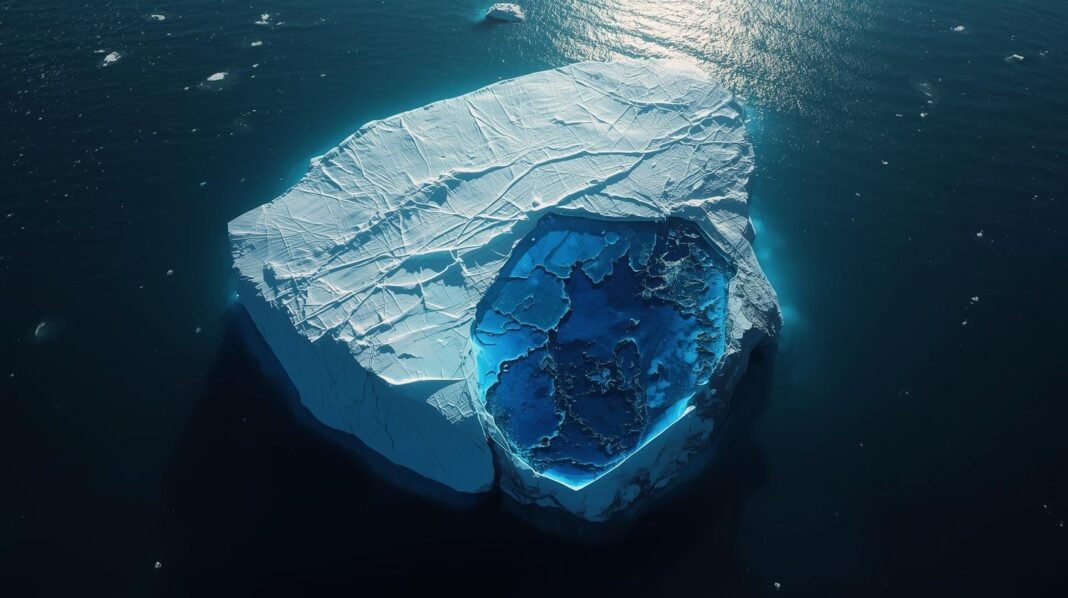
South Atlantic – The colossal iceberg known as A23a, once the largest in the world, is entering its final death throes. After a 40-year journey from Antarctica, satellite imagery reveals that the megaberg has shattered into a mesmerizing but tragic “blue lapis” slush. Riddled with melt ponds and fractures, A23a is no longer a solid white giant but a melting remnant, signaling the accelerating impact of warmer ocean waters.
Table of Contents
- The “Blue Lapis” Phenomenon
- A 40-Year Odyssey: From 1986 to Now
- The Science: Why Does It Look Like a Gemstone?
- Ecological Impact: Disaster Averted?
- Key Takeaways
- Dutch Learning Corner
- Community CTA
The “Blue Lapis” Phenomenon
Recent images captured by NASA’s Terra satellite show A23a reduced to approximately one-third of its original size (formerly three times the size of New York City). Its surface is now dominated by bright electric-blue lines—massive melt ponds formed by surface ice losing structural integrity.
These ponds give the iceberg the appearance of Lapis Lazuli, a semi-precious blue stone. An additional photograph taken by an astronaut aboard the International Space Station confirms a uniform blue water layer forming across the surface. This is not just melting; it is a structural collapse into an “ice-slush” mixture.
A 40-Year Odyssey: From 1986 to Now
A23a’s life story is remarkable:
- 1986: Calved from the Filchner-Ronne Ice Shelf in Antarctica.
- 1986-2020: Immediately got stuck (grounded) on the seabed, remaining stationary for nearly 34 years.
- 2020: Finally broke free and began drifting north into “Iceberg Alley.”
- 2024-2025: Trapped in an ocean gyre before escaping towards South Georgia Island.
- 2026: Rapid disintegration in warmer waters.
The Science: Why Does It Look Like a Gemstone?
According to glaciologists, the “blue lapis” effect is caused by water infiltrating cracks and refreezing or pooling. Ted Scambos from the University of Colorado Boulder explains that the weight of the meltwater fractures the ice further. Interestingly, some of the parallel cracks visible today are actually “scars” from when the iceberg dragged across the seafloor decades ago. The blue color comes from the density of the ice and the absorption of red light by the water.
Ecological Impact: Disaster Averted?
There was significant fear that A23a would crash into South Georgia Island, blocking penguins and seals from their feeding grounds. Fortunately, the iceberg began to fragment just in time. However, its melting releases billions of tons of freshwater into the ocean. While this won’t drastically raise sea levels on its own, it alters local salinity, which can disrupt the marine food web (plankton and krill) that thrives in these waters.
Key Takeaways
- The Event: World’s largest iceberg A23a is disintegrating rapidly.
- The Visual: Melt ponds have turned it into a “Blue Lapis” color.
- The Cause: Warmer waters and air temperatures in the South Atlantic.
- The Relief: It broke up before hitting wildlife sanctuaries on South Georgia Island.
Dutch Learning Corner
| Word | Pronun. (Eng) | Meaning | Context (NL + EN) |
|---|---|---|---|
| 🧊 De IJsberg | De Iys-berkh | The Iceberg | De ijsberg smelt snel. (The iceberg is melting fast.) |
| 🌊 Smelten | Smel-ten | To Melt | Het ijs begint te smelten. (The ice begins to melt.) |
| 🌍 De Klimaatverandering | De Kli-maat-ver-an-de-ring | Climate Change | Dit is een gevolg van klimaatverandering. (This is a result of climate change.) |
| 📉 De Afname | De Af-na-me | The Decrease | Er is een afname van het zee-ijs. (There is a decrease in sea ice.) |
Beautiful or Terrifying?
The “Blue Lapis” images are undeniably stunning, but they signal a dying giant. Does this imagery make the reality of climate change more visible to you? Share your thoughts below.
Source / Data: NASA Earth Observatory