


Contents
Checked on 26 November 2026. Rules and amounts can change, so follow the linked sources before you decide.
The stairs have become a daily obstacle, the vacuum cleaner stays in the cupboard, and the shopping is getting heavy: this is the moment the Wmo in the Netherlands is meant for. The Wet maatschappelijke ondersteuning (Social Support Act, officially Wmo 2015) obliges your municipality to offer support when you are not sufficiently self-reliant, or cannot take part in society, and the people around you cannot fill the gap.
The help ranges from a cleaner every week to a stairlift, a wheelchair or a regional taxi service. If you read on, you will know what to ask for, which deadlines the municipality must meet, and why the price is the same whether you get one kind of help or three.
1. Wmo in the Netherlands at a glance
| Question | Answer | Basis |
|---|---|---|
| Where do I ask? | The municipality where you are registered, via its Wmo-loket or sociaal wijkteam | Regelhulp (VWS) |
| How fast must they act? | Investigation within 6 weeks of your report; decision within 2 weeks of your application | Wmo 2015, art. 2.3.2 and 2.3.5 |
| What does it cost? | €21.80 a month in 2026, €22.40 in 2027 (fixed amount) | Rijksoverheid; CAK |
| Who pays nothing? | Under-18s (except home adaptations); couples where at least one partner is below AOW age; some low incomes, depending on the municipality | Rijksoverheid; CAK |
| Medical nursing at home? | Not Wmo: arranged via your health insurer, with no Wmo contribution | Rijksoverheid |
Sources: Wmo 2015 (version in force from 1 July 2026), Rijksoverheid (updated 23 November 2026), CAK and Regelhulp. Checked 26 November 2026.
2. What the gemeente can provide
The law does not list exactly what you get. It sets a duty, and the municipality decides with you what fits. There are two kinds of help.
Algemene voorzieningen (general provisions) are open to everyone without an investigation of your situation. Examples the government gives: a shopping service, meal delivery (often called tafeltje-dekje), a meeting place for people who are lonely, shelter for the homeless, and the advice and reporting point for domestic violence and child abuse. The municipality may ask a contribution for these.
Maatwerkvoorzieningen (tailored provisions) are for you personally, after an investigation. They are not medical care. Typical examples:
- household help, such as tidying, cleaning and washing windows;
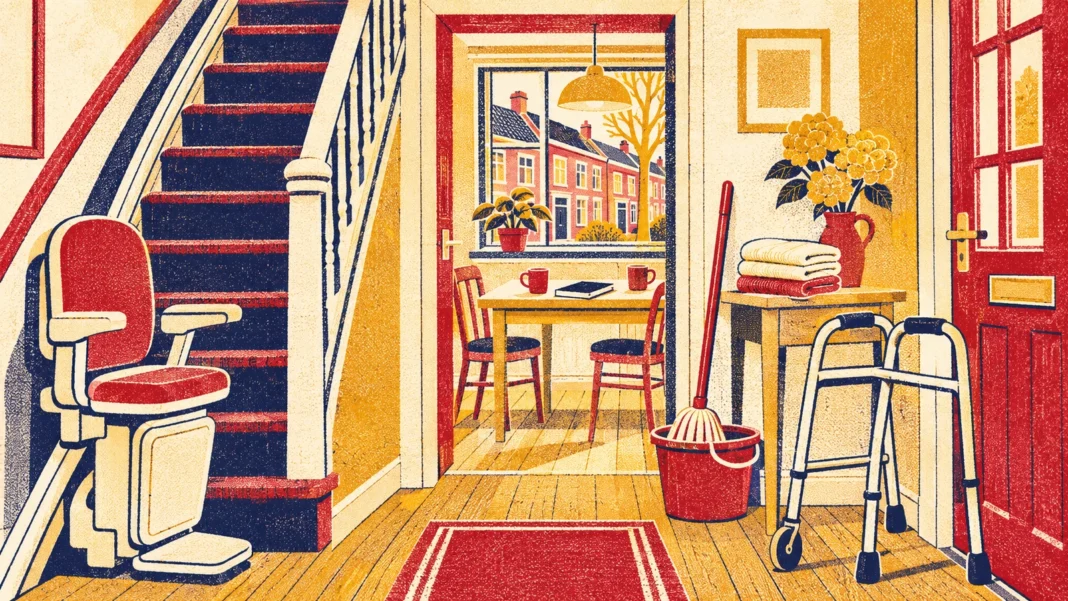
- home adaptations, such as a stairlift or a raised toilet;
- a wheelchair, if you need it for a longer period (for short-term use, go to a home-care loan shop or your health insurer);
- a transport provision, including regional transport for people who walk badly and cannot use public transport;
- individual guidance and day activities;
- respite care and support for informal carers;
- protected housing and shelter.
If a partner or child already looks after you, that matters too: support for carers is part of the Wmo. Our guide to mantelzorg and care leave covers the carer’s side.
3. From first call to decision, step by step
The process is set out in the law and explained on the government’s Regelhulp site. You can only apply in the municipality where you are registered, not in a neighbouring one.
- The melding (report). Contact the Wmo-loket or the sociaal wijkteam; some municipalities call it a gebiedsteam or hulpteam. The municipality must confirm receipt, usually within a few days. If finding things online is hard, the local library can help.
- Your personal plan (optional). You have the right to hand in a persoonlijk plan describing your situation and the help you think fits best. The law gives you seven days after the report to submit it, and the municipality must take it into account.
- The investigation. The municipality must carry it out as soon as possible and at the latest within six weeks of your report. Regelhulp is candid that busy municipalities do not always manage this; they should tell you how long it will take. In an emergency, such as domestic violence, shelter must be offered immediately, in practice usually within two days.
- The application. After the investigation you apply formally for a tailored provision.
- The beschikking (decision). The municipality must give its decision within two weeks of receiving the application. The letter states what support you get and for how long. A refusal also comes in writing.
Many decisions are valid for a limited time, for example six months, which means reapplying. Municipalities may grant support for longer, or even indefinitely, when it is clear that the need is long-term. If your situation will not improve, ask for that.
4. The keukentafelgesprek: how to prepare
The investigation centres on a conversation, nicknamed the keukentafelgesprek (kitchen-table talk) because it usually takes place at home. You explain what you need, what your days look like (work, school, how you live, what you do and want to do) and what the people close to you already do or could still do.
Picture an older man living alone after a hip operation. His daughter visits twice a week but works full-time. At the table, the useful answers are concrete: which tasks he can no longer do, how often, and what the daughter realistically covers. Specific answers give the municipality something to work with; “I manage” does not.
Three practical points help:
- Bring someone. A relative, a friend or a free, independent client supporter (onafhankelijke cliëntondersteuner) may join you. The municipality must point this option out to you.
- Bring advice. For aids and adaptations, a doctor, therapist or occupational therapist (ergotherapeut) can write a functional advice.
- Know your privacy. The municipality may only look at your medical file with your consent and when it matters for the application. It may check, without consent, only whether you have an indication under the Wlz (the long-term care act), not what is in that file.
5. Pgb or zorg in natura
If you get a tailored provision, you choose how it is delivered. With zorg in natura (care in kind), the municipality arranges everything: it decides, for example, which wheelchair you get or who cleans your house. With a persoonsgebonden budget (pgb, personal budget) you receive money to arrange the help yourself, from whoever you choose. A pgb also lets you buy a different wheelchair or mobility scooter than the municipality’s standard model. Regelhulp sums up the trade-off: more freedom, but also more work.
6. What it costs: €21.80 a month
Adults pay a fixed own contribution, the abonnementstarief, for most Wmo support: €21.80 a month in 2026, rising to €22.40 in 2027. It applies to every tailored provision and to general provisions that involve a lasting relationship, such as someone who cleans for you or helps with your administration. Income, assets and the amount of help make no difference.
That last point is worth understanding. According to the CAK, the agency that collects the contribution, the amount does not go up if you receive several kinds of support at once: a mobility scooter plus household help still costs €21.80 a month in 2026.
You pay nothing if you are under 18 (except for home adaptations), if you are married or have a partner and at least one of you has not reached AOW (state pension) age, or if you already pay a contribution for protected housing or Wlz care. If your partner receives Wlz care and you receive Wmo support, you do not pay for the Wmo part. Some municipalities exempt residents with a low income; the CAK checks this with income data from the tax authority. General provisions without a lasting care relationship can carry a separate charge.
A change is planned. The cabinet wants an own contribution that depends on income and assets; both chambers of parliament still have to approve it. Until a new law is in force, the fixed rate applies.
7. If the answer is no
If you disagree with the decision, you can lodge an objection (bezwaar) with the municipality and, after that, an appeal (beroep) with the court. If the problem is how you were treated rather than the decision itself, you can file a complaint, and after that turn to the local or national ombudsman. Keep your report confirmation, your personal plan and notes from the conversation: they show what you asked for and when.
The first step costs only a phone call or an online form. If someone you care for is struggling at home, make that report this week, and write down the date.
8. FAQ
How do I apply for Wmo in the Netherlands?
Report your need to the Wmo-loket or sociaal wijkteam of the municipality where you are registered. The municipality must then investigate within six weeks, and decide within two weeks of your formal application.
How much is the Wmo own contribution?
€21.80 a month in 2026 and €22.40 in 2027, regardless of income or how much help you get. Some groups pay nothing, and some municipalities exempt low incomes.
Is household help covered by the Wmo?
Yes. Household help, such as cleaning and tidying, is one of the tailored provisions a municipality can grant after an investigation.
Can I choose my own carer?
Yes, with a personal budget (pgb). With zorg in natura the municipality chooses the provider.
Is nursing at home part of the Wmo?
No. Nursing and personal care at home are arranged through your health insurer, and there is no Wmo contribution for them.
Can I bring someone to the kitchen-table talk?
Yes. You can bring a relative, a friend or a free independent client supporter.
🇳🇱 Dutch Corner
| Dutch | English |
|---|---|
| de maatschappelijke ondersteuning | social support |
| de melding | the report (first request for help) |
| het keukentafelgesprek | the kitchen-table talk (needs assessment) |
| de maatwerkvoorziening | the tailored provision |
| de algemene voorziening | the general provision |
| de beschikking | the formal decision |
| de huishoudelijke hulp | household help |
| de eigen bijdrage | the own contribution |
| Ik wil een melding doen voor de Wmo. | I would like to report a need for Wmo support. |
Sources
- Rijksoverheid: Welke hulp kan ik thuis krijgen van de gemeente vanuit de Wmo? (municipal duty, tailored and general provisions, pgb and zorg in natura)
- Rijksoverheid: Betaal ik een eigen bijdrage voor ondersteuning uit de Wmo? (€21.80 in 2026, €22.40 in 2027, exemptions, planned income-dependent contribution)
- CAK: Eigen bijdrage (fixed amount regardless of how much help, minimabeleid, when you pay nothing)
- Regelhulp (VWS): Wmo-ondersteuning aanvragen (report, personal plan, investigation, kitchen-table talk, medical data, beschikking, long-term decisions, objection)
- Wet maatschappelijke ondersteuning 2015 (version in force from 1 July 2026) (art. 2.3.2 six-week investigation and seven-day personal plan, art. 2.3.5 two-week decision)
Renting or buying in 2027?
Our free checklist covers the transfer tax cut, box 3, energy and every deadline before 1 January. Confirm your email and the PDF is yours; we will also email you when the 2027 figures are confirmed.
 Read nextLiving in NLDog Tax in the Netherlands (Hondenbelasting): Who Pays, How Much and Which Municipalities Charge It