


Contents
Checked on 26 November 2026. Rules and amounts can change, so follow the linked sources before you decide.
The electric scooter you rode to work in Paris or Lisbon, or the one that arrived in a box after a sale, may well be illegal on Dutch roads, and e-step rules in the Netherlands are the reason. Most electric steps without pedal support are not approved, and the government is blunt about the consequence: you may not ride them on public roads, and the police can fine you or seize the step.
That does not mean every e-step is banned. Since 1 July 2025 there is a route to approval and a new small blue licence plate, and steps where you push yourself with a little motor help follow the rules for electric bikes. Read on to find out which kind you have, what an approved model must have, what you need before you ride it, and what is planned for young riders from 2027.
1. E-step rules in the Netherlands at a glance
| Type | Allowed on the road? | Plate and insurance |
|---|---|---|
| E-step without pedal support, not approved (most models on sale) | No | A plate cannot be requested |
| E-step without pedal support, approved by the RDW | Yes, from age 16, on the cycle path, max 25 km/h | Blue E-plate and third-party (WA) insurance required |
| E-step with pedal support (you push, motor max 250 W, max 25 km/h) | Yes, under the rules for electric bicycles | No plate needed |
Sources: Rijksoverheid (page updated 27 October 2026) and RDW. Checked 26 November 2026.
2. Two kinds of electric step
Start by looking at how your step moves. An ordinary e-step runs on its own: you stand on it, use the throttle and do not have to push. Legally it is a bijzondere bromfiets (special moped), with a top speed of 25 km/h. Only approved models of this kind are allowed on the road.
The other kind is an e-step with pedal support (trapondersteuning). You push off with your foot yourself, and an auxiliary motor of at most 250 watts helps you go faster, up to 25 km/h. These steps do not need a licence plate, and the same rules apply as for an electric bicycle.
The difference sounds technical, but it decides everything. If the motor drives you without you pushing, and there is no plate, assume the step is not allowed on Dutch roads until you have checked the RDW’s list.
3. Approval and the blue E-plate
Since 1 January 2024 the RDW, the Dutch vehicle authority, has been the national approval body for special mopeds such as the e-step. Manufacturers can apply for admission. On 1 July 2025 the RDW issued the first plate for an e-step with national type approval, a model by Selana.
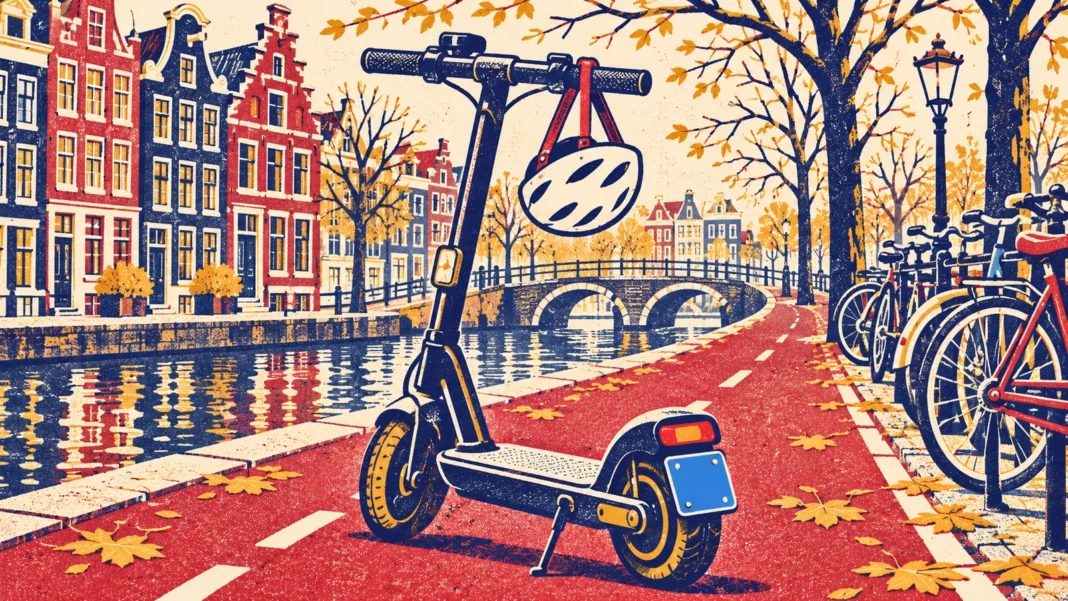
From the same date, a licence plate obligation applies to all newly admitted special mopeds. The plate starts with a capital E and is smaller than usual: a blue plate of 10 by 12 centimetres, issued with a registration card (kentekencard). After you receive the card, you must pass the plate number and the reporting code (meldcode) to your insurer.
The key practical point: a plate cannot be requested for a step that is not approved. The government notes that most e-steps on offer are not approved. The RDW publishes an overview of approved models, so check it before you buy, not after.
An approved e-step comes with equipment you would expect on a small vehicle, including brakes, a bell, front and rear indicators, a mirror, a white or yellow front light, a red brake and rear light, reflectors, a vehicle identification number (VIN) and a licence plate. A step without indicators or a mirror is a quick sign that it is not an approved model.
4. Riding an approved e-step
Once you have an approved step with its plate, these rules apply, according to the Rijksoverheid:
- you must be 16 or older;
- you ride on the cycle path or the cycle/moped path, never on the pavement;
- you keep to the right as much as possible;
- maximum speed 25 km/h;
- one person per step;
- no use of electronic devices while riding;
- no riding under the influence of alcohol, drugs or medicines;
- third-party liability (WA) insurance is compulsory.
You do not need a driving licence, and under current rules you do not have to wear a helmet. For the rest of the road rules you share the cycle path with bikes; our guides to Dutch bike light rules and traffic fines cover the basics there.
Picture a commuter who buys an approved model. Before the first ride, three things should be done: the plate fixed on the step, the insurance active with the plate number and meldcode, and a check that the route runs over cycle paths.
5. Riding one that is not approved
With an unapproved e-step without pedal support you may not ride on the road at all. The Rijksoverheid says the police can give you a fine or seize the step. The rule is about the model, not where you bought it: only approved models may use Dutch roads.
If you want to use a step to get around town, the choices are an approved model with a plate, or a step with pedal support that you push yourself. Fatbikes are a separate category with their own rule changes on the way.
6. Coming: a helmet rule for under-18s
On 13 November 2026 the cabinet sent parliament a helmet obligation for young people up to 18 on electric bicycles and light electric vehicles. It explicitly covers e-steps, alongside fatbikes, electric cargo bikes and the Segway, and applies to both riders and passengers. The aim is for it to start on 1 September 2027, the beginning of the next school year. The fine has not yet been set.
Minister Karremans (Infrastructure and Water Management) gave the reason: in 2024 young people suffered six times as much brain injury as in 2020. Vehicles with extra safety features, tested and designated by the RDW, may be exempted. This is a plan in progress, not a rule in force today. Even so, if a teenager in your family rides an e-step or e-bike, buying a helmet now is a sensible step.
The short version for anyone thinking of buying: check the RDW list first, budget for insurance, and keep the receipt that shows which model you bought.
7. FAQ
Are e-steps legal in the Netherlands?
Only approved models with a blue E-plate, and steps with pedal support where you push yourself. Most e-steps without pedal support on sale are not approved and may not be used on public roads.
Do I need insurance for an e-step?
Yes, an approved e-step without pedal support needs third-party liability (WA) insurance. Pass the plate number and meldcode to your insurer.
How old do you have to be to ride an e-step?
At least 16 for an approved e-step without pedal support.
Can I ride an e-step on the pavement?
No. Use the cycle path or the cycle/moped path.
Do I need a helmet on an e-step?
Not under current rules. The cabinet plans a helmet obligation up to age 18, with 1 September 2027 as the target date.
What happens if I ride an unapproved e-step?
The police can fine you or seize the step.
🇳🇱 Dutch Corner
| Dutch | English |
|---|---|
| de elektrische step (e-step) | the electric scooter |
| de trapondersteuning | pedal (push) support |
| de bijzondere bromfiets | the special moped (legal category) |
| het kenteken | the licence plate number |
| de typegoedkeuring | the type approval |
| de WA-verzekering | third-party liability insurance |
| het fietspad | the cycle path |
| de helmplicht | the helmet obligation |
| Is deze step goedgekeurd door de RDW? | Is this scooter approved by the RDW? |
Sources
- Rijksoverheid: Regels voor elektrische steps (e-steps) (types, approval, required equipment, riding rules, insurance, fine or seizure)
- Rijksoverheid: Per 1 juli introductie kenteken voor bijzondere bromfiets zoals e-step (24 April 2025) (plate obligation from 1 July 2025, blue E-plate)
- RDW: Eerste e-step met goedkeuring en kenteken (1 July 2025) (RDW approval body since 2024, first approved e-step, 10×12 cm plate, meldcode to insurer)
- Rijksoverheid: Helmplicht voor jongeren op fatbikes en andere e-bikes gaat naar Tweede Kamer (13 November 2026) (helmet obligation up to 18, e-steps included, aim 1 September 2027)
Free: Netherlands 2027 Money Checklist
Every deadline and number you need before and after 1 January 2027, on two printable pages. Confirm your email and the PDF is yours; we will also email you when the 2027 figures are confirmed.
 Read nextLiving in NLRenewing a Dutch Driving Licence: Online via RDW, at the Municipality, and the Rules From Age 75