




Last updated:
Contents
Prices, fees and rules in this article were checked on 27 October 2026. They can change, so check the linked pages before you decide.
Dutch traffic fines for common offences are fixed by law. They are listed in the annex (bijlage) to the Wet administratiefrechtelijke handhaving verkeersvoorschriften, the Wahv, usually called the Mulder law, and published on wetten.overheid.nl. In the version in force since 1 September 2026, holding a phone while driving a car costs €440, holding a phone while cycling costs €170, and running a red light costs €320 in a car and €120 on a bike. The CJIB (Centraal Justitieel Incassobureau), which collects the fines, adds €9 in administrative costs to each fine, according to the Rijksoverheid. This guide lists the official amounts for the most common offences, how to pay and how to object.
1. Dutch traffic fines at a glance
The Wahv annex sets one amount per offence and per type of road user. The table shows the most common offences. Amounts are in euros and exclude the €9 administrative costs.
| Offence | Car driver | Moped or snorfiets | Cyclist |
|---|---|---|---|
| Holding a phone or other mobile device while riding or driving | €440 | €300 | €170 |
| Not stopping at a red traffic light | €320 | €220 | €120 |
| Not wearing a seatbelt | €190 | Not applicable | Not applicable |
| No helmet (rider or passenger) | Not applicable | €130 | Not applicable |
| Not using the mandatory cycle path | Not applicable | €130 | €75 |
| Riding without the required continuous front and rear lights | See note | See note | €75 |
Source: Wahv annex, version in force from 1 September 2026 (feitcodes R 545, R 602, R 533, R 536a, R 308, R 438k), checked 27 October 2026. Note: lighting offences for motor vehicles and mopeds have separate codes and amounts in the annex.
A pedestrian who does not stop at a red light pays €95 under the same annex. Under article 2 of the Wahv, the amount is halved for people who were not yet 16 at the time of the offence. Under the same article, situations where someone is injured or goods are damaged fall outside the Wahv procedure.
2. Fines for cyclists
Cyclists fall under category 4 in the Wahv annex (“fietsers en bestuurders van gehandicaptenvoertuigen”). The main amounts:
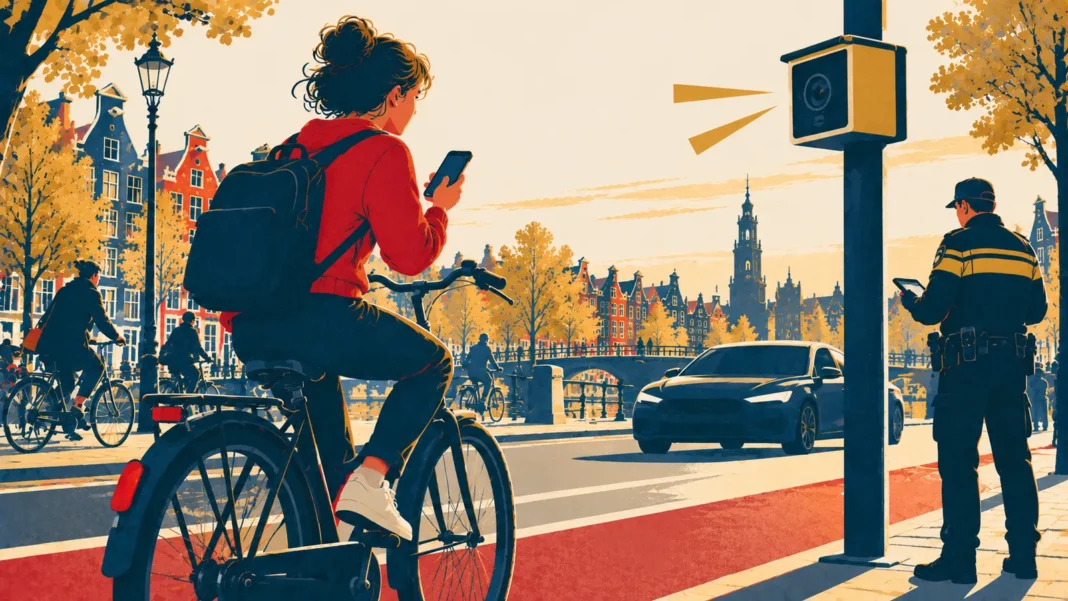
- Holding a phone while cycling: €170. The offence is holding a mobile electronic device that can be used for communication or information processing while riding (article 61a of the RVV 1990, the Dutch traffic rules). The annex describes the offence as holding the device.
- Red light: €120. This applies to both three-colour and two-colour traffic lights.
- Lights: €75. The annex fines riding without continuously visible white or yellow light at the front and/or red light at the rear (feitcode R 438k). A separate code for flashing lights also applies to cyclists at €75.
- Not using a mandatory cycle path: €75. Where a cycle path is mandatory, cyclists must use it.
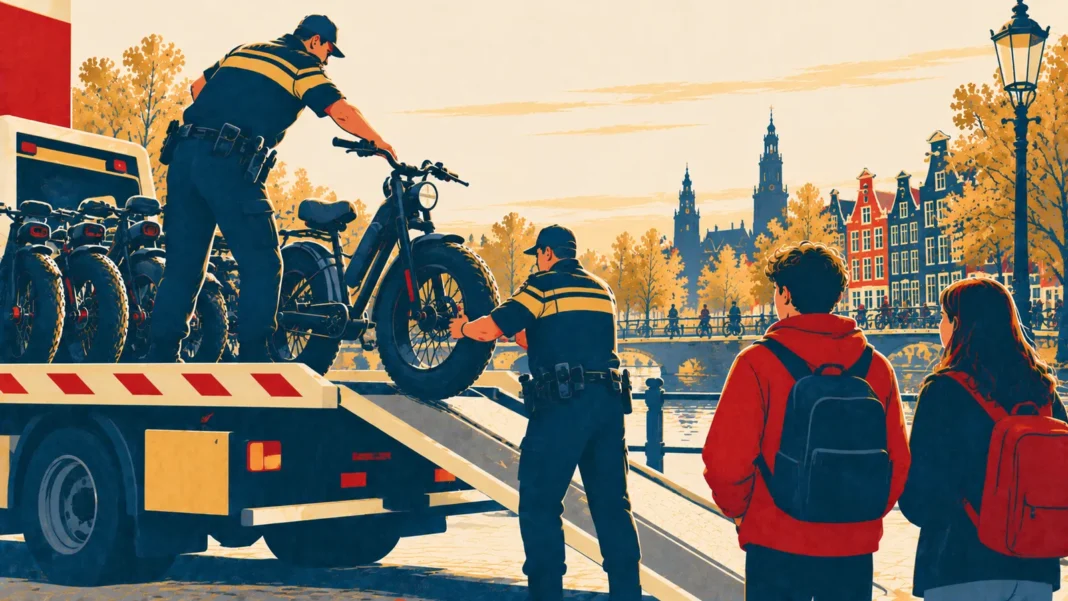
For e-bikes and fatbikes, see our guide to fatbike rules, which covers the separate rules for these vehicles.
3. Fines for car drivers
Drivers of cars and other motor vehicles on more than two wheels fall under category 1. Selected amounts from the annex:
| Offence | Fine |
|---|---|
| Holding a phone while driving | €440 |
| Not stopping at a red traffic light | €320 |
| Not wearing an available seatbelt (driver or passenger) | €190 |
| Carrying a child under 3 without a seatbelt or child seat available | €280 |
| Driving over a pavement, footpath or cycle path | €190 |
| Stopping on a pavement, footpath or cycle path | €130 |
| Parking less than five metres from a junction | €130 |
Source: Wahv annex, version in force from 1 September 2026 (R 545, R 602, R 533, R 535h, R 315a/b, R 397a), checked 27 October 2026.
The CJIB explains that in the Netherlands the registered owner of a car must pay a fine linked to the number plate, even if someone else was driving. This is called kentekenaansprakelijkheid. The owner can ask the driver to pay, but if the driver does not, the owner remains responsible. If you have just moved here with a car or a foreign licence, our guide to exchanging a foreign driving licence explains the licence rules.
4. Speeding fines by how fast you were going
Speeding fines depend on how far you were over the limit and on the type of road. The amounts below are for cars (category 1 in the speed table) and come from the Wahv annex. Separate, higher amounts apply in 30 km/h zones, in a woonerf (residential zone) and at road works.
| Over the limit | Inside a built-up area | On roads outside a built-up area | In a 30 km/h zone or woonerf |
|---|---|---|---|
| 4 km/h | €37 | €33 | €62 |
| 10 km/h | €95 | €89 | €142 |
| 20 km/h | €255 | €243 | €342 |
| 30 km/h | €446 | €424 | Not in the table |
Source: Wahv annex, version in force from 1 September 2026, feitcodes VA, VF, VS and VV, checked 27 October 2026. Amounts exclude €9 administrative costs.
The annex lists amounts per km/h. If you were going faster than the highest amount listed for that road type, the case is not settled with a fixed Mulder fine. A note in the annex also states that when police stop a driver who exceeds the limit by 50 km/h or more (30 km/h for mopeds), the driving licence is taken in. Fines for vans, trucks and buses (category 2) are higher than the amounts shown.
5. Fines for moped and snorfiets riders
Riders of bromfietsen (mopeds, yellow plate) and snorfietsen (light mopeds, blue plate) fall under category 3. The annex sets these amounts:
- Holding a phone while riding: €300.
- Red light: €220.
- No helmet: €130. The offence covers riders and passengers of a bromfiets, snorfiets or brommobiel without a closed body who do not wear a properly fitting, fastened and approved helmet.
- Not using the mandatory cycle path, or not using the road where required: €130. A snorfiets rider who uses the optional cycle path with the combustion engine running also pays €130, and so does a snorfiets rider who does not use the road where a local traffic decision requires it.
6. Paying a fine: the CJIB, deadlines and surcharges
The CJIB collects traffic fines and sends the letter. The Rijksoverheid states that the CJIB charges €9 in administrative costs. The Wahv sets the payment rules:
- Payment term. The fine and the administrative costs must be paid within the term stated on the decision. Article 23 of the Wahv sets the legal deadline as two weeks after the decision becomes final (onherroepelijk).
- First surcharge: 50%. If the amount is not paid in time, the fine is increased by 50% by law (article 23).
- Reminder and second surcharge: 100%. After a reminder (aanmaning), you have four weeks to pay the increased amount (article 24). If you still do not pay, the amount is increased again by 100% of the fine plus the earlier surcharge, and the CJIB can recover the debt (article 25).
- Payment in instalments. According to the CJIB, you can sometimes agree a payment plan if the fine is €75 or more, or several fines together are €75 or more, counting surcharges but not administrative costs. If you made an arrangement in the past six months, a new one is only possible if you kept to the previous one.
The Rijksoverheid summarises it simply: if you pay a fine late or not in full, you may have to pay double.
7. How to object to a traffic fine
The CJIB explains that a traffic fine is a letter marked with the letter M. To object, you write to the officier van justitie (public prosecutor) within six weeks of the date the CJIB sent the letter. While you object, you do not have to pay the fine yet, and the CJIB advises not to request a payment plan at the same time.
Your letter must include, according to the CJIB:
- your name, address, town, date and place of birth;
- the CJIB number of the fine, shown at the top right of the letter;
- why you disagree with the fine;
- your IBAN;
- the date and your signature.
Send it with a copy of the fine to Parket CVOM, Afdeling Mulder, Postbus 50.000, 3500 MJ Utrecht. If you paid the police directly, include a copy of the police report. The CJIB says it can take up to sixteen weeks before you receive the prosecutor’s decision. For number-plate fines, the CJIB notes that objecting on the grounds that you were not driving has no effect, but the owner can authorise the driver to appeal with a signed authorisation form.
If you disagree with the prosecutor’s decision, the next step is the kantonrechter (sub-district court). The CJIB and the Openbaar Ministerie explain that procedure on their own pages.
8. FAQ
How much is the fine for using a phone on a bike in the Netherlands?
€170 for holding a mobile device while cycling, plus €9 administrative costs, under the Wahv annex in force since 1 September 2026.
How much is the fine for using a phone while driving?
€440 for a car driver, plus €9 administrative costs.
What happens if I pay a Dutch traffic fine late?
The fine is increased by 50%. After a reminder you have four weeks to pay; if you still do not pay, it is increased by a further 100% of the fine plus the first surcharge.
How long do I have to object to a traffic fine?
Six weeks from the date the CJIB sent the letter, according to the CJIB. You object in writing to the officier van justitie.
Can I pay a traffic fine in instalments?
Sometimes. The CJIB allows a payment plan if the fine, or several fines together, come to €75 or more, not counting administrative costs.
Are fines lower for teenagers?
Yes. Under article 2 of the Wahv, the amount is halved for people who were not yet 16 at the time of the offence.
🇳🇱 Dutch Corner
| Dutch | English | Example |
|---|---|---|
| de verkeersboete | traffic fine | Ik heb een verkeersboete gekregen. (I got a traffic fine.) |
| de feitcode | offence code | De feitcode staat op de brief. (The offence code is on the letter.) |
| de aanmaning | payment reminder | Na de aanmaning wordt de boete hoger. (After the reminder, the fine goes up.) |
| het beroep | appeal, objection | Ik ga in beroep bij de officier van justitie. (I am objecting to the public prosecutor.) |
| de betalingsregeling | payment plan | Ik vraag een betalingsregeling aan. (I am applying for a payment plan.) |
| de bebouwde kom | built-up area | Binnen de bebouwde kom rijd je meestal 50. (Inside built-up areas you usually drive 50.) |
| het kenteken | number plate | De boete hoort bij het kenteken. (The fine is linked to the number plate.) |
Sources
- wetten.overheid.nl: Wet administratiefrechtelijke handhaving verkeersvoorschriften (Wahv) and annex, version in force from 1 September 2026 (articles 2, 6, 23, 24 and 25; checked 27 October 2026)
- Rijksoverheid: Hoe hoog zijn de boetes in Nederland? (administrative costs €9; checked 27 October 2026)
- CJIB: Ik wil mijn boete in termijnen betalen (checked 27 October 2026)
- CJIB: Bent u het niet eens met een verkeersboete? (checked 27 October 2026)
Free: Netherlands 2027 Money Checklist
Every deadline and number you need before and after 1 January 2027, on two printable pages. Confirm your email and the PDF is yours; we will also email you when the 2027 figures are confirmed.
 Read nextLiving in NLLegal Warranty Netherlands: Your Rights When a Product Breaks Too Soon