AMSTERDAM – October 8, 2026 | The Dutch Daily
Things the Dutch do that shock foreigners: every newcomer to the Netherlands has that moment. A colleague tells you your presentation “wasn’t very good” in front of everyone. A friend sends you a Tikkie for €2.35 after coffee. Your neighbour invites you to a birthday party and you end up sitting in a circle of chairs congratulating people who are not the birthday person.
Dutch culture is not rude – it is efficient, egalitarian and honest, and once you understand the logic behind it, most of these habits start to make sense. Some you may even come to love. Here are 21 Dutch habits that surprise foreigners, grouped by situation, with the reasoning behind each one.
Note: this is a culture guide based on everyday life in the Netherlands. The habits below are common generalisations, not rules, and not every Dutch person does them.
Dutch culture shock: quick answer
- Directness: Dutch people say what they think; it is meant as respect, not rudeness.
- Money: splitting the bill (and sending a Tikkie for €2) is completely normal.
- Social life: everything goes in the agenda, dinner is at 18:00, and birthdays are celebrated in a circle.
- Work: flat hierarchy, first names for the boss, and leaving on time is normal.
- Why: Calvinism, a trading history and centuries of jointly managing water.
Contents
1. At work
1. Directness that feels like an attack
The famous Dutch directness (Nederlandse directheid) is the number one culture shock. Dutch people say what they think, even to their boss. The idea is that honesty is a form of respect: telling you clearly what is wrong saves time and avoids misunderstandings. It is not personal, and most Dutch people expect you to be just as direct back.
Tip: Feedback is usually about the work, not about you. Answering with “Thanks, what would you change?” earns a lot of respect.
2. Everyone calls the boss by their first name
Hierarchy in Dutch workplaces is flat. Interns question managers in meetings and the CEO might queue behind you at the canteen. Decisions are made through overleg (consultation) – which also explains the many meetings.
3. The “poldermodel”: endless consensus
Big and small decisions are discussed until (almost) everyone agrees. This comes from centuries of jointly managing dikes and water: if you didn’t cooperate, everyone flooded. It is slow, but once a decision is made, people stick to it.
4. Leaving work at exactly 17:00
Working late is not a sign of dedication; it is usually seen as poor planning. Part-time work is extremely common: according to CBS, Dutch women and men work part-time more often than in any other EU country. About 61% of women and 19% of men aged 20 to 65 work part-time, against an EU average of 28% of working women and 8% of working men (2023). Don’t be surprised if your colleague “works Mondays to Thursdays”.
5. Lunch is a sandwich and a glass of milk
Lunch at a Dutch office is often bread with cheese (boterham met kaas), maybe a glass of milk or buttermilk (karnemelk), eaten in 20 minutes – sometimes at your desk. A warm lunch is the exception.
2. Money
6. Splitting the bill to the cent (“going Dutch”)
Paying for each other is not the norm, even on a first date. Tikkie payment requests for tiny amounts are completely normal and not considered stingy. It is about equality: no one owes anyone anything.
7. Talking openly about money – except salary
The Dutch will happily tell you how much they paid for their house or how they found a cheap energy contract. Bragging, however, is frowned upon, and asking someone’s salary directly can still feel awkward.
8. Being proud of a bargain
“Doe maar normaal, dan doe je al gek genoeg” – just act normal, that’s crazy enough. Showing off is unpopular, while a good deal from the market or the Action is something to brag about.
3. Social life
9. The birthday circle (kringverjaardag)
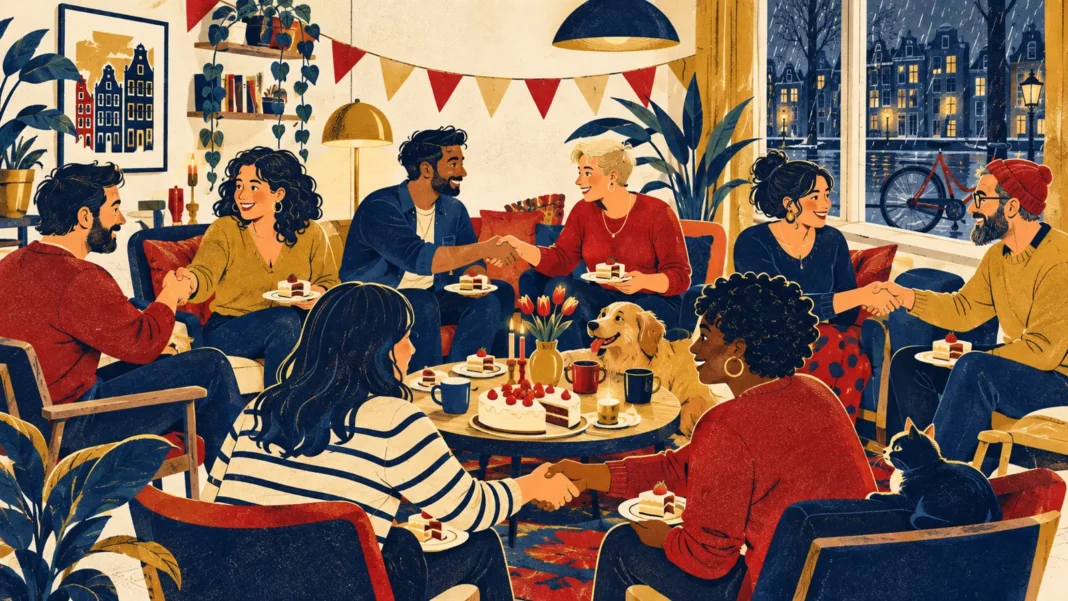
At a Dutch birthday party, guests sit in a circle and you go round shaking hands with everyone – and congratulating them all on the birthday of the host (“Gefeliciteerd met je zus!“). Coffee comes with exactly one slice of cake.
10. Everything is scheduled in the agenda
Spontaneous visits are rare. Friends book dinners weeks ahead, and even children have play dates in the family calendar. Don’t drop by unannounced – it can genuinely stress people out.
11. Dinner at 18:00
Most Dutch families eat between 17:30 and 18:30. Calling someone at dinnertime is a minor social crime.
12. Three kisses
Friends and family greet each other with three kisses on the cheek (right–left–right). In professional settings, a firm handshake is expected.
13. Curtains wide open at night
Many Dutch homes have big windows and no curtains closed in the evening. It is linked to a Calvinist idea that you have nothing to hide. Staring in is still considered rude.
14. Birthday calendars in the toilet
Yes, many Dutch households hang a birthday calendar (verjaardagskalender) on the toilet wall. It is the one place where you are guaranteed to see it every day.
4. Daily life
15. Cycling in any weather – including storms
Dutch people cycle in rain, wind and snow, often carrying children, groceries or furniture. Cyclists rule the road, and stepping onto a bike lane as a tourist is a real danger. Read our public transport and bike guide.
16. Children cycle to school alone
Kids of 10 or 11 cycling across town on their own is normal. In UNICEF’s Report Card 19 (May 2025), the Netherlands ranked first for child well-being, ahead of Denmark and France.
17. Doctors who send you home with paracetamol
The Dutch GP (huisarts) is your first stop for almost everything. Many newcomers are surprised when they are told to rest and take paracetamol instead of getting a prescription. See our guide to finding a huisarts.
18. Shops close early (outside the big cities)
In many towns shops close at 18:00 and on Sundays only open in the afternoon – or not at all. Thursday or Friday is often koopavond, late-night shopping.
19. Hagelslag for breakfast
Chocolate sprinkles on buttered bread are a breakfast staple for adults, not just kids. There are dozens of varieties.
20. Raw herring, held by the tail
Fresh Hollandse Nieuwe herring is eaten raw with onions, held by the tail and lowered into the mouth. It is a summer ritual, especially in June.
21. Wearing orange from head to toe
On King’s Day (27 April) and during big football tournaments, the whole country turns orange. Streets become flea markets, and the normally reserved Dutch party everywhere.
5. Why the things the Dutch do that shock foreigners make sense: a short history
Three explanations come up again and again:
- Calvinism valued sobriety, honesty and modesty over politeness and show.
- Trade: a nation of merchants needed clear agreements, not vague promises.
- Low hierarchy and the polder: when everyone has to work together to keep the water out, plain speaking is more useful than flattery.
The result is a culture where saying what you mean is polite, and hinting is seen as unclear or even dishonest.
6. How to adapt (without losing yourself)
- Don’t take directness personally. Ask questions back – that is the Dutch way.
- Make appointments. Use an agenda for social life, too.
- Learn a little Dutch. Even basic phrases open doors. Start with our basic Dutch phrases and untranslatable Dutch words.
- Say no clearly. A Dutch “no” is final, and your “maybe” will be read as “yes”.
- Join the circle. Go to the birthday party, shake every hand, eat the cake.
Give it time: most of the things the Dutch do that shock foreigners in the first weeks start to feel normal once you know the reasoning behind them.
7. FAQ
Are Dutch people rude?
No. They value honesty over politeness and consider direct speech a form of respect. Most Dutch people are helpful and friendly once you get to know them.
What is “going Dutch”?
Everyone pays for their own share of a bill. In the Netherlands this is the norm among friends, colleagues and often on dates.
What is a kringverjaardag?
A typical Dutch birthday gathering where guests sit in a circle, drink coffee, eat cake and congratulate everyone present.
How long does it take to get used to Dutch culture?
It differs per person. Many newcomers find the first months the hardest; once you understand the logic behind the habits, Dutch directness often starts to feel refreshing.
What are the things the Dutch do that shock foreigners the most?
The things the Dutch do that shock foreigners most are usually directness, splitting the bill to the cent, the birthday circle and dinner at six.
🇳🇱 Dutch Corner
| Dutch | English |
|---|---|
| Direct | Direct, straightforward |
| Gezellig | Cosy, convivial |
| Doe maar normaal | Just act normal |
| De kringverjaardag | Birthday party in a circle |
| Gefeliciteerd! | Congratulations! |
| Het overleg | Consultation, meeting |
| De boterham | Slice of bread / sandwich |
| De hagelslag | Chocolate sprinkles |
| De agenda | Diary, calendar |
| Een Tikkie sturen | To send a payment request |
Sources
- CBS, Emancipatiemonitor 2024: Gelijk in Europees perspectief? (part-time work in the Netherlands and the EU, 2023)
- UNICEF Innocenti, May 2025: Report Card 19, Child Well-Being in an Unpredictable World (Netherlands ranked first)
- Government of the Netherlands: public holidays (King’s Day, 27 April)
More on The Dutch Daily: Untranslatable Dutch words · Basic Dutch phrases
Dutch rules change fast. Stay ahead.
Get an email when citizenship, immigration or tax rules change, plus our free Netherlands 2027 Money Checklist. Confirm your email and the PDF is yours; we will also email you when the 2027 figures are confirmed.
 Read nextBusiness & FinanceDutch Municipal Taxes: Waste Tax, Sewer Charges & Water Board Tax