


Contents
Prices, fees and rules in this article were checked on 21 November 2026. They can change, so check the linked pages before you decide.
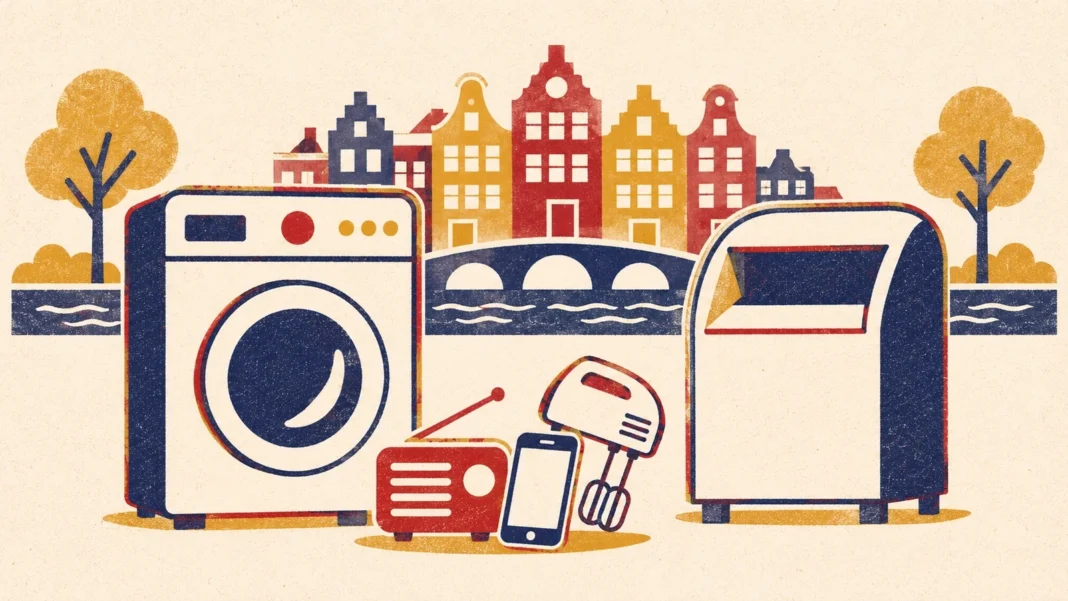
Your options for appliance recycling in the Netherlands include returning an old, similar device when you buy a replacement, using a small-appliance collection point, or checking your municipality’s arrangements. The government’s household guidance distinguishes these routes. Which one fits depends on whether you are buying something new, the device’s dimensions and the collection services available locally.
This guide concerns household devices. It explains existing arrangements rather than a newly announced recycling scheme. A replacement washing machine, a drawer of small gadgets and an appliance that still works need different decisions before you carry anything to a shop.
1. Your options for appliance recycling in the Netherlands
Start by deciding whether you are replacing the item or simply clearing it out. RVO’s retailer guidance confirms that sellers, including webshops, must take back a comparable discarded appliance free when supplying a new one. It separately describes small-device collection without a purchase at qualifying retailers. These are different collection routes, so identify which you intend to use before arranging a return.
| Your situation | Where to start | What to check |
|---|---|---|
| Buying a comparable replacement | The seller of the new appliance | Its free take-back arrangements |
| Discarding a small device without buying | A qualifying electronics retailer or collection point | Dimensions and accepted items |
| Using a local service | Your municipality | Drop-off or collection arrangements |
Routes checked 21 November 2026 against RVO’s retailer guidance and the government’s household guidance linked above.
RVO also explains why collection is organised through these channels: producers bringing equipment onto the market have responsibilities for its waste management, including arranging and paying for collection and recycling. That background does not mean that every optional transport or household service has the same terms. Ask about the particular collection route you will use.
2. Online orders and delivery
The government calls replacement take-back the oud-voor-nieuwregeling. Under its guidance checked 21 November 2026, the old appliance can be a different brand or size and does not have to work. It must be similar to the new purchase. The service is free for private households.
Online and telephone purchases are included. The guidance allows return to the delivery driver or collection point. If immediate take-back is unavailable, it describes later collection within two weeks or seller-provided packaging for free return shipping. Ask the seller which arrangement it offers before delivery, rather than assuming a driver can accept an unannounced item. The two-week period described here concerns later collection.
3. Returning small devices without a purchase
The no-purchase route is called oud-voor-niets. The published regulation’s Article 5 and explanatory note specify at least 400 square metres of sales area for electrical and electronic equipment. This is the electronics sales area, rather than the total size of a supermarket or department store. Current RVO guidance, checked 21 November 2026, confirms that threshold.
The regulation defines very small discarded equipment as having no outside dimension above 25 centimetres. Measure length, width and depth, rather than judging only whether an item looks small. Article 5 provides for free collection in or immediately near qualifying shops without a comparable purchase. It also contains an exception where publicly available research establishes an equally effective alternative collection arrangement. Check the retailer’s instructions for the actual handover location.
4. Municipal collection: two local examples
Local arrangements should be checked for your address. The following examples were checked on 21 November 2026 and describe the named municipalities’ services.
Groningen
Groningen’s appliance page offers a waste-station route when you are not buying a replacement. It also lists home collection by appointment for larger devices such as washing machines and refrigerators. That service is free for private individuals; businesses, associations and other organisations pay.
The municipality asks for appliances to be empty and tidy: leave no oil or fat in a fryer and no food in a refrigerator. For smaller devices, its chemokar accepts items that fit in a normal shopping bag. Consult the local waste calendar to find when it visits your neighbourhood. A device that still works can instead go to a kringloopwinkel or be collected by a reuse business. Check that organisation’s arrangements before transporting it.
The Hague
The Hague’s English guidance lists waste depots and small-appliance collection bins at all municipal city farms. These provide an alternative starting point when a shop return does not fit your situation.
Working devices can go to a charity shop; the municipality also points to repaircafés for broken ones. If the listed options do not work for you, large appliances can be collected as bulky waste through a separate appointment. The city cautions that not all appliances may be recycled through that route. It lists depots and many shops selling the relevant lamps as collection options for energy-saving and LED bulbs. Use the city’s linked instructions to arrange a visit or collection; these examples do not establish the service offered at an address elsewhere.
5. Finding a point and preparing your devices
Wecycle’s collection-point finder covers locations including supermarkets, DIY shops, electronics shops, garden centres and municipal depots. Its descriptions distinguish different collection streams, including bicycle batteries at participating bicycle shops. Use the finder for the item you have, then check the selected location’s instructions. Finding an appliance collection point does not establish that the same container accepts lamps or loose batteries.
Battery disposal has its own rules. Government guidance checked 21 November 2026 says empty batteries must not go in the rubbish bin. Household batteries can be returned to shops and supermarkets selling batteries; industrial batteries go to the municipal depot. Identify the battery collection stream separately when organising your discarded items.
For devices with a built-in battery, Wecycle’s collection instructions direct small devices to an appliance collection point or municipal depot. They direct bicycle batteries to a participating bicycle shop or municipal depot. Those instructions are a route for handing items over, rather than directions to dismantle a battery.
6. What happens after collection?
Wecycle describes transport to specialised processing locations, sorting, dismantling and separation of materials. Its account includes removing batteries before shredding and recovering metals and plastics for further use. This describes the scheme’s process, rather than guaranteeing a particular recovery percentage for your individual device.
Think about personal information before handing over a computer, phone or tablet. Wecycle notes that storage media can hold photos and other confidential information and links instructions for deleting data. Read the relevant instructions before surrendering your device. Its household advice also asks people to keep discarded devices dry and complete while collecting them for handover.
7. FAQ
Does every device need a plug?
No. Wecycle’s FAQ includes devices operating on a plug or a built-in battery. A cordless device therefore belongs in your search for an appropriate collection route too.
Should a working device go straight for recycling?
Wecycle suggests considering repair, selling or giving an item away before recycling it. Decide which outcome you want, then check the chosen organisation’s acceptance arrangements. A reuse handover and an e-waste collection are different decisions.
Can I put an appliance outside for collection?
Follow your municipality’s instructions. Groningen and The Hague both describe appointment-based routes for larger items. Confirm the arrangements for your own address before putting anything out.
🇳🇱 Dutch Corner
| Dutch | English |
|---|---|
| het apparaat | the appliance or device |
| de milieustraat | the municipal waste drop-off facility |
| het afvalbrengstation | the waste drop-off station |
| de kringloopwinkel | the second-hand or reuse shop |
| de oud-voor-nieuwregeling | the old-for-new take-back arrangement |
| het inleverpunt | the collection or return point |
Sources
- Rijksoverheid: returning household appliances — replacement returns and online purchases.
- RVO / Ondernemersplein: electrical and electronic equipment recycling — retailer obligations and producer responsibility.
- Staatscourant 2014, 2975 — original regulation, Articles 1 and 5 and explanatory note; current shop-area threshold corroborated by RVO.
- Gemeente Groningen: Elektrische apparaten inleveren — local collection options.
- The Hague: Separating waste: electric appliances — local collection and reuse options.
- Wecycle: collection-point finder — finding a suitable location.
- Rijksoverheid: returning empty batteries — separate battery collection.
- Wecycle: battery collection instructions — built-in batteries and bicycle batteries.
- Wecycle: Over recyclen — preparation, data and processing.
- Wecycle: household guidance and FAQ — battery-powered equipment and reuse.
Free: Netherlands 2027 Money Checklist
Every deadline and number you need before and after 1 January 2027, on two printable pages. Confirm your email and the PDF is yours; we will also email you when the 2027 figures are confirmed.
 Read nextLiving in NLDutch Low-Emission Zones (Milieuzones): Which Cars Can Enter Which Cities
 HousingEnergy Bill 2027 in the Netherlands: What Changes on 1 January and What You Can Do Now
 Living in NLPartner Visa Netherlands: Requirements, the Income Rule, MVV and Costs
 Living in NLLegal Expenses Insurance in the Netherlands: What a Rechtsbijstandverzekering Covers, Free Choice of Lawyer and Alternatives