


Contents
- 1. The consultatiebureau at a glance
- 2. The first weeks: home visit, first appointment and the RIVM letter
- 3. What happens at a consultatiebureau visit
- 4. The Dutch vaccination schedule, age by age
- 5. What changed in the schedule from 2025
- 6. Free, and your choice
- 7. After age 4: school doctor and group vaccinations
- 8. Moving to the Netherlands with a young child
- 9. FAQ
- 🇳🇱 Dutch Corner
- Sources
Prices, fees and rules in this article were checked on 26 November 2026. They can change, so check the linked pages before you decide.
The consultatiebureau is the free well-baby clinic that follows every child in the Netherlands from the first weeks of life until about age 4, and it is also where your child gets most of the vaccinations of the Dutch National Immunisation Programme, the Rijksvaccinatieprogramma (RVP). For parents who grew up elsewhere it can feel unfamiliar: you do not choose it, you do not pay for it, and the first contact usually comes to you. According to the Dutch government, the consultatiebureau invites you when your baby is 1 month old. This guide explains what happens at those visits, which vaccinations your child is offered at which age, what changed in 2025, and what to do if your child was born or vaccinated abroad.
1. The consultatiebureau at a glance
The consultatiebureau is part of Dutch youth healthcare, the jeugdgezondheidszorg (JGZ). The national knowledge centre for youth healthcare, the NCJ, describes the JGZ as a service for all children, young people and (expecting) parents. It gives free advice, information and support about healthy growing up and parenting, carries out preventive checks such as eyes, ears and growth, and gives the vaccinations of the RVP. It follows children from before birth until they turn 18.
Many parents simply know the 0–4 part as “the consultatiebureau” and the later part as “the school doctor” (schoolarts). The building can also carry another name. The NCJ lists Centra voor Jeugd en Gezin (CJG), Ouder- en Kindcentra, a consultatiebureau inside a health centre, or a GGD or home-care building. Which one you get depends on where you live, because youth healthcare is organised regionally.
| Question | Answer | Source |
|---|---|---|
| Who is it for? | All children; the well-baby clinic covers ages 0–4, school JGZ takes over from 4 | NCJ; RVP |
| What does it cost? | Nothing: youth healthcare advice is free and RVP vaccinations are free up to and including age 18 | Rijksoverheid; RVP |
| Is it compulsory? | Vaccination is voluntary; parents decide | RVP |
| First contact | Home visit about 2 weeks after birth; first clinic visit usually at 4 weeks | RVP |
| Vaccinations before 14 months | Given during 5 of the clinic visits | RVP |
Sources: Rijksoverheid (page updated 30 September 2026), NCJ and Rijksvaccinatieprogramma.nl. Checked 26 November 2026.
2. The first weeks: home visit, first appointment and the RIVM letter
You do not need to sign up yourself. The RVP explains the order of events as follows.
- Around 2 weeks after birth: a home visit. A doctor or nurse from the well-baby clinic comes to your home to introduce themselves. Your baby is not medically examined during this visit. You can ask questions about caring for your baby, and you are told about the vaccination programme.
- The first clinic appointment. The nurse who visits usually also makes the appointment for your first visit to the consultatiebureau. That first visit usually takes place when your baby is 4 weeks old.
- Around 4 weeks: the RIVM letter. The national public health institute RIVM sends an invitation to take part in the programme. The envelope contains a letter, the vaccination certificate, all the invitation cards for the vaccinations until your child turns 4, and an information leaflet.
If your baby is 2 months old and you have still not received an invitation for the first vaccinations, the RVP asks you to contact the RIVM Department of Vaccine Provision and Prevention Programmes (DVP) in your region. If you have not yet registered the birth, see our guide on how to register a birth in the Netherlands, because the invitations depend on that registration.
Keep the vaccination certificate somewhere safe. It is the paper record of the vaccinations your child receives in the programme.
3. What happens at a consultatiebureau visit
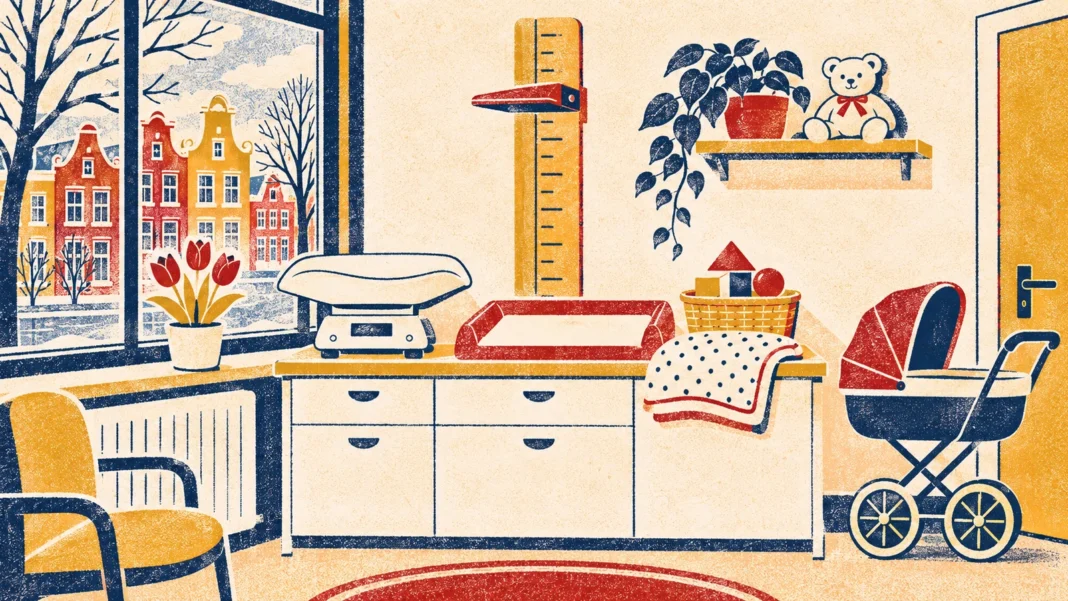
A visit is a short health check, not a sick-child appointment. According to the RVP, the doctors and nurses check that children aged 0–4 are developing healthily. They look at things such as your child’s height and weight and how well your child can see and hear. On some visits your child also gets a vaccination, but health checks take place on the visits without a vaccination too.
Your baby visits the clinic a number of times during the first 14 months and receives a vaccination during 5 of those visits. Under the schedule that applies from 2025, the last vaccination at the well-baby clinic is the second BMR jab, offered around age 3 (between 2.5 and 3.5) to children born from 2022; the DKT jab at 5 is given by the school-age youth healthcare team. The exact number of other appointments is not set out on the national pages and can differ by region, so follow the invitations from your own JGZ organisation.
The visits are also the moment for your own questions. The government gives examples such as dealing with a baby who cries a lot, moving to solid food, or a child who is not talking yet. The consultatiebureau is not a replacement for your GP (huisarts): when your child is ill, you go to the GP. If you still need one, see our guide on how to find a huisarts.
A practical tip: bring the invitation card for the vaccination, the vaccination certificate, and your questions written down, so nothing is forgotten during a short appointment.
4. The Dutch vaccination schedule, age by age
The official vaccination schedule (vaccinatieschema) shows when children receive each vaccination. The RVP says it is the best schedule for every child in the Netherlands and that there is no medical reason to deviate from it for a healthy child. The table below follows the schedule as published on 26 November 2026.
| Age | Vaccination | Protects against |
|---|---|---|
| 0–2 weeks (or 0–7 months) | RSV injection | RS virus |
| 6–9 weeks | Rota; DKTP-Hib-HepB only in some cases (see below) | Rotavirus; diphtheria, whooping cough, tetanus, polio, Haemophilus influenzae type b, hepatitis B |
| 3 months | Rota, DKTP-Hib-HepB and pneumococcal | Rotavirus; diphtheria, whooping cough, tetanus, polio, Haemophilus influenzae type b, hepatitis B; pneumococcal disease |
| 5 months | DKTP-Hib-HepB and pneumococcal | As above, plus pneumococcal disease |
| 12 months | DKTP-Hib-HepB and pneumococcal | As above |
| 14 months | BMR and MenACWY | Mumps, measles, rubella; meningococcal ACWY |
| 3 years | BMR (second dose) | Mumps, measles, rubella |
| 5 years | DKT | Diphtheria, whooping cough, tetanus |
| 10 years | HPV, 2 doses, the second half a year later | Human papillomavirus |
| 14 years | DTP and MenACWY | Diphtheria, tetanus, polio; meningococcal ACWY |
Source: Rijksvaccinatieprogramma.nl, Vaccinatieschema (schedule from 2025). Checked 26 November 2026.
The schedule has footnotes that matter for some families:
- RSV timing depends on the birth month. Babies born from October to March get the RSV injection within 2 weeks after birth. Babies born from April to September get it in September or October.
- DKTP-Hib-HepB at 6–9 weeks. This early jab is only given if the mother was not vaccinated against whooping cough during pregnancy, or in special situations. The youth doctor (jeugdarts) discusses this with you.
- Second BMR for older children. Children born from 1 January 2016 up to and including 2021 get the second BMR jab between the ages of 5 and 9.
- DTP at 14. Children born from 2016 onwards get a DTP jab at 14.
The abbreviations are Dutch. BMR is the Dutch name for MMR (bof, mazelen, rodehond), and DKTP stands for difterie, kinkhoest, tetanus, polio. If a doctor abroad later asks for your child’s records, these translations help.
5. What changed in the schedule from 2025
If an older sibling followed a different timetable, one reason may be that the schedule changed in 2025. The Health Council (Gezondheidsraad) reviewed the programme at the request of the health ministry and advised keeping all vaccinations while moving some of them, so that children are protected better. The RVP lists the changes:
- 12 months instead of 11 months for the DKTP-Hib-HepB and pneumococcal vaccination.
- Second BMR at 3 years instead of 9 years, for children born from 1 January 2022. Children born from 2016 up to and including 2021 get their second BMR earlier too, between 5 and 9.
- DKT at 5 years instead of DKTP at 4 years. The DKT vaccine does not contain a polio component.
The RVP stresses that the vaccines themselves did not change in content or composition; only the timing did. The reason given for the earlier second BMR is measles: after the first BMR at 14 months, a small number of children have not yet built up enough protection, and an earlier second dose protects them sooner. Separately, the RVP timeline records that an injection against RSV was added in 2025, while the whooping-cough vaccination for pregnant women at 22 weeks has been offered since 2019.
6. Free, and your choice
All vaccinations in the RVP are free for children aged 0 to 18, as the government confirms. The consultatiebureau’s advice and checks are free youth healthcare as well.
Vaccination is voluntary in the Netherlands. The RVP states it plainly: as a parent, you choose whether your child is vaccinated. If you have doubts or questions, you can discuss them with the youth doctor or nurse at the consultatiebureau.
7. After age 4: school doctor and group vaccinations
When your child turns 4, the well-baby clinic’s role ends. According to the RVP, youth healthcare then moves to JGZ teams working through schools, and health screenings take place at school. The NCJ adds that each school usually has its own JGZ team with a youth doctor, a youth nurse and a JGZ assistant, and the school has their contact details.
Vaccinations after age 4 work differently. They are usually not combined with a health check. Instead, children of the same age are vaccinated together in a large venue in the municipality, such as a sports hall, once or several times a year depending on the JGZ organisation. RIVM sends your child an invitation letter, which often already includes an appointment. If the time does not suit you, you can arrange another appointment with the JGZ during the period when the group vaccination is offered.
8. Moving to the Netherlands with a young child
Whether your child can join the programme depends mainly on registration. The RVP’s eligibility page says Dutch law entitles children aged 0–18, and pregnant women from week 22, to RVP vaccinations if at least one of these applies:
- they are registered in the Personal Records Database (BRP) and live in the Netherlands;
- they are registered in ProBas, the register for “privileged persons” such as diplomats and staff of international organisations, and their children;
- they are asylum seekers living in a COA reception location;
- another situation makes vaccination necessary, for example illness.
For most newcomers the first point is the one that counts, so registering at your municipality matters. Our guide to BRP registration explains that step. Adopted children from abroad are registered in the BRP and are therefore eligible too.
For children who arrive not fully vaccinated, the RVP page sets out a principle for foreign children aged 0–4: they should in principle get their vaccinations in their country of origin. If arranging that would take longer than a month, the medical interest of protecting as many children in the Netherlands as possible weighs more heavily. The RVP adds that the one-month period is not a hard limit. In practice, bring your child’s vaccination records from abroad to the consultatiebureau or JGZ, and they will look at what is missing and which catch-up schedule fits.
Cross-border situations have their own rules. Dutch children living in Germany or Belgium are not registered in the BRP, so they cannot take part in the RVP, even if they go to school in the Netherlands; they use the programme of the country where they live. Pregnant women who live in Germany or Belgium but receive obstetric care in the Netherlands do qualify for the 22-week whooping-cough jab. Dutch citizens living abroad long term are generally not in the BRP and arrange vaccinations where they live. If you are expecting, our pregnancy guide covers the midwife and kraamzorg stage before the consultatiebureau takes over.
9. FAQ
Do I have to register my baby with the consultatiebureau?
No separate sign-up is needed. A doctor or nurse from the clinic visits about 2 weeks after birth and usually books the first clinic appointment, and RIVM sends the vaccination invitation when your baby is about 4 weeks old. If nothing has arrived by 2 months, contact your local consultatiebureau or the RIVM regional office (DVP).
Does the consultatiebureau cost money?
No. Advice and checks from youth healthcare are free, and all RVP vaccinations are free for children up to and including 18.
Is vaccination compulsory in the Netherlands?
No. Vaccination is voluntary and parents decide. You can discuss doubts with the youth doctor or nurse at the consultatiebureau.
When does my child get the second MMR (BMR) jab?
Children born from 1 January 2022 get it at 3 years. Children born from 2016 up to and including 2021 get it between 5 and 9. Older children followed the old schedule, with the second dose at 9.
My child was vaccinated in another country. What now?
Take the records to the consultatiebureau or JGZ. They check what your child has had and what is still needed. For foreign children aged 0–4 the RVP’s principle is that vaccinations should be arranged in the country of origin, unless that would take too long; the JGZ decides on catch-up in each case.
Can I go to the consultatiebureau when my child is ill?
The consultatiebureau is for prevention, development and parenting questions. For illness, contact your GP.
🇳🇱 Dutch Corner
| Dutch | English |
|---|---|
| het consultatiebureau | the well-baby clinic |
| de jeugdgezondheidszorg (JGZ) | youth healthcare |
| de jeugdarts | the youth doctor |
| de jeugdverpleegkundige | the youth nurse |
| het Rijksvaccinatieprogramma (RVP) | the National Immunisation Programme |
| het vaccinatieschema | the vaccination schedule |
| het vaccinatiebewijs | the vaccination certificate |
| de prik | the jab, the injection |
| de kinkhoest | whooping cough |
| de mazelen | measles |
Sources
- Rijksoverheid: Waar kan ik vragen stellen over de gezondheid en opvoeding van mijn kind van 0–4 jaar? (free youth healthcare, invitation at 1 month, example questions)
- Rijksvaccinatieprogramma.nl: How does it work? (home visit, first visit, RIVM letter, visits and vaccinations, after age 4, no invitation)
- Rijksvaccinatieprogramma.nl: Vaccinatieschema (schedule and footnotes)
- Rijksvaccinatieprogramma.nl: Veranderingen in het vaccinatieschema vanaf 2025 (2025 schedule changes)
- Rijksvaccinatieprogramma.nl: What is the National Immunisation Programme? (free up to 18, voluntary, timeline)
- Rijksvaccinatieprogramma.nl: Who is the National Immunisation Programme intended for? (eligibility, cross-border, children from abroad)
- Rijksoverheid: Zijn vaccinaties gratis? (RVP free for 0–18)
- NCJ: Over jeugdgezondheidszorg (what JGZ does, location names, school JGZ teams)
Free: Netherlands 2027 Money Checklist
Every deadline and number you need before and after 1 January 2027, on two printable pages. Confirm your email and the PDF is yours; we will also email you when the 2027 figures are confirmed.
 Read nextHealthVitamin D in the Netherlands: Who Needs a Supplement in Winter and How Much