


Contents
Checked on 25 November 2026. Rules and amounts can change, so follow the linked sources before you decide.
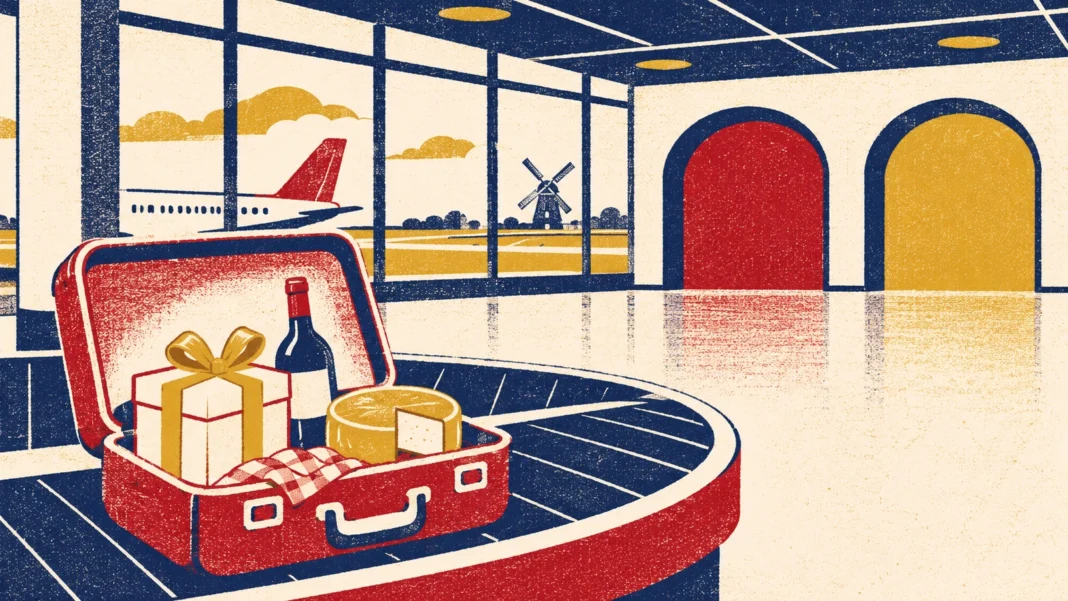
What is in your suitcase when you land at Schiphol after the holidays decides how you leave the baggage hall, and the customs allowance in the Netherlands is the line that tells you which exit to take. Bought a new phone in Istanbul, a bottle of whisky in London and a cheese from your aunt’s village? Each of those follows a different rule, and only one of them is about money.
Read this before you pack for the return trip. You will know how the €430 limit is counted (and why one expensive item can blow it completely), how many litres and cigarettes you can bring, which food must stay behind, and what happens at the red exit.
1. EU or not: the question that decides everything
You only pay import duties, VAT or excise on goods from countries outside the European Union, and from so-called exception areas (uitzonderingsgebieden) of the EU. If you buy within the EU, you pay no extra tax on your purchases when you bring them home (Douane, “Belasting betalen over aankopen uit het buitenland”).
For many expats the trip home for Christmas goes to a country outside the EU: the United Kingdom, Turkey, Morocco, the United States, India. Customs says its tobacco rules for non-EU countries also apply when you travel from Turkey and the Canary Islands, and that Northern Ireland follows the EU amounts for drinks and tobacco. Check the Customs list of EU countries if you are unsure about your departure point.
The difference is large. From an EU country you may bring, for your own use, 110 litres of beer and 800 cigarettes per person aged 17 or over. From outside the EU it is 16 litres of beer and 200 cigarettes. The rest of this page is about trips from outside the EU.
2. The €430 customs allowance in the Netherlands
If you travel as a passenger by plane or ship, you can bring goods bought outside the EU without paying tax if together they are worth no more than €430. Above that, you pay import duties and VAT. It does not matter whether you bought the goods, swapped them or received them as a gift, and the rule also applies to second-hand products (Douane).
Three details trip people up:
- It is per person. You cannot add up the allowances of your partner and children to cover one large purchase.
- One item cannot be split. Two examples show how it works. Five pairs of jeans of €100 each: four fall under the €430 and you pay duties and VAT on the fifth. A watch of €1,000: you pay on the whole amount, not on the €570 above the limit.
- Foreign tax-free shops count. Purchases in a tax-free shop abroad count towards the €430. Purchases in a Dutch tax-free shop before you leave do not, as long as you keep the receipt to show where you bought them.
Some things stay outside the €430 altogether. The Customs handbook leaves the value of your personal luggage and personal medicines out, and alcohol and tobacco have their own quantity limits instead (Handboek Douane, Reizigersbagage). If you arrive by private plane or private boat, the value limit is €300 per person.
One step happens before you fly out. If you take an expensive camera or laptop on the trip, pack the receipt as proof that you bought it in the EU. That prevents problems on your return.
| Travelling from outside the EU | Tax-free per person |
|---|---|
| Other goods (gifts, electronics, clothes), by plane or ship | Up to €430 in total |
| Same, by private plane or boat | Up to €300 in total |
| Beer | 16 litres |
| Still wine | 4 litres |
| Spirits over 22%, or lighter drinks up to 22% (incl. sparkling wine) | 1 litre, or 2 litres, or a proportional mix |
| Tobacco | 200 cigarettes, or 50 cigars, or 250 g tobacco, or 100 cigarillos, or a proportional mix |
| Meat, milk, cheese and other dairy | Not allowed (limited exceptions) |
Source: Douane pages on purchases abroad, drinks, tobacco and animal products, and Handboek Douane, checked 25 November 2026. Alcohol and tobacco allowances apply only from age 17.
3. Alcohol: litres, not euros
From a non-EU country, each traveller aged 17 or over may bring 16 litres of beer and 4 litres of still wine, such as red, white or rosé. Sparkling wine like champagne or cava does not count as wine here (Douane, “Drank meenemen uit het buitenland”).
On top of that comes one of two things: at most 1 litre of spirits above 22% alcohol, such as rum or whisky, or at most 2 litres of a lighter drink up to 22%, such as liqueur or sparkling wine. You may combine them, but if you take some of one, you may take less of the other. Customs gives this example: half a litre of spirits plus 1 litre of sparkling wine is fine. One litre of spirits plus one litre of liqueur is not, because the full spirits allowance leaves no room for the liqueur.
Picture a couple flying back from London with a bottle of gin, a bottle of champagne and a few bottles of red. Each of them has a separate allowance. If one carries the gin and the other the champagne, and they split the wine between them, everything can stay within the limits. Packed in one person’s suitcase, the same bottles go over.
Under 17? Then there is no tax-free allowance at all for alcohol or tobacco.
4. Cigarettes and tobacco
From outside the EU, each traveller aged 17 or over may bring one of these, or a proportional mix: at most 200 cigarettes, 50 cigars, 250 grams of tobacco or 100 cigarillos. In practice that is one carton (slof) of 200 cigarettes (Douane, “Sigaretten of tabak meenemen uit het buitenland”).
The mixing works like the alcohol rule. 125 grams of tobacco and 25 cigars is half of each, so it is allowed. 250 grams of tobacco and 25 cigars is not, because the full tobacco allowance leaves nothing for cigars.
Take a familiar case: someone returning from Turkey with two cartons, 400 cigarettes. 200 are tax-free; the other 200 must be declared and taxed. Customs says the duties, excise and VAT on one carton of up to 200 cigarettes come to a good €100. If you do not declare, a fine comes on top.
E-cigarettes, vapes, snus and nicotine pouches may only be brought in for your own use, never to sell on.
5. Meat, cheese and other food
This is where well-meant gifts from family end up in the customs bin. You may not bring meat, milk, cheese or other dairy products from a country outside the EU. The ban exists to stop animal diseases from spreading (Douane, “Dierlijke producten en levensmiddelen meenemen”).
There are a few exceptions, such as powdered baby milk and food for medical purposes, under conditions, for example that the product does not need to be refrigerated before use. Some countries and areas, including Switzerland and San Marino, have different quantities; the Netherlands Food and Consumer Product Safety Authority (NVWA) lists them.
Within the EU you may bring meat, fish and dairy in your luggage, but Customs advises against it because some products can carry diseases. If you do carry food that is not allowed, declaring it is mandatory; products that do not meet the rules are seized, and you can be fined.
So when the homemade sausage or the wheel of cheese comes out on the last evening, the kindest answer may be to eat it there.
6. Red exit, green exit: declaring and paying
If you have more than the tax-free amounts, you must declare it. At the airport or port you choose the exit with the sign “Goods to declare / Aangifte goederen”, usually shown in red. With nothing to declare you walk through the green exit. Not declaring can bring a fine on top of the tax you owe (Douane).
What you then receive is an uitnodiging tot betaling (UTB): a letter telling you how much tax to pay. A UTB is a tax assessment, not a fine. A fine for not declaring is a different document, the fiscale strafbeschikking (FSB), which Customs sends by post later because it has to calculate the amount (Douane, “Uitnodiging tot betaling (UTB)”).
If you live in the Netherlands, you can pay a UTB on the spot by cash or card. If you do not, you get the UTB by post and transfer the amount within 10 days of the date on the letter. Travellers who live outside the Netherlands and cannot pay straight away cannot take the goods with them until they pay.
The choice is simple. With the watch from section 2, declaring means paying duties and VAT on €1,000. Walking through green and being stopped means the same tax, and you can get a fine on top.
Ordering online from outside the EU instead? Parcels follow other rules, including the new EU handling fee; see our guide to the EU parcel handling fee. And if your residence permit is being renewed while you travel, check our return visa guide before you book.
7. FAQ
How much can I bring into the Netherlands from outside the EU without paying tax?
Goods worth up to €430 per person if you travel by plane or ship, plus separate allowances for alcohol and tobacco if you are 17 or older.
Can my family combine their €430 allowances for one item?
No. The limit is per traveller and cannot be added up. If one item costs more than €430, you pay duties and VAT on its full value.
Is the United Kingdom inside the EU for customs?
No. Travel from Great Britain follows the non-EU limits. Customs says Northern Ireland follows the EU amounts for drinks and tobacco.
Can I bring cheese from outside the EU?
No. Meat, milk, cheese and other dairy from outside the EU are not allowed, with limited exceptions such as powdered baby milk. Some countries, such as Switzerland, have different rules via the NVWA.
Is a UTB a fine?
No. A UTB is the tax you owe on goods above the allowance. A fine for not declaring comes separately as a fiscale strafbeschikking.
🇳🇱 Dutch Corner
| Dutch | English |
|---|---|
| de Douane | Dutch Customs |
| de reizigersvrijstelling | traveller’s tax exemption |
| de invoerrechten | import duties |
| de accijns | excise duty |
| aangifte doen | to declare |
| de slof | carton of cigarettes |
| de uitnodiging tot betaling (UTB) | customs tax demand |
| de fiscale strafbeschikking (FSB) | tax penalty order (fine) |
Sources
- Douane – Belasting betalen over aankopen uit het buitenland (EU vs non-EU, €430 and €300, examples, tax-free shops, declaring)
- Handboek Douane – Reizigersbagage: beperking waarde en hoeveelheden (value limits, luggage and medicines excluded)
- Douane – Drank meenemen uit het buitenland (alcohol from EU and non-EU countries)
- Douane – Sigaretten of tabak meenemen uit het buitenland (tobacco allowances, Turkey example, tax per carton)
- Douane – Dierlijke producten en levensmiddelen meenemen (meat and dairy ban, exceptions)
- Douane – Uitnodiging tot betaling (UTB) (UTB vs FSB, paying within 10 days)
Free: Netherlands 2027 Money Checklist
Every deadline and number you need before and after 1 January 2027, on two printable pages. Confirm your email and the PDF is yours; we will also email you when the 2027 figures are confirmed.
 Read nextLiving in NLBringing a Pet to the Netherlands: Chip, Rabies Rules and Dog Registration