Last updated:
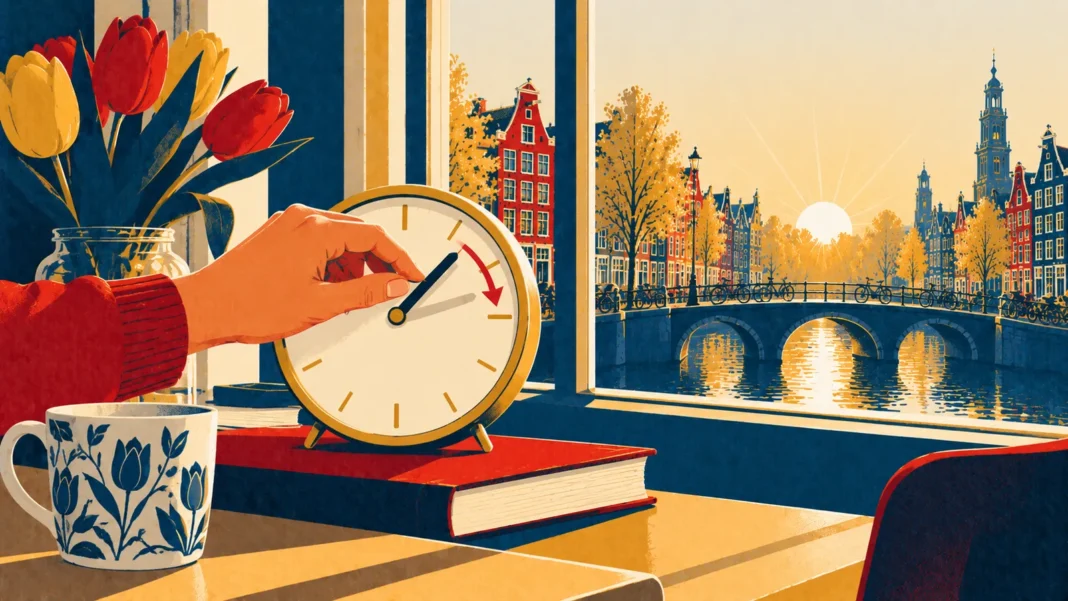
Amsterdam – Twice a year, people in the Netherlands adjust their clocks by one hour. In spring, the clocks move forward to summer time (zomertijd). In autumn, they move back to standard time (wintertijd).
For many residents and expats, the clock change raises the same questions every year: Why do we still change the clocks? When exactly does it happen? Does it really save energy? Can it affect sleep and health? And will the European Union ever stop the twice-yearly change?
Here is a practical guide to daylight saving time in the Netherlands, including the current EU situation, health research and useful Dutch vocabulary.
Table of Contents
- What Is Daylight Saving Time?
- When Do the Clocks Change in the Netherlands?
- Why Does the Netherlands Change the Clocks?
- Does Daylight Saving Time Save Energy?
- How Can the Time Change Affect Sleep and Health?
- Why Has the EU Not Abolished the Clock Change?
- How to Adjust to the Time Change
- Key Takeaways
- Dutch Learning Corner
What Is Daylight Saving Time?
Daylight Saving Time is the system of changing the clocks seasonally so that there is more daylight in the evening during the summer months.
In Dutch, summer time is called zomertijd. The standard time used during the winter is commonly called wintertijd.
During summer time, the clocks are moved forward by one hour. This means that it becomes lighter later in the morning and stays light for longer in the evening.
In winter, the clocks are moved back by one hour, returning to standard time.
The system is used across most European countries and is coordinated at EU level. Under the current rules, clocks move forward on the last Sunday of March and back on the last Sunday of October.
When Do the Clocks Change in the Netherlands?
The Netherlands follows the European schedule for seasonal clock changes.
In spring:
- The clocks move forward by one hour.
- The change takes place on the last Sunday of March.
- The Netherlands then enters summer time (zomertijd).
In autumn:
- The clocks move back by one hour.
- The change takes place on the last Sunday of October.
- The Netherlands returns to standard time (wintertijd).
For example, in 2026, the spring change took place on 29 March.
The next change is on Sunday, 25 October 2026. At 03:00, the clock will move back to 02:00, giving people an extra hour compared with the previous night.
Most smartphones, computers and smartwatches adjust automatically. Traditional clocks, ovens, microwaves, car clocks and other devices may need to be changed manually.
Why Does the Netherlands Change the Clocks?
The history is more complicated than simply saying that daylight saving time was introduced to save energy.
The Netherlands reintroduced summer time in 1977 to align its clocks with neighbouring countries. According to the Dutch government, many other European countries had introduced summer time partly with energy saving in mind, while the Netherlands’ decision was primarily about having the same time as neighbouring countries.
Since 1980, summer-time arrangements have been coordinated at European level.
The EU’s current system is designed to coordinate the dates when member states change their clocks. This helps avoid different countries making seasonal clock changes on different dates, which could create problems for cross-border activities such as transport and business.
Does Daylight Saving Time Save Energy?
Energy saving was one of the historical reasons associated with summer time in Europe, but the modern debate is more complicated.
Changes in lighting technology, household energy use and modern lifestyles mean that the amount of energy saved or consumed because of the clock change is not straightforward.
Rather than claiming that daylight saving time definitely saves or wastes a specific amount of energy, it is more accurate to say that the energy argument remains part of the wider debate about the system.
Today, discussions about seasonal clock changes also involve transport, business coordination, daylight availability, sleep and health.
How Can the Time Change Affect Sleep and Health?
Losing or gaining one hour may sound minor, but changing the clock can temporarily affect sleep schedules and daily routines.
The spring transition can be particularly noticeable because people have to adjust to a schedule that is one hour earlier according to the clock.
Research into the health effects of daylight saving time is ongoing. A 2026 systematic review examined 157 studies from 36 countries and found that the evidence is mixed rather than uniformly harmful or beneficial.
The review found that the spring transition appears to be associated with a short-term increase in some cardiovascular events, particularly myocardial infarction, and with increases in some traffic accidents in certain settings. However, the researchers also identified potentially beneficial effects associated with other outcomes and with the autumn transition.
This means that headlines suggesting that changing the clocks is simply “bad for your health” are too simplistic.
Individual experiences can also vary. Some people notice almost no difference, while others may experience temporary difficulty adjusting their sleep schedule.
Why Has the EU Not Abolished the Clock Change?
This question comes up almost every year.
The European Commission proposed ending the twice-yearly clock change in 2018. The European Parliament supported ending the seasonal clock changes in 2019.
However, the proposal did not become EU law.
The Council of the European Union has not reached a final position on the proposal. Because both the Council and the European Parliament need to agree on the legislation, the current system remains in place.
One of the challenges is that countries would need to coordinate which permanent time they would use if seasonal changes were abolished. Different choices between neighbouring countries could create practical problems for transport, communication and cross-border business.
As of 2026, there is therefore no final EU decision to abolish the twice-yearly clock change.
The European Commission said in March 2026 that it was working on further analysis of possible scenarios, with the work expected to be completed toward the end of 2026.
How to Adjust to the Time Change
If the clock change affects your sleep, a few simple habits may make the transition easier:
- Adjust gradually: If possible, move your bedtime and wake-up time slightly before the change.
- Get daylight: Spending time outdoors during the day can help your body adjust to the new schedule.
- Keep a regular routine: Try to maintain consistent sleeping and waking times.
- Limit unnecessary late-night stimulation: Give yourself time to wind down before bed.
- Don’t panic about one bad night: Temporary sleep disruption is not unusual around a clock change.
If sleep problems continue for a long period or significantly affect daily life, consider discussing them with a healthcare professional.
Key Takeaways
- Summer time: The clocks move forward by one hour on the last Sunday of March.
- Winter time: The clocks move back by one hour on the last Sunday of October.
- Netherlands: Summer time was reintroduced in 1977 to align with neighbouring countries.
- EU: Seasonal clock changes are currently still in place.
- Abolition: The EU has discussed ending the system, but no final decision has been adopted.
- Health: Research suggests that the effects vary and are more complicated than simply saying the clock change is good or bad.
Dutch Learning Corner
| Word (Dutch) | Pronun. (Eng) | Meaning | Context (NL + EN) |
|---|---|---|---|
| ☀️ De zomertijd | duh ZOH-mur-tite | Summer time / DST | De zomertijd begint in maart. (Summer time begins in March.) |
| ⏰ De klok verzetten | duh klok fur-ZET-tun | To change the clock | Vergeet niet de klok te verzetten. (Don’t forget to change the clock.) |
| 😴 Uitslapen | OWT-slah-pun | To sleep in | Ik wil zondag uitslapen. (I want to sleep in on Sunday.) |
| 🌓 Het daglicht | ut DAHK-likht | Daylight | Er is ‘s avonds langer daglicht. (There is more daylight in the evening.) |
What Do You Think?
Would you prefer the Netherlands to keep changing the clocks twice a year, or would you rather see the system replaced with one permanent time?
What matters most to you: brighter evenings, brighter mornings, sleep, or keeping the Netherlands aligned with neighbouring countries?
Sources
- Rijksoverheid – Why do we change the clocks twice a year?
- Council of the European Union – Seasonal clock changes in the EU
- European Commission Representation in the Netherlands – Seasonal clock changes, March 2026
- European Journal of Epidemiology – Systematic review of daylight-saving time and health, 2026
Information checked and updated for 2026. Clock-change dates and EU policy may change in the future.
Clocks go back on Sunday 25 October 2026: at 03:00 it becomes 02:00 and winter time starts. See time change Netherlands 2026.
More in our guide: Healthcare in the Netherlands – insurance, GP and costs guides
Free: Netherlands 2027 Money Checklist
Every deadline and number you need before and after 1 January 2027, on two printable pages. Confirm your email and the PDF is yours; we will also email you when the 2027 figures are confirmed.
 Read nextLiving in NLDigiD, MijnOverheid & Toeslagen in the Netherlands: The Complete Newcomer Guide 2026