






Last updated:
Dutch Central Bank Gold Reserves, crisis preparedness, and what the shift out of New York and Ottawa actually means for people living in the Netherlands.
On 2 September 2026, De Nederlandsche Bank published a dry press release with an undry message. Between March and August, the Dutch central bank relocated approximately 86 tonnes of gold — worth just over €10 billion at year-end 2025 prices — out of the United States and Canada and into London.
DNB did not say the gold was seized, frozen, or lost. It did not announce a sale of the national stockpile. The total reserve is unchanged at 612.4 tonnes, valued at €72.2 billion at the end of 2025. What changed is where a large slice of that metal sits, and how fast it could be sold if a crisis ever required it.
This is not a story about doomsday bunkers. It is a story about liquidity, vault standards, and a central bank that has decided New York and Ottawa are no longer the best places to keep metal it might one day need to deploy quickly — and it is not the only European bank thinking that way this year.
| Relocated | Total reserve | End-2025 value | Operation window | New largest vault share |
|---|---|---|---|---|
| ~86 tonnes (~€10.1bn) | 612.4 tonnes | €72.2 billion | March–August 2026 | London 32.1% |
In This Guide
- What DNB actually announced
- The new map of Dutch gold
- How 86 tonnes moved without a Hollywood airlift
- Why London beats New York for a crisis
- Not alone: France, Germany, and a nervous gold market
- What “geopolitical unrest” does — and does not — mean
- What this is not, and what it means if you live here
- Dutch Learning Corner
- Verified data sources
What DNB actually announced
The official English headline was bureaucratic on purpose: “DNB improves tradability of gold reserves.” The substance sits in three sentences.
First, DNB says geopolitical unrest is rising, so it is strengthening crisis preparedness.
Second, gold stored at the Bank of England in London must meet modern international trade standards and is treated as the world’s most easily tradable bullion. Gold in New York (Federal Reserve Bank of New York) and Ottawa (Bank of Canada) “cannot be utilised as quickly and directly in such a situation.”
Third, a more even split between North America, the United Kingdom and the Netherlands spreads risk and makes the metal available faster if it ever has to be used.
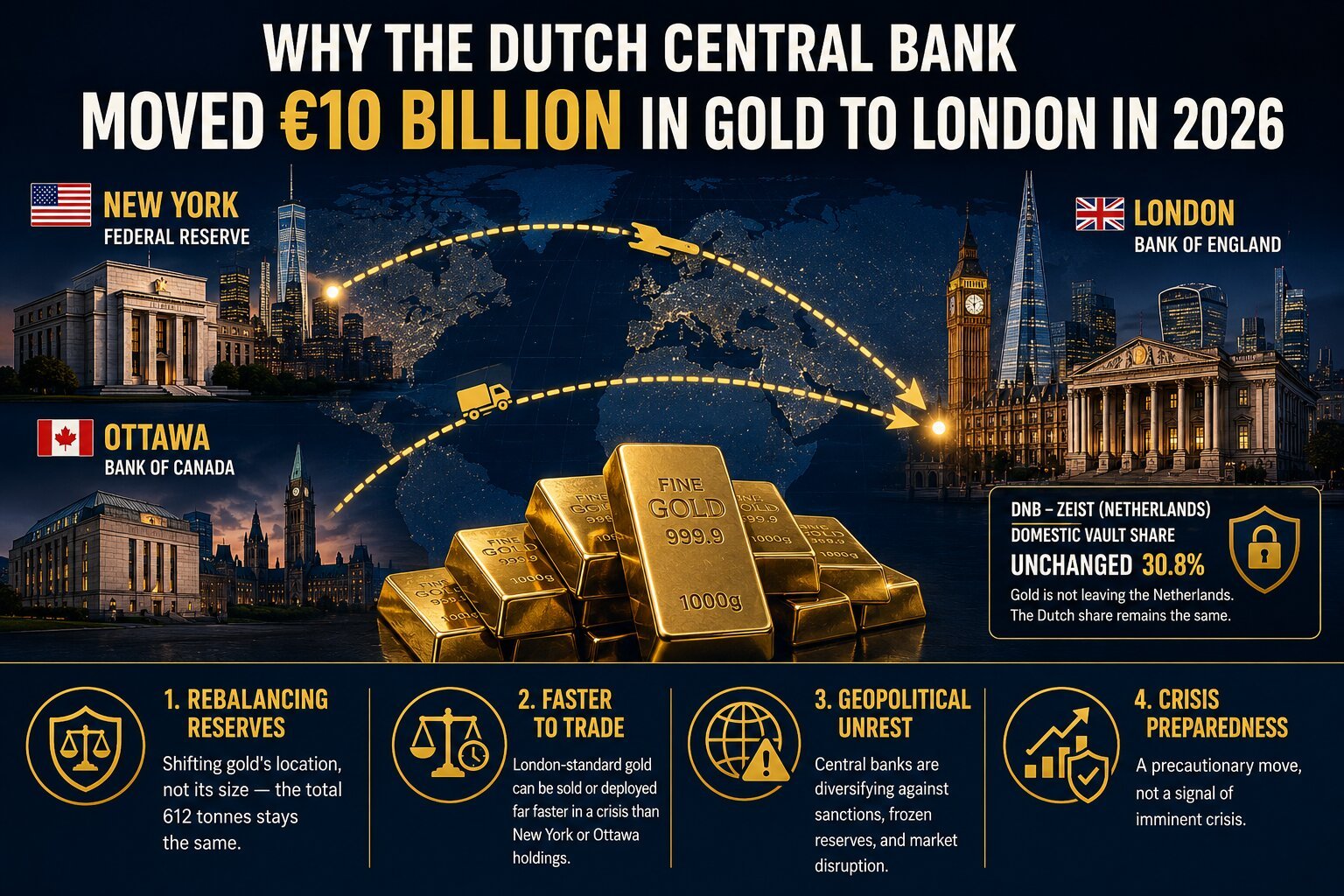
Governor Olaf Sleijpen put the official tone on the record:
“With this relocation, we have improved the tradability of our gold reserves. We expect that we will never need to use them, but we do need to strengthen our resilience and preparedness.”
Read that quote twice. The bank is not forecasting a collapse. It is saying the old storage map was built for a calmer world, and the new map is built for a world in which you may need to sell or pledge gold quickly — and you may not get to choose the week.
The gold remains part of DNB’s official foreign reserves. It is not the government’s rainy-day petty cash. It is the last-resort asset that is supposed to hold value when confidence in paper claims, including currencies, is under stress.
The new map of Dutch gold
DNB published the before-and-after table itself. The domestic share did not change. London became the single largest location. New York stopped being the largest foreign vault.
| Location | Share before | Share after | What sits there |
|---|---|---|---|
| Zeist (DNB Cash Centre) | 30.8% | 30.8% | Domestic vault in the Netherlands |
| London (Bank of England) | 18.1% | 32.1% | Now the largest single share |
| New York | 31.3% | 18.5% | Cut by roughly two-fifths |
| Ottawa | 19.7% | 18.5% | Brought in line with New York |
A few numbers help keep the scale honest.
- 86 tonnes is about 27.5% of the 313 tonnes that previously sat in the US and Canada combined.
- It is about 14% of the entire Dutch stockpile.
- At the end of 2025 valuation, the moved metal was worth €10.11 billion. Intraday reporting on 2 September put the same metal closer to €10.34 billion as the gold price ticked higher.
- Gold’s share of the Netherlands’ total official reserves is around 73% — one of the highest ratios of any central bank in the world, alongside the US, Germany, Italy and France.
Nothing in the table says “bring it all home.” Zeist still holds just under a third. North America still holds 37% combined. This is rebalancing, not repatriation. A repatriation story would have increased the Zeist column. DNB left Zeist exactly where it was and thickened London.
How 86 tonnes moved without a Hollywood airlift
If you imagine a single unmarked cargo plane crossing the Atlantic with 86 tonnes of bars, you have the cinema version. DNB ran a two-track operation on purpose.
Track one: sell in New York, buy in London
About 59 tonnes of gold held in New York were sold. DNB then bought gold in London that already meets the international market standards used in the over-the-counter bullion market. No melting. No recasting. The metal that now sits in London is the kind of bar a dealer can actually trade.
Track two: physical swaps via Zeist
More than 27 tonnes were physically shipped from the United States and Canada to the DNB Cash Centre in Zeist. A similar quantity of already-standard bars then moved from Zeist to London. That swap avoided remelting bars that did not match the London good-delivery profile.
DNB is explicit about why it used both methods at once. Combining sales and physical transport spread the operational risk of moving a large quantity of gold, was cheaper and cleaner than shipping every bar, and — the detail most casual coverage skipped — gave the bank practice with both channels. If a future crisis makes one of them impossible, DNB now has recent operational experience with the other.
The press release does not describe aircraft, escorts, insurers, or routes. That omission is normal. Central banks do not publish logistics for gold in transit. Treat any social-media “reconstruction” of the flight path as unverified unless DNB or a named logistics contractor confirms it.
Two technical points are worth keeping straight. First, the stockpile size did not change — selling 59 tonnes in New York and buying the equivalent in London is a location-and-quality switch, not a liquidation of national gold. Second, quality improved, because a larger share now meets the standards the London market actually uses. Some of the North American bars were legally Dutch gold, but they were not the most convenient gold. London gold is convenient gold.
Why London beats New York for a crisis
This is the policy core of the announcement, and it is more interesting than the politics draped over it.
Physical gold is not like a bond you can sell on a screen in thirty seconds. To use gold in a crisis you generally need bars that match the London Bullion Market Association (LBMA) Good Delivery standard, a vault and clearing system the rest of the market already trusts, counterparties who can take the metal without a week of legal argument, and a jurisdiction where settlement is routine.
London is still the centre of the global wholesale gold market. The Bank of England vaults a large share of official-sector gold. Unallocated and allocated loco-London gold is the benchmark the market prices. New York remains important — the Fed’s basement is one of the most famous vaults on earth — but DNB’s point is narrower: in a hurry, London gold is the gold you can actually use. Ottawa is even further from that market: safe, but not where the world trades 400-ounce bars at 7 a.m. on a bad Monday.
None of this requires you to believe the Federal Reserve would confiscate Dutch gold. DNB did not allege that. The operational claim is sufficient on its own: distance plus market structure plus bar standards equals slower deployability. After several years of sanctions regimes, frozen reserves, disrupted shipping lanes, and louder great-power rivalry, “slower” is a risk DNB no longer wants at 31% of the pile. There is also a quieter European reading: keeping more official gold inside the European time zone, under a central bank DNB already works with weekly, is simply closer to home. The UK is not in the EU — but it is next door, in English law, in a market Dutch institutions have used for generations.
Not alone: France, Germany, and a nervous gold market
DNB’s move looks less like an isolated Dutch decision once you place it next to what other European central banks have been doing.
Banque de France has been running the same playbook since 2025: it sold roughly 129 tonnes of gold held in New York for about €13 billion and used the proceeds to buy bullion for storage in Paris — the same sell-there, buy-here mechanic DNB used for its 59-tonne New York leg, just pointed at home soil instead of London.
In Germany, the direction of pressure is the opposite but the underlying anxiety is the same. Politicians have been pushing the Bundesbank to repatriate more of its 1,236 tonnes still stored at the New York Fed, on the argument that a wartime-era storage map no longer fits a world of sanctions and frozen reserves.
The backdrop makes all of this easier to read: gold has been on a tear. At the time of DNB’s announcement it was trading near $4,430 an ounce, up roughly 25% over the previous twelve months, driven by the same mix of tariff friction, Middle East tension and central-bank buying that shows up in every reserve-manager memo this year. None of that proves DNB’s timing was reactive rather than planned — the operation itself ran quietly from March to August, before the announcement — but it explains why 2026 has become the year several European central banks decided their old vault map no longer matched the risks they’re actually managing.
What “geopolitical unrest” does — and does not — mean
DNB used a phrase and then stopped. “Increasing geopolitical unrest” is the entire political diagnosis in the press release. It did not name the United States, Canada, China, Russia, Iran, or any election.
Context still exists, and a journalist should put it on the table without pretending DNB wrote it. The operation ran from March to August 2026 — a planned, multi-month programme, not a weekend evacuation. International coverage on 2–3 September linked the announcement to trade friction between the United States and Canada, wider tariff risk, and continued U.S.–Iran tension over the Strait of Hormuz. Those are reporters connecting dots, not DNB’s footnote. Gold is harder to freeze than a euro clearing balance, but it is not impossible to complicate — location still matters.
What the phrase does not mean: that the Netherlands is secretly leaving the euro, that DNB expects the dollar to fail next quarter, that Canadian or American vaults are unsafe in the ordinary sense, or that households should empty savings accounts and buy coins this weekend. If a central bank expected an imminent seizure of its foreign gold, it would not advertise the remaining 37% still sitting in New York and Ottawa. It would also not wait until September to announce a move that finished in August.
DNB repeats a sentence it has used in annual reports: gold is an anchor of trust and the ultimate reserve asset for extreme systemic risk. Translate that out of central-bank English: modern money is a claim on a chain of institutions that is invisible and boring in ordinary years, but gets questioned in a systemic event. Gold does not need a counterparty’s solvency the same way. That is why DNB holds 612 tonnes it does not intend to spend — not to fund childcare or NS tracks, but so that in a tail event the Netherlands still has an asset the rest of the world recognises without a software update.
What this is not, and what it means if you live here
Get the “is not” list right first, because it is where casual recaps go wrong. This is not a secret sale of the family silver — the reserve is the same size, a large slice just changed postcode and bar specification. It is not proof the euro is finished — official gold and the euro aren’t rivals in DNB’s framework; gold backs confidence in the system that issues the euro. It is not a signal that Dutch banks are unsafe — no retail deposit is “backed by the gold in Zeist”; deposit protection and Eurosystem liquidity are the relevant stack, and mixing those layers is how Telegram threads get written. And it is not unprecedented — official gold has been stored abroad for decades precisely to diversify disaster risk. What’s new is the direction of this tilt: away from North America, toward the London market.
Most people in the Netherlands will feel this story zero times in daily life. Trains will still run or not run for union reasons, rent will still be too high, Box 3 will still be the tax argument that actually hits a spreadsheet. Still, four practical points are worth knowing.
It’s not a reason to change banks. DNB moving official reserves says nothing about ABN AMRO, ING, or Rabobank solvency.
It doesn’t change Box 3 — unless you personally hold gold. Physical investment gold, gold ETCs and certain funds can sit in Box 3 like other investments. The central bank’s bars are not your bars, but if you already own gold as a hedge, the same logic DNB applied still applies to you: allocated metal in a reputable vault is a different product from an unallocated paper claim.
It’s a mild positive for institutional quality, not a policy signal. A central bank that spends six months improving the deployability of its last-resort asset is thinking in tail risks — conservative behaviour, not panic. It sits next to other 2026 files this site has covered, like Box 3 and the digital euro pilot.
It’s not a reason to buy gold this week. The announcement tells you DNB wants its own gold liquid in London — it says nothing about retail premiums, storage fees, or Box 3 treatment suddenly looking attractive. If gold belongs in a household portfolio, it belongs there on a written allocation, not as a reaction to one PDF.
If you already hold gold, check whether you own allocated bars, an ETF, or a mining stock — three different risks — confirm the vault location and legal structure, and keep purchase records for Box 3. If you’re watching the politics rather than the portfolio: the operational clock already finished in August, the communications clock started on 2 September, and the geopolitical clock — tariffs, wars, alliance noise — was running before either. DNB timed the statement after the bars had moved. That is the opposite of a panic button.
Dutch Learning Corner
A few useful words for reading the DNB gold file in Dutch:
| Dutch | English | Example | Translation |
|---|---|---|---|
| goudvoorraad | gold reserves / gold stockpile | DNB verplaatste een deel van de goudvoorraad naar Londen. | DNB moved part of the gold reserves to London. |
| verhandelbaarheid | tradability | De bank wil de verhandelbaarheid van het goud verbeteren. | The bank wants to improve the tradability of the gold. |
| crisisparaatheid | crisis preparedness | De verplaatsing hoort bij de crisisparaatheid van DNB. | The relocation is part of DNB’s crisis preparedness. |
| geopolitieke onrust | geopolitical unrest | DNB wijst op toenemende geopolitieke onrust. | DNB points to increasing geopolitical unrest. |
| spreiding | diversification / distribution | Een evenwichtige spreiding verlaagt de risico’s. | A balanced distribution lowers the risks. |
| anker van vertrouwen | anchor of trust | Goud geldt als een anker van vertrouwen. | Gold is considered an anchor of trust. |
| officiële reserves | official reserves | De goudvoorraad hoort bij de officiële reserves. | The gold stock is part of the official reserves. |
| kluis | vault | Een deel van het goud ligt in de kluis in Zeist. | Part of the gold is in the vault in Zeist. |
Verified data sources
| Fact | Figure | Source |
|---|---|---|
| Gold relocated from US + Canada to London | ~86 tonnes | DNB press release, 2 September 2026 |
| Of which sold in New York and bought in London | ~59 tonnes | DNB press release, 2 September 2026 |
| Of which physically moved via Zeist | >27 tonnes each way | DNB press release, 2 September 2026 |
| Total Dutch official gold | 612.4 tonnes | DNB press release, 2 September 2026 |
| Value at year-end 2025 | €72.2 billion | DNB press release / DNB Annual Report 2025 |
| London share after the move | 32.1% (was 18.1%) | DNB press release, 2 September 2026 |
| Zeist share | 30.8% unchanged | DNB press release, 2 September 2026 |
| New York / Ottawa shares after the move | 18.5% each | DNB press release, 2 September 2026 |
| Operation window | March–August 2026 | DNB press release, 2 September 2026 |
| Governor | Olaf Sleijpen | DNB |
| Gold as share of Dutch official reserves | ~73% | World Gold Council / Visual Capitalist, 2025 data |
| Banque de France gold sold in New York, rebought in Paris | ~129 tonnes, ~€13 billion | Banque de France, reported 2025–26 |
| Bundesbank gold still held at the New York Fed | 1,236 tonnes | Deutsche Bundesbank |
| Gold price at time of announcement | ~$4,430/oz, +~25% YoY | Market data, 2–3 September 2026 |
Primary document: DNB improves tradability of gold reserves (2 September 2026).
Related reading on this site: Box 3 Tax Netherlands 2026 · Digital Euro Pilot 2026
More in our guide: Taxes, Salary & Money in the Netherlands – all our guides
Free: Netherlands 2027 Money Checklist
Every deadline and number you need before and after 1 January 2027, on two printable pages. Confirm your email and the PDF is yours; we will also email you when the 2027 figures are confirmed.
 Read nextBusiness & FinanceDutch Toeslagpartner Rules 2027: When a Housemate No Longer Counts as Your Partner