





Last updated:
Update, September 2026: For most people the naturalisation requirements are still 5 years of residence and an inburgering diploma at A2, according to the IND. B1 is the standard for people whose civic integration obligation started on or after 1 January 2022. Plans to require B1 and a longer residence period for naturalisation have been announced but are not law yet.
Important for asylum status holders: since the EU Migration Pact took effect on 12 June 2026, the permanent asylum permit no longer exists and you cannot naturalise with a temporary asylum permit. Status holders first need an EU long-term resident permit, which requires, among other things, an A2 inburgering diploma and independent, sustainable and sufficient income (for example an employment contract that still runs for at least 12 months; social assistance does not count). Once that permit is granted, you can apply for Dutch citizenship. If you already had a permanent asylum permit before 12 June 2026, you keep it. A route after 6 years with a temporary asylum permit and B1 Dutch has been agreed politically but is not law yet.
Sources: Divosa, RefugeeHelp, Stichting IPN. See also our Dutch citizenship and inburgering guide.
THE HAGUE – February 9, 2026 | Updated for accuracy | The Dutch Daily
Breathe easy on the waiting time. The 10-year naturalisation plan is not law. Do not treat a B1 language switch as if it already started.
For months, fear rippled through international offices from ASML in Veldhoven to Booking.com in Amsterdam: that a new coalition would stretch naturalisation from 5 years to 10. That proposal did not become a statute. The legal residence period in the Rijkswet op het Nederlanderschap is still five consecutive years.
The language file is a different story. Raising the naturalisation exam from A2 to B1 has been discussed for years and appears again in political texts. As of this guide’s publication date, the IND still states the civic-integration requirement for naturalisation as at least A2. There is no published law that rejects an A2 diploma on 2 July 2026. That date circulated widely. Treat it as a possible future change, not as a switch that has already flipped.
This is a practical guide: what the law does now, what politicians say they want next, the renunciation rule, the Turkish Blue Card, the option procedure, children, costs, and the gemeente steps. Rules on nationality can move. Before you book a desk appointment, check the live IND pages.
In This 2026 Master Guide:
- 1. The 10-Year Plan: Why It Did Not Become Law
- 2. The Great Debate: Citizenship vs. Permanent Residence
- 3. Language: A2 Now, B1 Possibly Later
- 4. Pro Tip: Why “Staatsexamen NT2” Is the Smarter Choice
- 5. The Renunciation Trap: Can I Keep My Passport?
- 6. Country Focus: Turkish Nationals & The “Blue Card”
- 7. Name Change: Fixing Your Name for Free
- 8. Medical Exemptions: What if I Can’t Take the Exam?
- 9. Children & Citizenship: The “Mee-naturaliseren” Rules
- 10. The “Option Procedure”: The Faster Track
- 11. Travel Strategy: Using Two Passports
- 12. Blueprint: The 7-Step Application Process
- 13. The Hidden Costs: Budgeting for 2026
- 14. After the Ceremony: Getting the Document
- 15. Citizenship Vocabulary (Verplichte Kost)
1. The 10-Year Plan: Why It Did Not Become Law
Extending naturalisation to 10 years was a campaign promise, not a finished Rijkswet. A draft went out for consultation in autumn 2025. It drew critical advice from the Council of State (Raad van State) in January 2026 and was not carried forward as enacted law. Until parliament adopts a new Rijkswet and it is published with a start date, five years remains the rule.
Business groups also argued that a 10-year wait would push scarce engineers and clinicians toward countries with shorter tracks. That lobbying is context. It is not the legal text. The legal text is still article 8 of the Rijkswet: five years of uninterrupted lawful residence, unless a listed exception applies.
A later cabinet can revive a longer wait. Check the wetgevingskalender and the IND naturalisation page before you assume the clock will stay at five forever.
- Standard route: naturalisation after 5 consecutive years of legal residence with a permit that counts.
- Partner route: married to, or in a registered partnership with, a Dutch citizen — often 3 years of living together (including some time abroad). A cohabitation contract alone is not the same as marriage or registered partnership.
- Stateless persons: a shorter track can apply; confirm the current IND exception page.
2. The Great Debate: Citizenship vs. Permanent Residence
Before you start studying for exams, answer a strategic question: Do I need the passport, or is permanent residence enough?
Many expats confuse naturalisation with permanent residence (national Type II or EU long-term resident). They look similar (no work permit, stay indefinitely), but three differences matter.
1. The “Bali Test” (Leaving the Netherlands)
PR: Long absence can kill the permit. National permanent residence is commonly lost after about 2 years outside the Netherlands. EU long-term resident status is more durable but is not a passport.
Citizenship: You can live abroad for decades and remain Dutch. You can return as an EU citizen.
2. The “EU Freedom” Factor
PR: Lets you live in the Netherlands. Moving to France or Germany is easier than for a first-time arrival, but you still deal with local residence rules.
Citizenship: Full free-movement rights as an EU national.
3. The Renunciation Cost
PR: You keep your original passport.
Citizenship: In most cases you must give up your original nationality, unless an exception applies.
3. Language: A2 Now, B1 Possibly Later
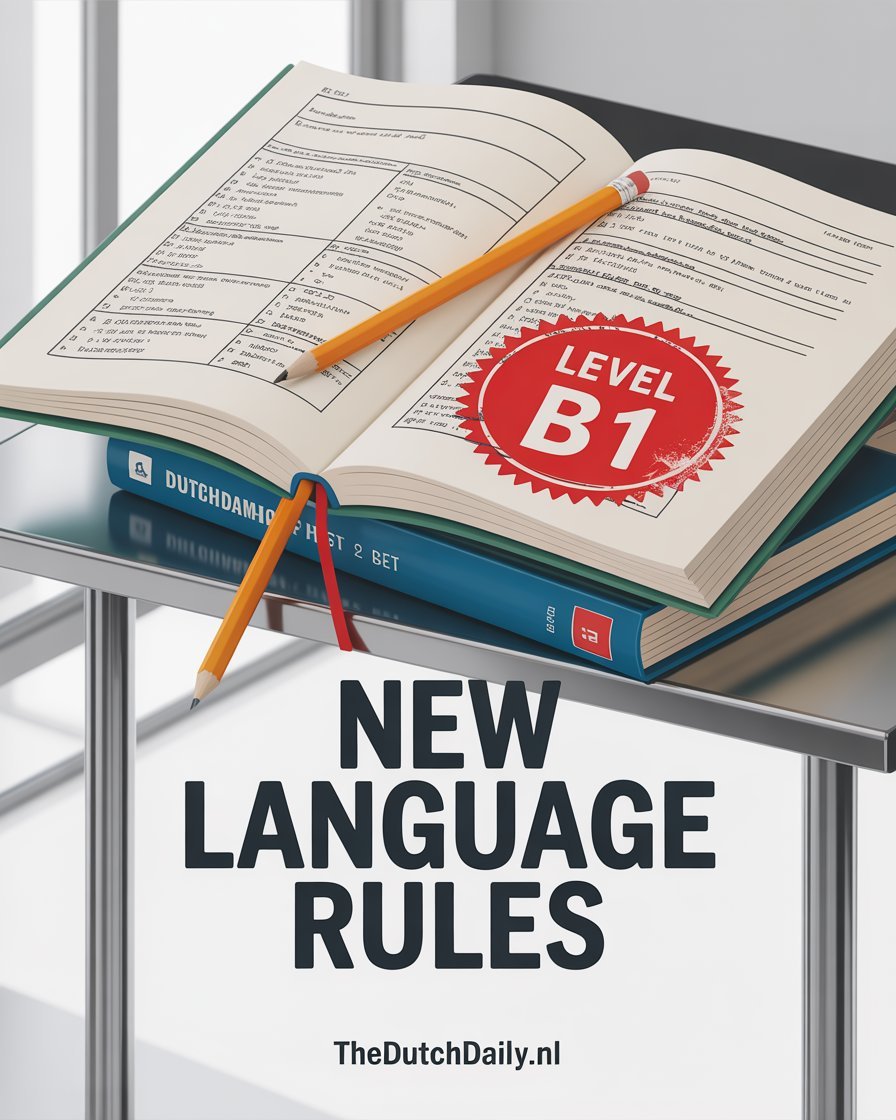
Do not plan your appointment around a rumour that “B1 starts on 1 July 2026.” That date spread online. It was not a confirmed statutory cut-off on the day this guide was first drafted, and the IND wording that still governs applications is minimum A2 on the inburgeringsexamen / naturalisatietoets.
A move to B1 for naturalisation is a real political project. It has been consulted on since 2020. Coalition texts have also linked B1 to a future asylum-naturalisation track. None of that is the same as a signed, in-force change for every applicant this summer. It may still happen later. If it does, the IND and Staatscourant will publish a start date and any transitional rule. Until then, an A2 civic-integration diploma remains the standard legal proof, unless you are exempt or you hold a higher diploma such as Staatsexamen NT2.
A2 vs. B1: What the Jump Would Mean If It Arrives
| Component | Current legal floor (A2) | Proposed higher bar (B1) |
|---|---|---|
| Speaking | Simple sentences (“Ik heet Jan”). | Opinions and reasons (“Ik ben het daar niet mee eens omdat…”). |
| Listening | Slow, clear speech. | Faster speech, news-style audio (e.g. NOS Journaal pace). |
Do not use a fake “grandfathering” deadline
Some explainers told readers: apply before 1 July 2026 with an A2 diploma or the file will be rejected the next day. That is not how the published IND rule reads. If a B1 requirement is enacted later, look for an official transitional clause — who is protected, from which application date, and whether old A2 diplomas still count. Do not invent a cut-off and do not delay a ready application out of panic.
Separate track: people with an inburgeringsplicht under the Wet inburgering 2021 often already sit on a B1 civic-integration route in their PIP. That municipal integration duty is not automatically the same as the IND naturalisation exam. Read both files.
4. Pro Tip: Why “Staatsexamen NT2” Is the Smarter Choice
Most expats default to the standard inburgeringsexamen. Career-focused applicants should look at Staatsexamen NT2 (Programma I or II).
Why take NT2 instead?
- Career proof: The basic inburgering diploma mainly unlocks permits and nationality. NT2 is a recognised language qualification for employers and many study programmes.
- Buffer if the law tightens: Programma I is B1. Programma II is B2. If naturalisation later moves to B1, you already hold a higher certificate.
- Exemptions: NT2 can replace language parts of the civic-integration set. Whether KNM or other modules drop out depends on the IND brochure for your year. Check the current “Inburgering voor naturalisatie” page; do not assume every module disappears.
5. The Renunciation Trap: Can I Keep My Passport?
The Netherlands still applies the Afstandseis (renunciation requirement). The general rule: to become Dutch you give up your other nationality.
Exceptions exist. You may keep the other passport if, for example:
- The “Love” exemption: you are married to, or in a registered partnership with, a Dutch citizen. A samenwooncontract is not enough.
- The “Impossible” exemption: your country of origin does not allow renunciation (often cited: Morocco, Iran, Syria, Argentina, Mexico, Costa Rica — the official country list can be updated; confirm yours).
- The “Refugee” exemption: recognised asylum status, where that exemption still applies to your permit type.
- The “Financial loss” exemption: you must prove a serious, documented loss. Informal talk of a €10,000 threshold is a rule of thumb, not a number to tattoo on the form. The IND assesses evidence.
Country lists and circulars can change (a 2026 update already reclassified South Africa on the renunciation list). Recheck before you sign the afstand statement.
6. Country Focus: Turkish Nationals & The “Blue Card”
For many Turkish residents, the fear is inheritance and property in Turkey. Turkey allows renunciation and then issues the Mavi Kart (Blue Card) to former citizens.
What the Mavi Kart typically preserves: residence-related civil rights in Turkey such as inheritance, buying and selling property, working without a Turkish work visa, and access to certain social-security arrangements — always confirm the current consulate text.
What you lose: voting in Turkish elections, serving as a public official (police, judge, and similar posts), and — in the standard Blue Card design — military service (askerlik) obligation.
This is Turkish status law, not Dutch IND policy. Use the Turkish consulate’s current Blue Card page, not a forum screenshot.
7. Name Change: Fixing Your Name for Free
A little-known feature of naturalisation is Naamswijziging.
A stand-alone name change in the Netherlands is slow and expensive. During naturalisation it is often cheap or included if you ask at the right moment.
Typical grounds:
- the name is hard to spell or pronounce in Dutch;
- you want a Dutch-facing form of the same name;
- you want to take a partner’s surname where the rules allow it.
Tip: Ask at the gemeente when you file. After the naturalisation decision is issued it is usually too late for the cheap track.
8. Medical Exemptions: What if I Can’t Take the Exam?
Ontheffing is possible if you can show you are physically or mentally unable to sit the exam.
Process: an independent medical assessment in the DUO / Argonaut track. A short note from your own huisarts is not enough.
Aantoonbaar geleverde inspanningen (proven effort): if the problem is not medical, DUO may accept a proven-effort file. The classic pattern is hundreds of hours at a recognised school plus multiple failed attempts. The exact hour and attempt counts are on inburgeren.nl and can be updated — read the live page, not this paragraph as a statute.
9. Children & Citizenship: The “Mee-naturaliseren” Rules
Children can often join your file (mee-naturaliseren). Age changes the load.
| Age of child | Usual requirement |
|---|---|
| 0–11 | No language exam. Valid residence permit and living with you. |
| 12–15 | The child must agree. The IND may hear the child. |
| 16–17 | Agreement plus the child’s own integration / language proof in most cases. |
Timing: if a child is close to 16 or 18, the month you file can change both exams and fees.
10. The “Option Procedure”: The Faster Track
Naturalisation is the default. Optie is a shorter municipal track: often about three months, a lower fee, and usually no integration exam.
Typical option categories (not a complete list):
- Born in the Kingdom and continuously resident, now an adult, with valid stay.
- 15 years + AOW age: long lawful residence and retirement age.
- Long marriage + long residence: a high-year combination with a Dutch spouse (confirm the current IND option page; older “15 and 15” summaries go stale).
EU citizenship alone does not put you in the option lane. Most EU expats still naturalise. Option categories are statutory and occasionally amended — read the IND option page the week you book.
11. Travel Strategy: Using Two Passports
If you are allowed to keep both nationalities, border practice is simple: use the document that gives you the strongest right in that country.
A common pattern:
1. Leaving Schiphol: Dutch passport.
2. Entering the other country: that country’s passport.
3. Airline check-in back to Schengen: Dutch passport, so the carrier sees an EU national.
4. Re-entering Schiphol: Dutch passport.
Always follow the airline and border-guard instructions in front of you. This paragraph is not a visa waiver.
12. Blueprint: The 7-Step Application Process
- Check eligibility: five years (or an exception), permit type that counts, no public-order block.
- Language proof: inburgeringsexamen at the level the IND lists on the day you file (today: A2 unless exempt), or Staatsexamen NT2.
- Documents: legalised or apostilled birth certificate, sworn translation if needed, valid passport.
- Gemeente appointment: you cannot file naturalisation online.
- Pay fees at the desk. Unpaid files do not start the IND clock.
- IND decision period: up to 12 months.
- Ceremony: you become Dutch after the verklaring van verbondenheid at the ceremony, not when the letter arrives.
13. The Hidden Costs: Budgeting for 2026
IND fees rose on 1 January 2026. Budget with the live tariff, not a 2025 screenshot.
| Item | Cost (2026 tariff) | Notes |
|---|---|---|
| IND naturalisation, 1 person | €1,139 | Non-refundable. Partner filing together: €1,454. Child under 18 joining: €168. Stateless / asylum reduced rate: €847. |
| Option, 1 person | €241 | Partner option: €412. Child joining option: €27. |
| Inburgering / NT2 exams | €350–€400+ | Depends on how many parts you sit and whether you resit. |
| Birth-certificate logistics | €150–€250 | Apostille / legalisation + sworn translation. |
| First Dutch passport | municipal tariff | Set by the gemeente; not the same as the IND fee. Urgent (spoed) costs extra. |
| Realistic single-person cash | ~ €1,900+ | IND + exams + papers + passport. |
14. After the Ceremony: Getting the Document
After the pledge you are Dutch, but you still need a passport or ID card.
1. Book eerste aanvraag paspoort at your gemeente.
2. Bring the naturalisation proof, your other passport, and a Dutch-spec photo.
3. Standard production is often about five working days. Spoed is faster and dearer.
If the other country requires you to surrender that passport after naturalisation, follow that consulate — not a blog comment.
🇳🇱 Citizenship Vocabulary
| Dutch Term | Pronunciation | Meaning | Context |
|---|---|---|---|
| Afstandseis | Af-stants-ice | Renunciation requirement | The default duty to give up the old nationality. |
| Ontheffing | Ont-heff-ing | Exemption | Medical or proven-effort relief from exams. |
| Naamswijziging | Naams-wize-i-ging | Name change | Ask at application, not after the decision. |
| Mavi Kart | Ma-vi Kart | Blue Card (Turkish) | Status for former Turkish citizens. |
| Optie | Op-tee | Option procedure | Faster municipal track for listed groups. |
📊 Official Sources & Verification
Nationality rules change. This page is a guide, not the decision on your file. Recheck IND the week you apply.
| Source | What it actually confirms | What it does not confirm |
|---|---|---|
| IND — Nederlander worden door naturalisatie | 5-year residence; integration at minimum A2; permit types; 12-month decision period; ceremony. | A hard B1 start date of 1 July 2026. |
| IND — Leges | 2026 fees: naturalisation €1,139 / option €241 (and the partner and child tariffs). | Older €1,023 / €217 figures. |
| inburgeren.nl | Naturalisation exam described at A2, or NT2 at B1/B2 as an alternative diploma. | That every applicant must already sit B1 for the passport. |
| Wetgevingskalender / coalition texts | Political intent: possible longer wait, possible future B1, possible new asylum-naturalisation track. | In-force law until a Rijkswet or besluit is published with a date. |
| Turkish consulate — Mavi Kart | Rights after Turkish renunciation. | Dutch IND exceptions. |
More in our guide: Dutch Citizenship, Inburgering & Learning Dutch – all our guides
Dutch rules change fast. Stay ahead.
Get an email when citizenship, immigration or tax rules change, plus our free Netherlands 2027 Money Checklist. Confirm your email and the PDF is yours; we will also email you when the 2027 figures are confirmed.
 Read nextLiving in NLDutch Citizenship 2026 Update: 5-Year Rule Stands, A2 Still Required, New Asylum Rules Change the Path