THE HAGUE – October 12, 2026 | The Dutch Daily
Emergency kit Netherlands: the Dutch government wants every household to be ready for 72 hours without power, water or internet. On 12 October 2026 it launched a new “Denk vooruit” (Think ahead) campaign. According to the government, more than half of Dutch people worry about outages of vital services such as power, water or internet, and more than four in ten have already taken action to be better prepared. Here is what the government says should be in your emergency kit (noodpakket), how you will be warned, and which radio frequency to tune to in your region.
Emergency kit Netherlands: quick answer
- Goal: be prepared for the first 72 hours after a disaster or emergency.
- Water: 3 litres per person per day.
- Must-haves: long-life food, a battery radio, phone with power bank, torch, first-aid kit, blankets, a whistle, cash, copies of ID, spare keys.
- Check it every six months.
- Warnings: NL-Alert on your phone, the siren, and your regional public broadcaster on the radio.
Contents
- 1. Why the government wants you to have an emergency kit
- 2. Emergency kit Netherlands: the official checklist
- 3. Emergency kit Netherlands: where to keep it and how often to check it
- 4. Emergency kit Netherlands campaign: three steps
- 5. How you will be warned: NL-Alert, siren, radio
- 6. Emergency kit Netherlands: radio frequencies by region
- 7. FAQ
- 🇳🇱 Dutch Corner
- Sources
1. Why the government wants you to have an emergency kit
The new campaign follows the latest Risk and Crisis Barometer of the National Coordinator for Security and Counterterrorism (NCTV), published on 12 October 2026. According to the government:
- More than half of Dutch people worry about outages of vital processes such as power, water or internet.
- More than four in ten have taken action to be better prepared for 72 hours without power, water and internet, for example by buying or putting together an emergency kit, or by making agreements with their family or neighbours.
The government says last summer showed why this is needed: the Netherlands faced large wildfires and extreme drought, while in Germany there were several attempts to sabotage the power grid.
The first Denk vooruit campaign focused on putting together an emergency kit. The new one asks broader questions, such as: who picks up the children if you cannot get home because of extreme weather? Is your power bank charged in case of a national outage? Who needs help if the lift does not work?
Justice Minister Van Weel: “Never before have so many Dutch people prepared for risks and threats. The emergency kit and making agreements are a good basis.” He mentions small steps such as deciding who looks after the children if you cannot get home, withdrawing some cash for emergencies, and setting your emergency radio to the right station.
2. Emergency kit Netherlands: the official checklist
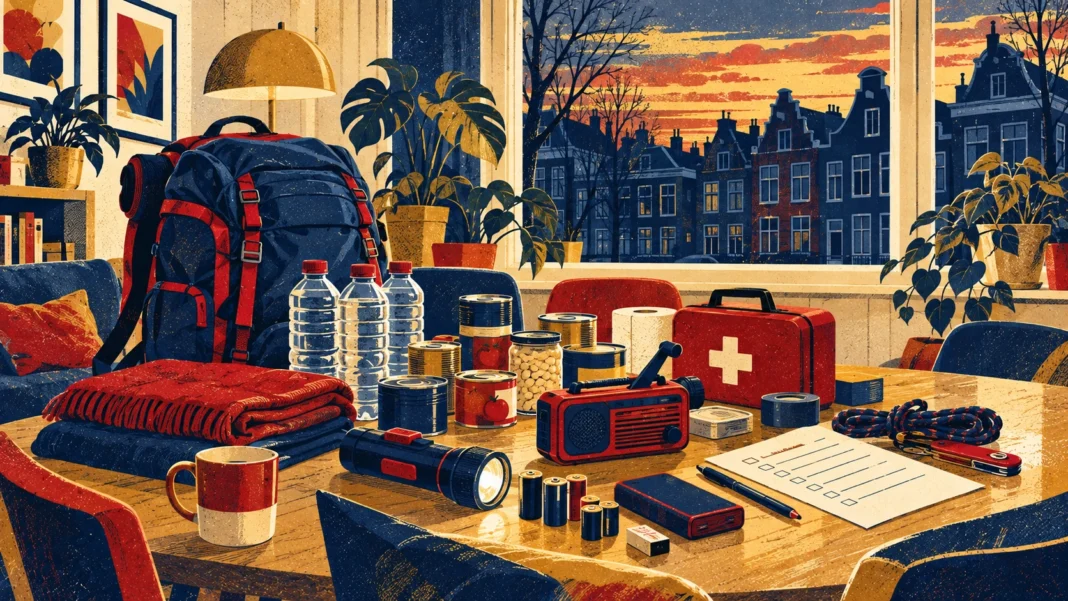
According to Denk vooruit, an emergency kit prepares you for the first 72 hours after a disaster or emergency, and you probably already have most items at home. The official list:
- Bottles of water: 3 litres per person per day.
- Long-life food, such as nuts, tinned vegetables and dried fruit.
- A battery-powered radio and a mobile phone with a power bank, to stay informed.
- A torch with extra batteries, candles and matches.
- A first-aid kit with instructions.
- Blankets to stay warm.
- A whistle, to let emergency services know where you are.
- Cash.
- Tools, such as a hammer, saw and pliers.
- Hygiene items: disinfectant gel, toilet paper, wet wipes, sanitary pads, toothpaste and toothbrush.
- Copies of ID documents and a list of important phone numbers.
- Spare keys for your house and car.
Your personal situation: also think about your health, children and pets. Denk vooruit advises adding medicines, baby food, and food and water for your pets.
Our calculation (not from the sources): at 3 litres per person per day, a household of two needs 18 litres of water for 72 hours, and a family of four needs 36 litres.
3. Emergency kit Netherlands: where to keep it and how often to check it
- Keep everything in a handy place that is easy to reach.
- Use waterproof packaging such as a backpack, which you can easily take with you if you suddenly have to evacuate. Keep a bag there for your keys, ID and cash.
- Agree who buys the supplies and who checks them.
- Check the kit every six months: is it still complete, and are the products still within their use-by date?
4. Emergency kit Netherlands campaign: three steps
The campaign is built around three simple steps, according to the government:
- Put together an emergency kit. Water, food and other things you cannot do without in an emergency. Don’t forget pet food, baby food or medicines.
- Make an emergency plan. Agree with your family or neighbours what you will do in an emergency: how you will reach each other, and who needs more help. Make sure everyone knows the agreements.
- Talk about it. With your family, neighbours, parents or children. That way you find out whether neighbours need care.
Our tip (not from the sources): if you are new to the Netherlands and far from family, step 3 matters even more. Swap phone numbers with a neighbour.
5. How you will be warned: NL-Alert, siren, radio
If there is danger, the authorities warn you in several ways, according to Denk vooruit’s English site:
NL-Alert
You only receive an NL-Alert if there is an incident near you. The message on your mobile phone tells you what is going on, what to do and where to find more information. Anyone in the area can receive it, even if you are just passing through or visiting. NL-Alert works even if the mobile network is overloaded. Read the message immediately, take action and help others.
Every first Monday in June and December, you receive a test message around noon, at the same time as the monthly siren test.
The siren
If the siren goes off and it is not the first Monday of the month, there is danger. Get inside as quickly as possible, close windows, doors and other openings, and follow the news on television, radio or the internet.
Radio
The government informs people through websites, social media and the (regional) public broadcasters on radio and television. If the power and internet go down, the regional public broadcaster can keep broadcasting on the radio. That is why Denk vooruit recommends a battery-operated radio or a digital (DAB+) radio in your kit. If you have a DAB+ radio, check that it also receives FM. A DAB radio automatically picks up the regional broadcaster.
6. Emergency kit Netherlands: radio frequencies by region
Every region has its own radio station and FM frequency. You can already tune your radio to the right one. Frequencies from Denk vooruit:
| Broadcaster | FM transmitter: frequency (MHz) |
|---|---|
| Radio Noord | Groningen 97.5 · Smilde 90.8 · Emmen 99.3 |
| Radio Oost | Hengelo 89.4 · Markelo 95.6 / 97.9 · Zwollekerspel 99.4 |
| Radio Gelderland | Arnhem 88.9 · Ugchelen 103.5 · Ruurlo 90.4 · Megen 89.1 · Zaltbommel 99.6 |
| Radio M Utrecht | Lopik 93.1 · Rhenen 97.9 |
| Omroep Flevoland | Lelystad 89.8 |
| NH Radio | Amsterdam 88.9 · Alkmaar 88.7 · Hilversum 88.7 · Wieringermeer 93.9 |
| Omroep West | Den Haag 89.3 · Leiden 88.0 |
| Radio Rijnmond | Rotterdam 93.4 |
| Omroep Zeeland | Goes 87.9 · Vlissingen 98.4 |
| Omroep Brabant | West-Brabant 91.0 · Midden-Brabant 91.9 · Noordoost-Brabant 95.8 · Zuidoost-Brabant 87.6 |
| L1 Radio (Limburg) | Roermond 100.3 · Emmaberg 95.3 |
For Friesland, check the full overview on Denk vooruit.
More on preparedness in Europe: NATO war prep and the Netherlands.
7. FAQ
What should be in an emergency kit in the Netherlands?
Water (3 litres per person per day), long-life food, a battery radio, a phone with power bank, a torch, first-aid kit, blankets, a whistle, cash, tools, hygiene items, copies of ID and spare keys, plus medicines, baby food and pet food if needed.
How long should an emergency kit last?
The government advises being prepared for the first 72 hours after a disaster or emergency.
How often should I check my emergency kit?
Every six months: check that it is complete and that nothing has passed its use-by date.
When is the NL-Alert test?
Every first Monday in June and December, around noon.
Which radio station do I need in an emergency?
Your regional public broadcaster. See the frequency table above.
🇳🇱 Dutch Corner
| Dutch | English |
|---|---|
| Het noodpakket | Emergency kit |
| De noodsituatie | Emergency |
| Het noodplan | Emergency plan |
| De stroomuitval | Power cut |
| De zaklamp | Torch, flashlight |
| De EHBO-doos | First-aid kit |
| De sirene | Siren |
| De rampenzender | Emergency broadcaster |
| Evacueren | To evacuate |
Sources
- Rijksoverheid, 12 October 2026: Nieuwe Denk vooruit campagne (NCTV barometer, campaign questions, three steps, minister’s quote)
- Denk vooruit: Stel je noodpakket samen (official checklist, storage, six-monthly check)
- Denk vooruit (English): NL-Alert
- Denk vooruit (English): The siren
- Denk vooruit (English): Radio (regional broadcasters and frequencies)
Free: Netherlands 2027 Money Checklist
Every deadline and number you need before and after 1 January 2027, on two printable pages. Confirm your email and the PDF is yours; we will also email you when the 2027 figures are confirmed.
 Read nextBusiness & FinanceDutch Municipal Taxes: Waste Tax, Sewer Charges & Water Board Tax