UTRECHT – October 12, 2026 | The Dutch Daily
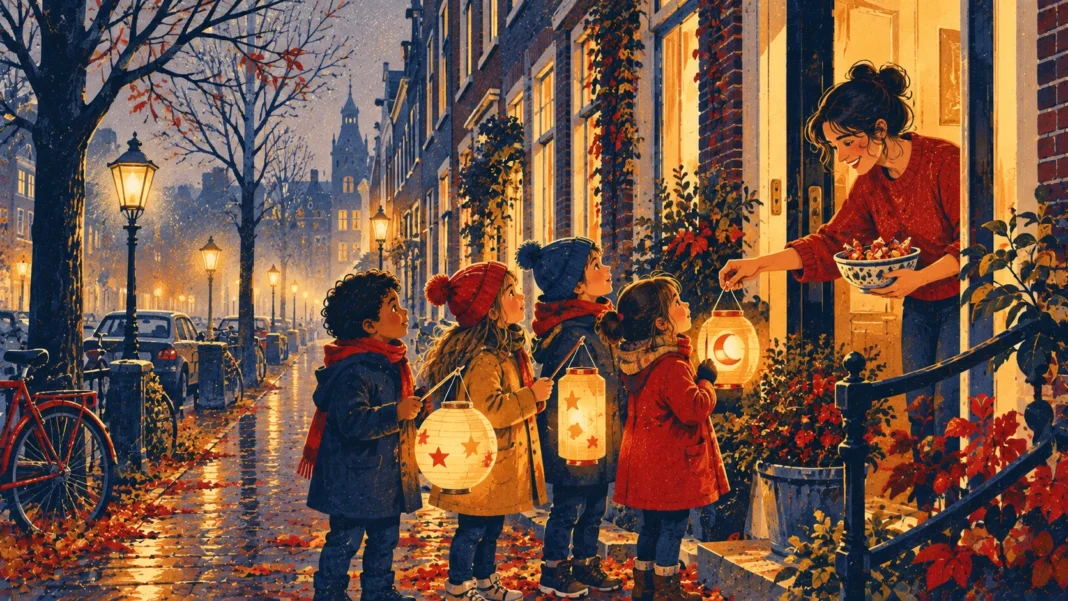
Sint Maarten in the Netherlands is the evening when children walk from door to door with glowing paper lanterns, sing a song and get a sweet in return. It is celebrated on 11 November, which in 2026 falls on a Wednesday. If you are new to the Netherlands and your doorbell suddenly rings at dusk with a choir of small children outside, this is why. Here is where the tradition comes from, where it is celebrated, what to expect and how to join in.
Sint Maarten Netherlands: quick answer
- When: 11 November, at the beginning of the evening. In 2026: Wednesday 11 November.
- What: children with lanterns go door to door, sing a Sint Maarten song and get sweets or fruit.
- Where: mainly Groningen, Utrecht, parts of Noord-Holland, Noord-Brabant and Limburg, and the north.
- Why: it remembers Martin of Tours, who shared his cloak with a beggar. It is a feast of sharing and light.
- Not Halloween: no scary costumes; the focus is lanterns and singing.
Contents
- 1. What happens on Sint Maarten in the Netherlands?
- 2. The story of Saint Martin
- 3. From begging feast to lantern parade
- 4. Sint Maarten Netherlands: where it is celebrated
- 5. Utrecht: the Sint Maarten city
- 6. Sint Maarten Netherlands vs Halloween
- 7. Sint Maarten Netherlands: how to join in as a newcomer
- 8. FAQ
- 🇳🇱 Dutch Corner
- Sources
1. What happens on Sint Maarten in the Netherlands?
At the beginning of the evening on 11 November, thousands of children go from door to door, NOS reports. As in the past, they carry a lantern (lampion) and sing songs. Today there is usually an LED light inside the lantern instead of a candle.
After they ring the bell, they sing a song in honour of Sint Maarten and hope for a treat: sweets, fruit or sometimes some money, according to the Dutch inventory of intangible heritage. One of the best-known songs begins “Elf november is de dag, dat mijn lichtje branden mag” (11 November is the day my little light may burn), as quoted by the Meertens Institute.
In Friesland many children now sing in Frisian, NOS reports. Some teachers even write new songs: a music teacher in Groningen made eleven modern ones with his pupils, and joked that singing a new song might earn an extra sweet.
2. The story of Saint Martin
The feast goes back to Martinus, later known as Martin of Tours, who lived in the fourth century (316–397, according to NOS) and served as a soldier in the Roman army. Outside the gates of the French city of Amiens he met a beggar who was cold. Martin cut his cloak in two with his sword and gave half to the beggar.
He later became a monk and eventually bishop of Tours, and was seen as the protector of the poor, especially (poor) children. He was buried on 11 November 397, and since then it has been customary to give children something on that day, NOS writes.
“Martin’s deed made him one of the best-known saints in Europe. He became the symbol of sharing and light in the dark,” says anthropologist Irene Stengs of the Meertens Institute, the Dutch research institute for language and culture. That is why it is also called “the feast of sharing”.
3. From begging feast to lantern parade
According to the Meertens Institute, the way Sint Maarten is celebrated has changed a lot over the centuries:
- Middle Ages: mainly poor people went door to door asking for food, and young people collected wood for a bonfire. The intangible heritage inventory adds that the poor went with torches to get food and fuel for the winter: “By Saint Martin one had to be ready for winter.”
- Start of a fasting period: 11 November was for a long time the start of a forty-day fasting period before Epiphany on 6 January, and adults also feasted, for example on the Sint-Maartensgans (Martin’s goose), NOS writes, citing the Meertens Institute.
- After the Reformation (around 1580) the celebration became much more subdued, according to the heritage inventory.
- From the 1980s, childcare helped the revival: carers looking for ways to keep children busy had them make lanterns, says Meertens researcher Peter Jan Margry.
“Where fire was central back then, children now bring light with their lanterns,” Stengs says. “The beggars of the past have been replaced by singing children who get a treat as thanks.” She calls it a secularised feast: “It no longer has anything to do with Catholicism.”
4. Sint Maarten Netherlands: where it is celebrated
Sint Maarten is not celebrated everywhere. One street may be full of children with lanterns, while it is completely quiet a neighbourhood away, the Meertens Institute notes.
According to Margry, the provinces where it is celebrated most are Groningen, Utrecht, parts of Noord-Holland, Noord-Brabant and Limburg. NOS mentions Noord-Holland, parts of Utrecht, the north of the Netherlands, Limburg and Brabant.
Why not everywhere? Margry points to its Catholic roots in a long-divided society: “A Protestant did not celebrate a feast in which a Catholic saint was central.” Stengs says the popularity has grown in recent years, mainly thanks to schools and neighbourhoods that take it up.
5. Utrecht: the Sint Maarten city
Utrecht has a special bond with Saint Martin. According to the Dutch intangible heritage inventory, where the Utrecht celebration has been listed since October 2012:
- The first church built in the seventh century on the spot of today’s Dom Square was dedicated to Saint Martin.
- On 11 November the bell ringers’ guild rings the heavy Martin bell in the Dom Tower, and the mayor raises the city flag with schoolchildren.
- In the Dom Church the solidarity prize “The Cloak of Saint Martin” is awarded. There are also exhibitions, walks, a free meal for the homeless, a Saint Martin fair at the Oudegracht and the “fanfare 11-11”, a musical lantern parade.
- The parade draws about 7,000 participants and spectators.
6. Sint Maarten Netherlands vs Halloween
In parts of the country where Sint Maarten is not celebrated, Halloween on 31 October has become popular in recent years, Stengs says. But she stresses that the two feasts fall in different weeks and have a different purpose: “Halloween is about being scared, dressing up and the surprise effect. Sint Maarten is originally a Catholic begging feast. It is a tradition of using lights to drive away the darkness, mark the approaching winter and herald the start of the fasting period.”
7. Sint Maarten Netherlands: how to join in as a newcomer
Our tips (not from the sources):
- Buy a bag of small sweets or mandarins before 11 November, especially if you live in one of the regions above.
- If you have children, ask their school or daycare: many make lanterns in the days before.
- Learning the first lines of the song is a fun way to practise Dutch with your kids.
- Not home or no sweets? Simply leave your outside light off.
More Dutch customs: 21 things the Dutch do that shock foreigners and our Dutch festival guide.
8. FAQ
When is Sint Maarten in the Netherlands in 2026?
On Wednesday 11 November 2026, at the beginning of the evening.
What do children get on Sint Maarten?
Usually sweets or fruit, and sometimes some money, in exchange for a song.
Is Sint Maarten the same as Sinterklaas?
No. Sinterklaas became a family feast for the whole society, says Margry; Sint Maarten remained a much smaller, originally Catholic feast.
🇳🇱 Dutch Corner
| Dutch | English |
|---|---|
| De lampion | Paper lantern |
| Langs de deuren gaan | To go door to door |
| Het liedje | Little song |
| Het snoepje | Sweet, candy |
| Het lichtje | Little light |
| Delen | To share |
| De mantel | Cloak |
| De bedelaar | Beggar |
| De optocht | Parade |
Sources
- Meertens Instituut, November 2025: Sint-Maarten, Sint-Maarten (Irene Stengs: history, symbolism, popularity, Halloween)
- Meertens Instituut, November 2024: De populariteit van Sint-Maarten (Peter Jan Margry: regions, childcare, Catholic roots, Sinterklaas)
- Kenniscentrum Immaterieel Erfgoed Nederland: Saint Martin celebration in Utrecht (Utrecht traditions, 7,000 participants, history)
- NOS, 11 November 2023: Een nieuw liedje? Dan ook een extra snoepje met Sint-Maarten (Martinus’ life, LED lanterns, fasting period, regions, Frisian song)
Free: Netherlands 2027 Money Checklist
Every deadline and number you need before and after 1 January 2027, on two printable pages. Confirm your email and the PDF is yours; we will also email you when the 2027 figures are confirmed.
 Read nextBusiness & FinanceDutch Municipal Taxes: Waste Tax, Sewer Charges & Water Board Tax