THE HAGUE – October 13, 2026 | The Dutch Daily
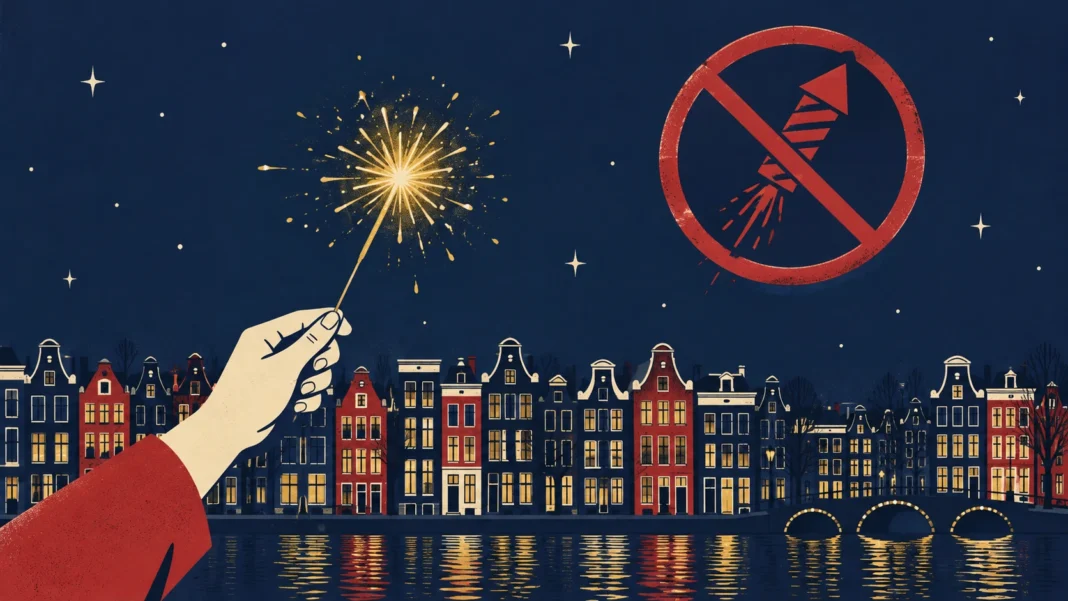
The Dutch fireworks ban is no longer a plan: since 1 August 2026, ordinary consumers in the Netherlands may no longer buy, possess or set off consumer fireworks. Only small category F1 fireworks, such as sparklers, are still allowed. The national hand-in period for leftover fireworks ended on 9 October. With New Year’s Eve 2026/27 approaching, this guide explains what the Dutch fireworks ban means in practice, what you can still do, and what the government itself says about exemptions, imports and enforcement.
Dutch fireworks ban: quick answer
- In force since: 1 August 2026 (Wet veilige jaarwisseling, the Safe New Year’s Eve Act).
- Banned for consumers: buying, possessing and setting off F2, F3 and F4 fireworks, such as rockets, cakes, compound boxes and bangers.
- Still allowed: category F1, such as sparklers (sterretjes) and bangers like knalerwten.
- Exemption: associations and foundations can ask their municipality for an ontheffing (exemption).
- Hand-in: free and without a fine from 1 September to 9 October 2026. That period is over.
- Professional shows: still possible with a permit.
Contents
- 1. What the Dutch fireworks ban says
- 2. The 7 rules to know
- 3. What is still allowed under the Dutch fireworks ban
- 4. Why the Netherlands banned consumer fireworks
- 5. Exemptions for associations and foundations
- 6. Buying fireworks abroad
- 7. Leftover fireworks after 9 October
- 8. Enforcement and penalties
- 9. What the Dutch fireworks ban means for newcomers
- 10. FAQ
- 🇳🇱 Dutch Corner
- Sources
1. What the Dutch fireworks ban says
The Dutch fireworks ban comes from the Wet veilige jaarwisseling. According to the Rijksoverheid, the law took effect on 1 August 2026, and since then buying, setting off and possessing consumer fireworks is no longer allowed in the Netherlands. The only exception for consumers is category F1.
The government describes the result like this: only professional parties with a permit, and foundations or associations with an exemption for the New Year’s celebration, may still use fireworks. Everyone else is limited to small F1 products.
The ban is not limited to New Year’s Eve itself: since 1 August the law covers buying, setting off and possessing consumer fireworks. Alongside the law, the government ran a national hand-in campaign in September and October.
2. The 7 rules to know
If you only want the essentials, these are the seven rules of the Dutch fireworks ban as the government describes them:
- Consumers may not buy, possess or set off F2, F3 and F4 fireworks. That covers rockets (vuurpijlen), cakes, compound boxes and bangers (knalvuurwerk).
- Only F1 remains for consumers. The category is printed on the packaging.
- Associations and foundations need a municipal exemption (ontheffing) to set off fireworks at New Year’s.
- Professional fireworks shows are still allowed with the required permits.
- From abroad, consumers may only bring F1 fireworks into the Netherlands. Importing other fireworks is a criminal offence.
- Retailers may sell F2 to F4 only to professionals and people with permission.
- Police and special investigating officers (boa’s) enforce the rules, with extra checks near the German and Belgian borders around New Year.
3. What is still allowed under the Dutch fireworks ban
Under the Dutch fireworks ban, small category F1 fireworks can still be used by consumers throughout the year. The Rijksoverheid gives these examples: knalerwten (bangers), knalbonbons (snap bonbons), sterretjes (sparklers) and sierfonteintjes (small fountains, for example for cakes). The category is printed on the packaging, so you can check it before you buy.
The government’s campaign site adds that F1 is allowed for everyone over 12.
The products that are no longer allowed are categories F2, F3 and F4. The Rijksoverheid lists rockets, cakes, compound boxes and bangers as examples. Consumers may not buy, possess or set off them. Sellers may only sell them to professionals and to people with permission.
4. Why the Netherlands banned consumer fireworks
The government gives several reasons for the Dutch fireworks ban, and it backs them with figures from the most recent New Year’s celebration:
- 1,239 firework casualties were treated at the 2025–2026 New Year, which is 7% more than the year before.
- 39% of the casualties were under 16, and half were bystanders.
- More than 500 emergency workers faced violence in 2026.
- Fires, damage to cars and bins, air pollution and environmental harm also increased.
- According to the government, about 60% of people support a ban, based on polls.
The rules also fit a wider Dutch debate about public safety around the turn of the year. If you are new to the country, the Dutch emergency kit guide explains how the government wants households to prepare for disruptions in general.
5. Exemptions for associations and foundations
The Dutch fireworks ban is not absolute. Municipalities can grant an exemption (ontheffing) for New Year’s events, for example carbide shooting at a neighbourhood association or a fireworks show by a foundation. According to the government:
- The association or foundation must have a local connection. Check with your own municipality what that means locally, for example whether the organisation must be registered in the municipality where it applies.
- Additional conditions apply to these exemptions.
- Foundations and associations with an exemption may buy and import up to 25 kg of F2 fireworks, but the government advises against buying abroad.
- Leftover fireworks must be returned to the retailer by 1 January. Possessing fireworks after 1 January is a criminal offence.
Carbide shooting is a separate case. According to the Rijksoverheid, the rules vary by municipality, so you need to ask your own municipality whether it is allowed and under which conditions.
Professional shows
Professional fireworks shows remain possible year-round with a permit. The government says they must meet requirements such as viewer distances of 14 to 50 metres, depending on the type of fireworks. Professionals also need a completed fireworks-expert training (vuurwerkdeskundige), an application permit (toepassingsvergunning), permission to set off fireworks via a notification or permit, and a pyro-pass to buy professional fireworks, which can be requested free of charge.
6. Buying fireworks abroad
Many people used to drive across the border for stronger fireworks. Under the Dutch fireworks ban that is no longer an option. The government says consumers may only bring F1 fireworks into the Netherlands, and that importing other fireworks is a criminal offence.
To make that enforceable, the police and the ILT (the inspectorate for the environment and transport) carry out extra checks near the German and Belgian borders around New Year. The Netherlands is also pushing for EU-wide restrictions on category F4 fireworks, including a ban on sales in border regions.
7. Leftover fireworks after 9 October
From 1 September to 9 October 2026, people could hand in fireworks safely, free of charge, anonymously and without a fine or criminal record. According to the campaign site, collection points were open at 35 locations, each on one day, and the offer covered both newly banned consumer fireworks and heavy fireworks that were already illegal.
That period is over. The pages I read do not say what happens to people who keep banned fireworks after 9 October, and they do not list specific fine amounts. The campaign site does state that possessing and setting off banned fireworks is punishable.
Two practical notes from the same site: fireworks that have already been set off can go in the regular household waste or to a milieustraat (the municipal recycling point), and unused fireworks should be kept dry in a separate bag, because flash powder can ignite when it gets wet.
8. Enforcement and penalties
The government says the police and boa’s enforce the Dutch fireworks ban. Enforcement also targets illegal trade: the government lists investigations, border and international checks (including with Europol), public information, social media monitoring and pseudo-purchases by undercover officers.
For young people, the government says minors receive interventions without prosecution where possible, such as a referral to Halt. Violence against emergency workers and others with public duties carries heavier penalties.
Retailers who lose sales can apply for compensation through RVO, the Netherlands Enterprise Agency. That compensation is for businesses, not for consumers.
9. What the Dutch fireworks ban means for newcomers
Our tips (not from the sources):
- Check the packaging before using anything you find at home or receive as a gift: only F1 is for consumers.
- If you were planning a New Year’s party with fireworks, look for a professional show or an event organised by a local association with an exemption.
- Ask your municipality or neighbourhood association whether an exempted event is planned in your area, since local rules differ.
- Do not bring fireworks back from a trip abroad, even for a neighbourhood gathering.
For more on Dutch seasonal traditions, see our Dutch festival guide, the guide to Christmas markets in the Netherlands and 21 things the Dutch do that shock foreigners.
10. FAQ
Is the Dutch fireworks ban already in force?
Yes. According to the Rijksoverheid, the Wet veilige jaarwisseling took effect on 1 August 2026.
Can I still use sparklers on New Year’s Eve?
Yes. Category F1, such as sterretjes and knalerwten, remains allowed for consumers.
Are rockets and cakes banned?
Yes. Rockets, cakes, compound boxes and bangers fall under F2, F3 and F4, which consumers may no longer buy, possess or set off.
Can I still hand in fireworks?
The national hand-in days ran from 1 September to 9 October 2026 and are over. The government pages I read do not describe an alternative.
Can a neighbourhood association still organise fireworks?
Possibly, if the association or foundation has a local connection and receives an exemption (ontheffing) from its municipality. Additional conditions apply.
Can I buy fireworks in Germany or Belgium?
Only F1. The government says consumers may only bring F1 fireworks into the Netherlands and that importing other fireworks is a criminal offence.
Are professional fireworks shows still allowed?
Yes, year-round with a permit, as long as requirements such as viewer distances of 14 to 50 metres are met.
🇳🇱 Dutch Corner
| Dutch | English |
|---|---|
| Het vuurwerk | Fireworks |
| Het vuurwerkverbod | Fireworks ban |
| De jaarwisseling | New Year’s turn (New Year’s Eve and Day) |
| De ontheffing | Exemption |
| Het sterretje | Sparkler |
| De knalerwt | Pop-pop (small banger) |
| De vuurpijl | Rocket |
| De boa | Special investigating officer |
| De milieustraat | Municipal recycling point |
| Inleveren | To hand in |
Sources
- Rijksoverheid: Maatregelen voor minder gewonden en schade door vuurwerk (ban from 1 August 2026, figures, exemptions, imports, enforcement, compensation)
- Rijksoverheid: Regels vuurwerk afsteken (categories F1–F4, professionals, carbide shooting)
- Rijksoverheid, 17 August 2026: Campagne rondom landelijke vuurwerkinleverdagen van start (law in force 1 August, hand-in campaign)
- Rijksoverheid: Verboden en toegestaan vuurwerk (F1 examples, banned products)
- Lever je vuurwerk in: Veelgestelde vragen (hand-in locations and hours, F1 age, leftover waste, penalties wording)
Free: Netherlands 2027 Money Checklist
Every deadline and number you need before and after 1 January 2027, on two printable pages. Confirm your email and the PDF is yours; we will also email you when the 2027 figures are confirmed.
 Read nextBusiness & FinanceStarting a Business in the Netherlands as an Expat: KvK, VAT and Your First Website