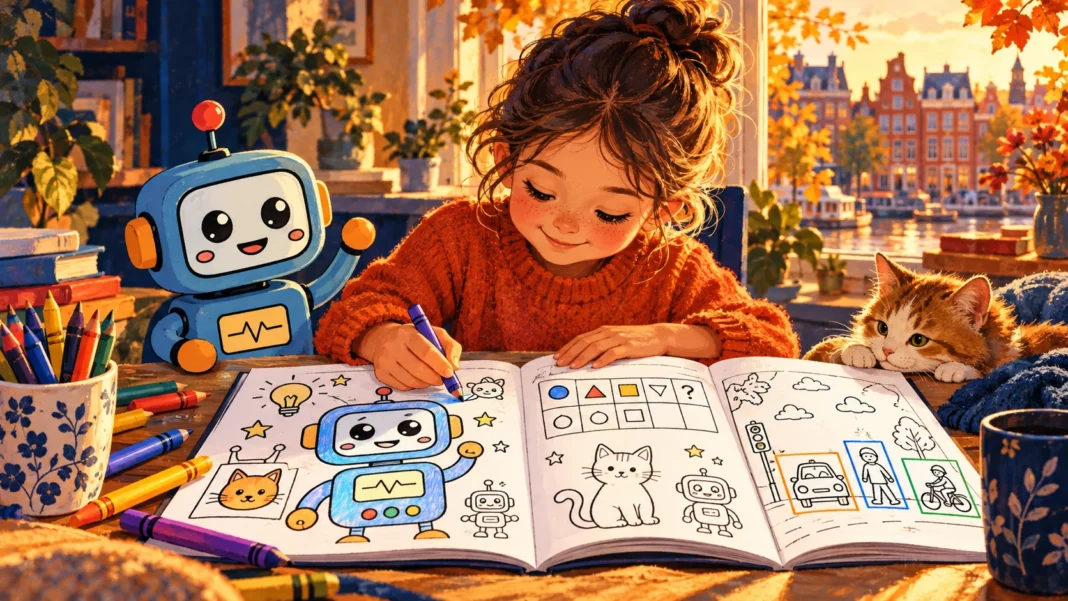
The book is designed for screen-free use: children do not need a computer, tablet or internet connection to complete its activities. For parents, caregivers and educators, it offers a practical starting point for conversations about how AI works, why it sometimes makes mistakes and why people remain responsible for the choices they make with technology.
Explore What Is AI? on Amazon.nl
Meet What Is AI? A Coloring & Activity Book for Curious Kids
Artificial intelligence can feel abstract when it is explained through technical terminology or advanced computer science. Children may find it easier to begin with familiar actions: looking for patterns, following instructions, sorting pictures, drawing objects and checking whether an answer makes sense.
What Is AI? uses that hands-on approach. Rather than asking children only to read about technology, it invites them to take part in activities connected to basic AI ideas. Pixel gives the book a friendly guide, while the illustrations and tasks help introduce the subject in an approachable format.
The book is Level 1 of the Pixel series, making it an entry point for curious young learners. It is intended as an introduction to AI concepts rather than a technical textbook or advanced coding course.
What’s Inside This AI Activity Book for Kids?
The book combines colouring pages, short lessons, practical tasks and supporting material for adults. Together, these elements introduce AI-related ideas while giving children different ways to engage with the subject.
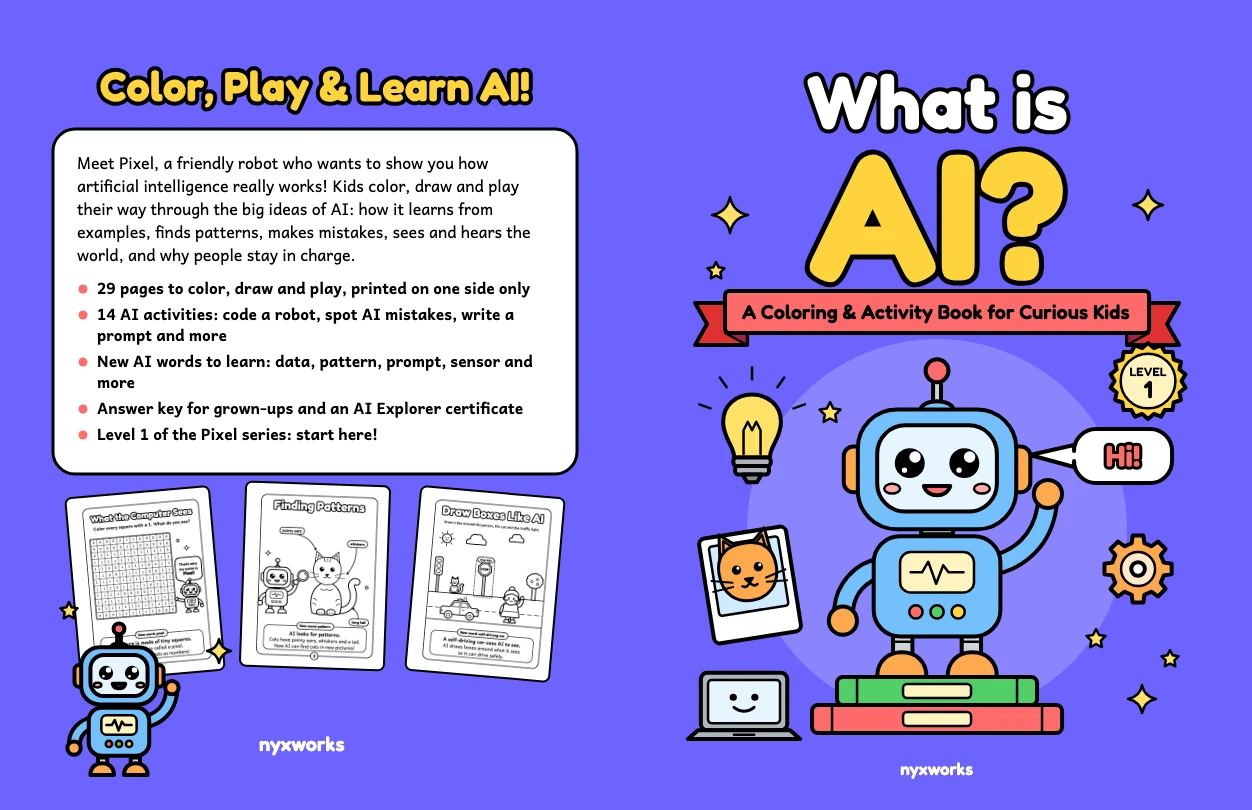
29 Pages to Colour, Draw and Play
The book includes 29 pages for colouring, drawing and play. Children can work with crayons or markers, making the activities suitable for an offline creative session at home, during a journey or as part of a supervised learning activity.
The pages are printed on one side only. This layout helps reduce the risk of markers affecting artwork on the reverse side and gives each activity its own working space.
Lessons About Artificial Intelligence
These lessons introduce ideas such as how AI learns from examples, finds patterns, makes mistakes and uses information from the world around it. The lessons also create opportunities to talk about how people interact with AI and why its results should not automatically be treated as correct.
The short format gives parents and educators natural places to pause, ask questions and connect an idea to something a child already knows. The aim is to build familiarity with core concepts without overwhelming the reader with technical detail.
14 Hands-On AI Activities
The book also contains 14 practical activities. Children can try coding a robot, spot AI mistakes, write a prompt, draw boxes around objects in a scene in a way that resembles object-detection tasks, and match AI-related vocabulary.
The activities use different kinds of thinking. Some focus on drawing and visual observation; others encourage children to follow instructions, recognise patterns or think carefully about how information is interpreted. They are designed to make the ideas behind AI more tangible through participation.
AI Words Explained in Simple Language
Words such as data, pattern, prompt and sensor can be new to young learners. The book introduces AI vocabulary in simple sentences that adults can read aloud and discuss with children.
Learning these terms gives children a starting point for describing what they notice. For example, they can begin to discuss the examples a system uses, the pattern it appears to recognise or the instruction someone has given it, rather than describing every technology as simply “smart.”
An Answer Key and AI Explorer Certificate
An answer key for grown-ups is included to support adults as they work through the activities with children. The book also contains an AI Explorer certificate that children can colour and sign when they finish.
These features make the book suitable for shared learning. Adults do not need to be AI specialists to use the pages as a starting point for questions and conversation; the answer key offers extra support where it is needed.
A Screen-Free Way to Explore AI
Children encounter digital technology in many parts of everyday life, but introducing artificial intelligence does not always require another app or online activity. A screen-free AI activity book offers a different way to engage with the subject using physical pages, drawing and discussion.
What Is AI? can be used at the kitchen table, during a quiet afternoon, on a car journey or as part of a classroom or STEM-club activity. It does not require an internet connection to complete the activities, so families and educators can choose when and where to use it.
Screen-free activities cannot explain every detail of a real AI system, and this book is not intended to do so. Instead, it provides an accessible starting point for exploring selected concepts before children encounter them in more complex digital environments.
Introducing AI Mistakes and Responsible Use
Learning about artificial intelligence involves more than discovering what technology can do. It also means understanding that AI systems can make mistakes and that people need to check information and think about how they use technology.
The book includes simple AI safety habits that adults can reinforce through conversation:
- Ask a grown-up when help or guidance is needed.
- Keep personal information and private details safe.
- Check whether information is true instead of automatically trusting an answer.
- Be kind and treat other people respectfully.
These rules give families a starting point for discussing privacy, accuracy and kindness. An adult might explain why personal details should not be shared carelessly online, or why an answer from an AI tool may need to be checked against a reliable source.
The book does not replace adult guidance. Rather, its child-friendly format can help open conversations about responsible technology use alongside introductory AI concepts.
Who Is This AI Activity Book For?
What Is AI? may be useful for families, educators and children who enjoy creative activities and are curious about technology.
- Parents and caregivers: Read the short lessons aloud, work through activities together and use the safety rules to start conversations about AI.
- Teachers and educators: Select pages as supplementary material for introductory technology discussions or creative learning sessions, depending on students’ needs and reading abilities.
- STEM clubs and informal learning groups: Use the book as a physical activity resource alongside discussions about technology, logic and problem-solving.
- Children who enjoy drawing and colouring: Explore an AI-related topic through creative tasks rather than relying exclusively on videos, apps or computer-based activities.
The right level of support will depend on each child’s reading ability, interests and independence. Some children may want an adult to explain the instructions, while others may prefer to explore the illustrations and tasks more independently.
How to Use the Book at Home or in a Learning Session
The activities do not require a long, uninterrupted lesson. Families can work through a few pages at a time, bring the book along on a trip or choose an activity for a home-learning session. Educators can select tasks that fit the purpose of a class or group activity.
Adults can make the experience more engaging by asking open questions: What did you notice? Why did you choose that answer? What could make a prediction wrong? What other information might help? These questions encourage children to explain their thinking instead of focusing only on completing a page.
There is no need to rush through the book. Giving children time to look carefully, try an idea and talk about a mistake can be just as important as finishing the activity. Later, everyday examples such as a video recommendation or an AI-generated image can provide opportunities to revisit concepts from the book.
What Makes It More Than a General Colouring Book?
A general colouring book primarily offers pictures to colour. An AI activity book adds a learning theme, connecting illustrations and tasks to concepts children can explore. In What Is AI?, the activities relate to basic AI ideas, vocabulary and responsible use.
The combination of 29 creative pages, 12 short lessons, 14 hands-on activities, AI safety rules, an answer key for adults and an AI Explorer certificate gives the book several ways to support the learning experience. Children can draw, follow instructions, work with new words and discuss why technology may get something wrong.
It remains an introductory resource, not a comprehensive textbook or coding course. Its purpose is to help curious children take their first steps towards understanding artificial intelligence through creative participation.
Frequently Asked Questions
What is an AI activity book for kids?
An AI activity book for kids introduces concepts related to artificial intelligence through activities such as drawing, puzzles, pattern recognition and simple problem-solving. What Is AI? combines creative tasks with short lessons and introductory AI vocabulary.
What is included in What Is AI?
The book includes 29 pages to colour, draw and play, 12 short lessons, 14 hands-on activities, AI vocabulary, safety rules, an answer key for adults and an AI Explorer certificate.
Do children need a computer or tablet to use the book?
No. The activities are designed to be completed with crayons or markers and do not require a computer, tablet or internet connection.
Does the book introduce AI safety?
Yes. It includes simple habits such as asking a grown-up for help, protecting personal information, checking whether information is true and treating others kindly.
Can the book be used in a classroom?
The activities may be used as supplementary material in suitable classroom or informal learning settings. Educators can select tasks according to their learning goals, students’ reading abilities and the adult support available.
Who publishes What Is AI?
What Is AI? A Coloring & Activity Book for Curious Kids is published under the NYXWorks imprint and is Level 1 of the Pixel series.
Where to Find What Is AI? A Coloring & Activity Book for Curious Kids
For families and educators looking for an AI activity book for kids, What Is AI? A Coloring & Activity Book for Curious Kids offers a screen-free introduction to artificial intelligence through colouring, drawing, short lessons and practical activities.
With Pixel as a friendly guide, children can explore ideas such as data, patterns, prompts and sensors while learning that AI can make mistakes and that responsible use matters. The one-sided page layout, adult answer key and AI Explorer certificate add practical features for shared learning.
As Level 1 of the Pixel series, the book is designed as an accessible starting point for curious young learners who are beginning to explore what artificial intelligence is and how it works.
Free: Netherlands 2027 Money Checklist
Every deadline and number you need before and after 1 January 2027, on two printable pages. Confirm your email and the PDF is yours; we will also email you when the 2027 figures are confirmed.
 Read nextLiving in NLNetherlands Asylum Law Proposal 2026: When Return Frustration Could Become a Crime