



Last updated:
Contents
- 1. The Dutch naturalisation process, step by step
- 2. Your exam route: inburgering at A2 or the NT2 State Exam
- 3. Exemptions and medical dispensation
- 4. Your name: when you can set or change it
- 5. Children: including them in your application
- 6. Your old passport and the Turkish Mavi Kart
- 7. Option instead of naturalisation?
- 8. Costs: the IND fees
- 9. The ceremony and your first Dutch passport
- 10. FAQ
- 🇳🇱 Dutch Corner
- Sources
Updated on 8 November 2026: this guide now covers the practical side of becoming Dutch. Prices, fees and rules in this article were checked on 8 November 2026. They can change, so check the linked pages before you decide.
This guide walks you through the Dutch naturalisation process in practice: where you apply, which exam route you can take, what happens to your name, your children and your old passport, and what it costs. It does not repeat the general rules. For the 5-year rule, the residence permits that count and the asylum changes, read our Dutch citizenship requirements guide. For the A2 versus B1 language question, see our language requirement guide.
The rules in brief (IND, checked 8 November 2026): you must be 18 or older, have lived in the Kingdom of the Netherlands for at least 5 consecutive years with a valid residence permit, have passed the civic integration exam at language level A2 or have an exemption, be willing to make the declaration of solidarity, and usually renounce your other nationality. Source: IND, Becoming a Dutch national through naturalisation (page updated 20 October 2026). Some people may apply earlier than after 5 years; the IND lists those exceptions on the same page.
1. The Dutch naturalisation process, step by step
You do not apply online and you do not send your file to the IND yourself. The application starts at the town hall of the municipality where you live. According to the IND, the process looks like this:
- Check the requirements. Make sure you meet the conditions above, and find out whether you must renounce your current nationality (section 6).
- Collect your documents. You need a valid passport or other travel document (with an asylum permit or as a stateless person, a refugee passport or foreigner’s passport), a birth certificate from your country of origin, a valid residence permit or other proof of lawful residence, and your civic integration diploma or an exemption decision. Official foreign documents must be legalised and translated into Dutch, English, French or German. If your documents are already registered in the Personal Records Database (BRP), you do not need to obtain and legalise them again. If you apply on the basis of a 3-year marriage or registered partnership, add the marriage or partnership certificate, unless it is already in the BRP.
- Make an appointment at the town hall. A municipal employee discusses the conditions with you, checks your documents and completes the application with you. If something is missing, the municipality makes another appointment. You can add children under 18 at the same appointment.
- Pay. You pay the fees to the municipality when you submit the application (see section 8).
- Wait for the decision. The municipality sends your application, documents and its advice to the IND. The IND must decide within 12 months. This decision period starts when the fees have been paid, and the IND can extend it, for example when the file is incomplete. You can follow your application in My IND.
- Royal Decree. If the IND approves, it asks the King to grant you Dutch nationality. The King signs, but you are not Dutch yet.
- Ceremony. You become Dutch only when you attend the naturalisation ceremony and make the declaration of solidarity (see section 9).
If your application is rejected and you disagree, the IND says you can apply for review.
2. Your exam route: inburgering at A2 or the NT2 State Exam
The IND civic integration page (updated 3 November 2026) says you must pass the civic integration exam at language level A2. This is also called the naturalisation test. You register with DUO at inburgeren.nl. The exam covers reading, listening, writing and speaking Dutch, Knowledge of Dutch Society (KNM), the labour-market part (ONA under the 2013 Act, MAP under the 2021 Act) and the Participation Statement Process (PVT). When you pass, you receive a digital civic integration diploma.
There is a second route. A diploma from the Dutch as a Second Language State Exam (NT2), programme I or II, is on the IND’s list of full exemptions from the civic integration exam for naturalisation. You then do not need the inburgering diploma as well. According to Staatsexamens NT2, programme I is level B1 and programme II is level B2. On 22 and 29 October 2026 it announced extra exam dates in December 2026 and January 2027 and published the February 2027 schedule.
| Route | Level | What it gives you for naturalisation |
|---|---|---|
| Civic integration exam (DUO) | A2 | Civic integration diploma: meets the requirement |
| NT2 State Exam, programme I | B1 | Full exemption from the civic integration exam |
| NT2 State Exam, programme II | B2 | Full exemption from the civic integration exam |
Sources: IND, Civic integration for naturalisation (updated 3 November 2026); Staatsexamens NT2 (checked 8 November 2026).
Which route suits you depends on your level and plans. The NT2 exam is at a higher level than A2. The A2 exam is the standard proof the IND asks for. Whether the language requirement for naturalisation will rise to B1 is a separate question: it is a plan, not a rule in force. See our language requirement guide.
3. Exemptions and medical dispensation
The IND distinguishes two things. An exemption means you show that you are already integrated, for example with a Dutch diploma. A dispensation means you cannot pass the exam for medical or other reasons.
Examples from the IND’s list of full exemptions (checked 8 November 2026):
- a Dutch diploma or certificate above primary-school level, for education taught in Dutch;
- an NT2 State Exam diploma, programme I or II;
- a civic integration diploma under the Civic Integration Act 2013 or 2021, at A2 or above;
- at least 8 years in the Netherlands while you were of school age (between 5 and 16);
- a Belgian or Surinamese diploma for education taught in Dutch (with an apostille), or a European Baccalaureate with Dutch as a first or second language.
The full list, including older certificates and partial exemptions, is on the IND civic integration page.
Medical dispensation. If you have a serious, long-term physical disability (such as deafness or blindness) or serious mental health problems, the IND describes several ways to prove a dispensation. One is a medical examination and advice from Argonaut, the medical adviser appointed by the Minister for Social Affairs and Employment. You pay for that examination yourself. The advice must not be more than 6 months old when you submit your naturalisation application. Another route is a DUO decision under Article 6(1) of the Civic Integration Act 2013. A short note from your own doctor is not on the IND’s list of proof.
You hand in your exemption or dispensation decision with your other documents at the town hall (step 2 in section 1).
4. Your name: when you can set or change it
Naturalisation is also the moment when your name can be formally set or changed. The IND describes two situations.
Establishing your name (mandatory in some cases). If you do not have a separate first name and surname, for example because you have only one name, or several names without a clear split, your name must be established. You fill in a form with the first name and surname (geslachtsnaam) you would like. Your municipality can tell you whether this applies to you.
Changing your name (optional, on limited grounds). You may ask in your naturalisation application to change your surname, or your surname and first name, if it is important for your integration. The IND lists these situations:
- your name is difficult for Dutch people to pronounce;
- you took your husband’s surname through marriage and want to go back to your maiden name;
- your name has an inappropriate or ridiculous meaning in Dutch;
- your surname has a masculine or feminine form, which you can change to the uninflected form (for example, Bonova to Bonov);
- you have a compound surname made of your mother’s and father’s names, and want one of them as your surname.
For children who join the application, children aged 12 to 15 may say what they think about a name change. Children aged 16 or 17 must give permission.
5. Children: including them in your application
A child under 18 cannot apply for naturalisation alone, but can join your application. In Dutch this is called mee-naturalisatie. The IND sets different conditions by age:
| Age of child | Main conditions (IND) |
|---|---|
| Under 12 | Lives in the Netherlands; has a valid permanent residence permit or a temporary permit with a non-temporary purpose, valid until the ceremony. |
| 12 to 15 | As above. The child must come with you to the town hall and tells the official what they think about being included. |
| 16 or 17 | Has lived in the Netherlands for at least 3 years in a row; valid permit as above; must be present, must agree, and must be willing to make the declaration of solidarity. |
Source: IND, Becoming a Dutch national through naturalisation (updated 20 October 2026).
If only one parent applies and includes a child, the other parent may give a written statement (zienswijze) saying whether they object. If your child does not naturalise with you, you can apply for the child later, after you have become Dutch yourself (subsequent naturalisation). Minors do not have to renounce their other nationality, according to the IND renunciation page.
6. Your old passport and the Turkish Mavi Kart
If you are 18 or older, you usually have to renounce your other nationality after naturalisation. The IND (page updated 9 September 2026) lists situations in which you do not have to, including:
- you are married to, or the registered partner of, a Dutch citizen on the date the Royal Decree is signed (a marriage or partnership after that date does not count);
- you have an asylum residence permit, or an EU long-term resident permit with a note that you were granted international protection;
- you were born in the Kingdom of the Netherlands and live there now.
If you think you cannot renounce for another reason, you must request an exemption with supporting documents during the procedure. The IND says you can no longer request one after you have become Dutch. Renouncing is done with the government of your other country and always costs money and time, so ask your consulate or embassy about both before you apply. For the full picture, read our dual citizenship guide.
Turkish nationals: what the Mavi Kart keeps
This part is Turkish law, not IND policy. According to Turkey’s General Directorate of Population and Citizenship Affairs (NVI, Mavi Kart), people who were Turkish by birth and gave up Turkish nationality with permission (çıkma izni), and their descendants up to the third degree, continue to enjoy the rights of Turkish citizens, with some exceptions. They do not have the right to vote or stand for election or to import a vehicle or household goods duty-free, and they have no military service obligation. Acquired social-security rights are kept. They cannot hold permanent civil-servant posts, but public bodies may employ them as workers or contract staff. Check the current conditions with the Turkish consulate before you start.
7. Option instead of naturalisation?
Some people can become Dutch through the option procedure. It is a quicker municipal procedure with an option declaration, but it is open only to listed groups. The IND option page (updated 18 August 2026) includes, for example:
- adults who were born in the Kingdom and have always lived there, with a valid residence permit or residence under EU law;
- adults who have lived in the Kingdom since the day they turned 4, always with a valid permit or residence under EU law;
- people with at least 15 consecutive years of residence who have been married to, or the registered partner of, a Dutch citizen for at least 3 years;
- people with at least 15 consecutive years of residence who are 65 or older;
- former Dutch citizens who have lived in the Kingdom for at least 1 year with a qualifying permit (not if they lost Dutch nationality by not renouncing another one).
For option you do not take the civic integration exam. You only have to renounce your nationality if you apply as someone who has lived in the Kingdom since age 4. The municipality decides, and by law it has 13 weeks, which it can extend once by up to 13 weeks. You still make the declaration of solidarity at a ceremony. EU citizenship alone does not give access to option; the groups above are the test.
8. Costs: the IND fees
You pay the fee at the town hall when you apply. These are the amounts on the IND fees page (updated 22 October 2026, checked 8 November 2026):
| Application | Fee |
|---|---|
| Naturalisation, 1 person | €1,139 |
| Naturalisation together with a partner | €1,454 |
| Child under 18 joining a parent | €168 |
| Naturalisation, stateless person or asylum permit holder | €847 |
| Same, together with a partner | €1,163 |
| Option, 1 person | €241 |
| Option together with a partner | €412 |
| Child under 18 joining a parent’s option | €27 |
Source: IND, Fees: costs of an application (updated 22 October 2026). Fees can change, often on 1 January.
Other costs come on top of the IND fee: legalising and translating foreign documents, any exam fees at DUO or Staatsexamens NT2, the Argonaut examination if you need one, renouncing your other nationality, and your first Dutch passport, which you apply for at your municipality. Check those amounts with the organisation concerned; they are not in the IND table.
9. The ceremony and your first Dutch passport
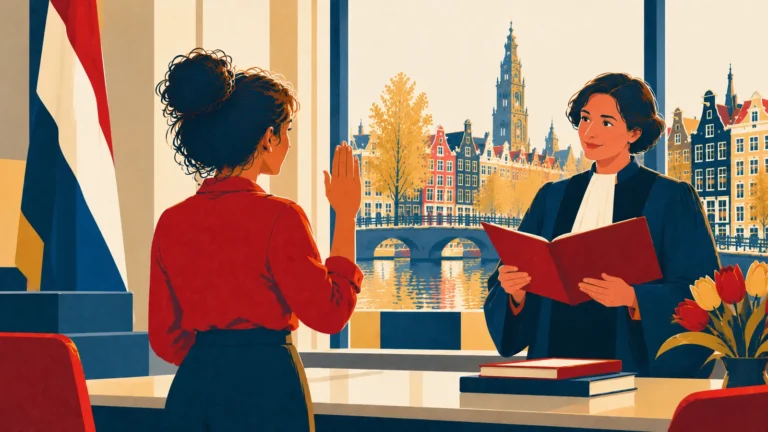
When your application is approved, the town hall invites you to the naturalisation ceremony. The IND is clear: you only become Dutch if you attend. At the ceremony you make the declaration of solidarity, in which you declare that the laws of the Kingdom of the Netherlands apply to you, and you receive the naturalisation decision. After that you can apply for a Dutch passport or ID card at your municipality, which sets its own processing times and fees.
If you have to renounce your other nationality, the IND sends you a letter after the ceremony. Keep your address up to date: the IND warns that if it cannot reach you and you do not renounce in time, your Dutch nationality could be revoked.
10. FAQ
Can I apply for naturalisation online?
No. According to the IND, you submit your application at the town hall of the municipality where you live, and you pay there.
How long does the Dutch naturalisation process take?
The IND must decide within 12 months of the fee being paid, and can extend that period. After approval you still have to attend the ceremony. Option is usually faster: the municipality has 13 weeks, which it can extend once by up to 13 weeks.
Do I need the inburgering exam if I have an NT2 diploma?
No. The IND lists an NT2 State Exam diploma, programme I or II, as a full exemption from the civic integration exam for naturalisation.
Does my 16-year-old need to take an exam to join my application?
The IND does not list an exam for children who join. A 16- or 17-year-old must have lived in the Netherlands for at least 3 years in a row, have a valid permit, come to the town hall, agree, and be willing to make the declaration of solidarity.
Can I change my name to my partner’s surname when I naturalise?
That is not one of the grounds the IND lists. You can go back to your maiden name if you took your husband’s name through marriage, and the other grounds are listed in section 4.
Can I still ask for an exemption from renouncing after I become Dutch?
No. The IND decides on the exemption while it handles your naturalisation application. After you have become Dutch, you can no longer request one.
🇳🇱 Dutch Corner
| Dutch | English |
|---|---|
| de naturalisatie | naturalisation |
| de mee-naturalisatie | a child naturalising together with a parent |
| de optieverklaring | option declaration |
| de verklaring van verbondenheid | declaration of solidarity |
| de vrijstelling | exemption (you are already integrated) |
| de ontheffing | dispensation (you cannot take the exam) |
| de geslachtsnaam | surname |
| de zienswijze | statement of view (e.g. from the other parent) |
| het gemeentehuis | town hall |
| de leges | application fees |
Sources
- IND, Becoming a Dutch national through naturalisation (requirements, documents, town-hall procedure, 12-month decision period, ceremony, name rules, children; updated 20 October 2026)
- IND, Civic integration for naturalisation (A2 exam, exam parts, NT2 and other exemptions, Argonaut dispensation; updated 3 November 2026)
- Staatsexamens NT2 (programme I = B1, programme II = B2, exam dates; checked 8 November 2026)
- IND, Renouncing your nationality (renunciation rule, exceptions, exemption requests, minors; updated 9 September 2026)
- IND, Becoming a Dutch national through option (option groups, no integration exam, 13-week decision period; updated 18 August 2026)
- IND, Fees: costs of an application (naturalisation and option fees; updated 22 October 2026)
- NVI (Turkey), Mavi Kart (rights of former Turkish citizens; checked 8 November 2026)
Dutch rules change fast. Stay ahead.
Get an email when citizenship, immigration or tax rules change, plus our free Netherlands 2027 Money Checklist. Confirm your email and the PDF is yours; we will also email you when the 2027 figures are confirmed.
 Read nextLearning DutchFree Inburgering Practice Exams: Official DUO and Nt2 Sets, and What Inburgeringscursus.nl Offers