



Contents
- 1. Grofvuil in the Netherlands: what counts
- 2. Two routes: bring it or book a pickup
- 3. Amsterdam, Rotterdam, The Hague and Utrecht compared
- 4. How to put it out without a fine
- 5. What the municipality will not take
- 6. Reuse first: second-hand shops and appliances
- 7. Checklist when you move out
- 8. FAQ
- 🇳🇱 Dutch Corner
- Sources
Prices, fees and rules in this article were checked on 25 November 2026. They can change, so check the linked pages before you decide.
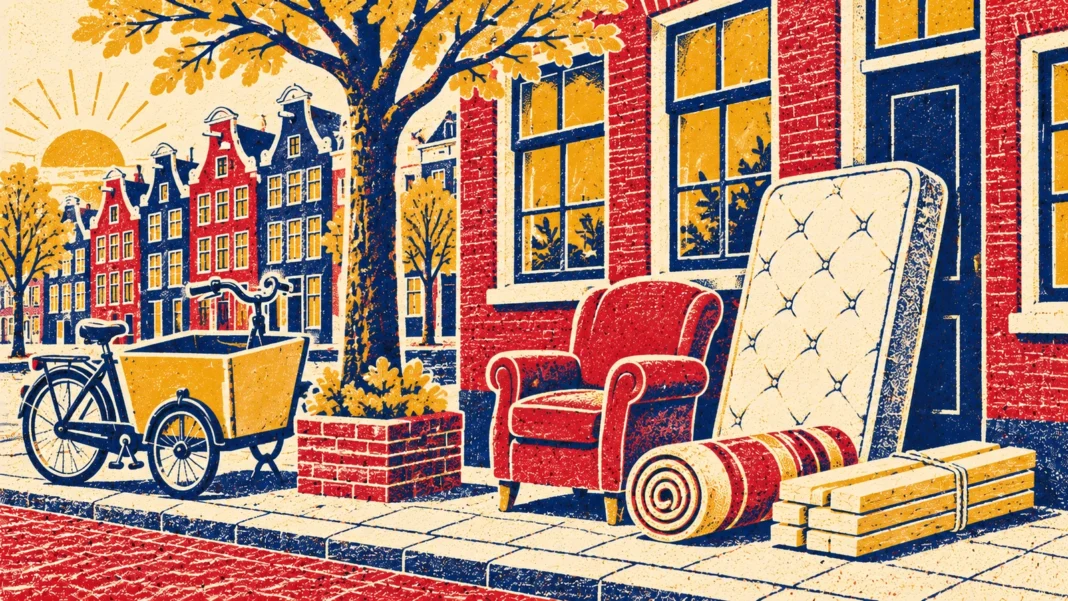
Grofvuil in the Netherlands is the Dutch term for bulky household waste: things such as an old sofa, a mattress or a roll of carpet that are too big for your rubbish bag or container. In the four largest cities you can bring it to a municipal recycling centre for free, or book a free collection, as Utrecht and The Hague state on their websites. What catches newcomers out are the local rules: what time you may put things on the street, how big a pile may be and what the municipality refuses to take. This guide explains how it works, compares Amsterdam, Rotterdam, The Hague and Utrecht, and lists what to check before you carry anything outside.
1. Grofvuil in the Netherlands: what counts
Municipalities define grofvuil in similar ways. Utrecht calls it household waste that is too big for your rubbish bag or container, for example old furniture, mattresses or floor covering. Rotterdam adds that it contains no hazardous substances. Amsterdam, which uses the term grof afval, describes it as items that do not fit in a waste bag.
The service is meant for residents. Rotterdam, for example, says residents who pay the municipal waste tax (afvalstoffenheffing) can hand in waste and grofvuil at its milieuparken. Our guide to Dutch municipal taxes explains that tax, and households on a low income may qualify for kwijtschelding (a waiver).
2. Two routes: bring it or book a pickup
Bring it yourself. Each city has drop-off points with different names: a Recyclepunt in Amsterdam, a milieupark in Rotterdam, an afvalbrengstation in The Hague and an afvalscheidingsstation in Utrecht. Amsterdam and Rotterdam state that bringing grof afval or grofvuil is free. Rotterdam has six milieuparken, with opening hours that differ per location; the park on Aploniastraat, for example, is open Monday to Saturday from 9:00 to 17:00, according to the city’s milieupark page. If you have no car, Rotterdam and Utrecht both lend out a cargo bike (bakfiets) or trailer for free.
Book a collection. If you cannot bring it yourself, you make an appointment and put the items outside on the agreed day. Utrecht says collection is free and can be booked online or by calling 14 030. The Hague says collection is free, you choose the day yourself, and you can change or cancel until 23:59 the day before via the link in your confirmation email or by calling 14070. Rotterdam asks you to make an appointment if you cannot bring the waste to a milieupark; questions go to 14 010. In Amsterdam, you enter your address on the city’s page to see how grof afval is collected where you live.
3. Amsterdam, Rotterdam, The Hague and Utrecht compared
| City | When to put it out | Size limit | Cost of collection |
|---|---|---|---|
| Amsterdam | From 21:00 the evening before; outside by 07:00 on collection day | Together max 2 m long, 1 m wide, 1 m high | Bringing to a Recyclepunt is free; collection method depends on your address |
| Rotterdam | Before 8:00 on the day, not the evening before | Max 1 parking space; packages max 1 m and 30 kg each | Free (bringing and collection) |
| The Hague | Before 7:45 on the day, or after 22:00 the evening before | Items max 1.5 m long, max 0.5 m wide or high | Free |
| Utrecht | Before 7:00 (June–August) or before 8:00 (September–May) | Max 1.5 m × 1 m × 1 m (1.5 m³) | Free |
Sources: Gemeente Amsterdam (page updated 25 November 2026); Gemeente Rotterdam; Gemeente Den Haag (updated 16 November 2026); Gemeente Utrecht. Checked 25 November 2026. Other municipalities set their own rules.
4. How to put it out without a fine
The rules on where to place items are similar in all four cities. The collection truck or crane must be able to reach the pile easily.
- At the street, not on your own property. Utrecht asks you to place grofvuil on the pavement by the road, not on your own grounds. Rotterdam says not in your front or back garden or on the driveway, and allows a free parking space. The Hague also allows a parking bay.
- Not against a building or containers. The Hague and Utrecht say not against the facade of a building; The Hague mentions fire risk and nuisance. Rotterdam, The Hague and Utrecht do not want it next to or around (underground) containers; The Hague explains that the containers cannot be emptied then.
- Not against trees or lampposts. Rotterdam and Utrecht say not against a tree, hedge or lamppost, and Utrecht adds not behind or between parked cars.
- Prepared for lifting. Rotterdam asks for packages of at most 1 metre and 30 kilograms each, carpet rolled into 1-metre rolls and glass panes packed in cardboard or taped together. You do not have to saw a sofa into pieces. Utrecht asks for loose planks to be bundled with rope or tape, no longer than 1.5 metres and without protruding nails. The Hague asks you to put the same types of waste together and tie branches into bundles.
- Bikes. In Utrecht a bike is only taken if it is unlocked and carries a weatherproof tag reading “ophalen grofvuil”.
Timing matters. Rotterdam warns that putting grofvuil out the evening before can lead to a fine. The Hague says that putting grofvuil out incorrectly, or putting out waste that will not be collected, can also lead to a fine. If your appointment in The Hague is missed and the items are still there at 17:00, you report it to the municipality; you do not need to take the items back inside.
5. What the municipality will not take
Building and demolition waste is the main exclusion. The Hague lists what it does not collect: railway sleepers, gas bottles and fire extinguishers, turf, earth and sand, small chemical waste, and building or demolition waste such as rubble, plasterboard, old sanitary ware, demolition wood and asbestos. You bring those yourself to an afvalbrengstation. Amsterdam likewise sends building and demolition waste, such as rubble and a toilet bowl, and stones, sand and earth to a Recyclepunt.
What The Hague does collect gives a good picture of a typical list: mattresses, furniture such as cupboards, sofas and chairs, metal items such as an old bike or drying rack, white goods such as washing machines and fridges, electrical appliances, prams, plastic toys and pruning waste. Each municipality publishes its own list, so check yours before booking.
6. Reuse first: second-hand shops and appliances
Many items do not need to be thrown away. Rotterdam points out that its milieuparken have separate containers for reusable goods, and that second-hand shops such as Het Goed collect larger amounts of reusable goods for free if you make an appointment. The Hague notes that many local kringloopwinkels (second-hand shops) offer a free pick-up service, and also mentions repair cafés.
For an old washing machine, fridge or other appliance there is another route: when you buy a similar new appliance, the shop must take back the old one for free. Our guide to appliance recycling in the Netherlands explains how that works.
7. Checklist when you move out
- Sort what can be sold, given away or picked up by a second-hand shop.
- Check your municipality’s list of items it collects and what it refuses.
- Book the collection early if you need a specific date before your move.
- Put items out within your city’s time window, not earlier.
- Stay within the size limit and bundle loose items.
- Keep building materials, paint and chemicals apart; bring them to the recycling centre.
- Read the conditions in your rental contract about leaving the home empty; our guide to ending a rental contract covers the handover.
8. FAQ
Does it cost money to get rid of a sofa in the Netherlands?
Not in Amsterdam, Rotterdam, The Hague or Utrecht if you use the municipal service. Bringing it to a municipal drop-off point is free in Amsterdam and Rotterdam, and collection by appointment is free in Rotterdam, The Hague and Utrecht. Other municipalities may have different rules.
Can I put my old mattress out the evening before?
It depends on the city. Amsterdam allows it from 21:00 and The Hague from 22:00 the evening before. Rotterdam says not the evening before, and you can be fined for it.
Will the municipality take my renovation rubble?
No. Building and demolition waste is not collected as grofvuil in The Hague, and Amsterdam asks you to bring it to a Recyclepunt yourself.
What if they did not collect my grofvuil?
In The Hague, report it if it is still there at 17:00 on the collection day; you do not need to bring it back inside. In other cities, contact the municipality, for example on 14 010 in Rotterdam or 14 030 in Utrecht.
Can I bring grofvuil if I live in another municipality?
Check your own municipality’s rules. Rotterdam, for example, says its milieuparken are for residents who pay afvalstoffenheffing in Rotterdam.
🇳🇱 Dutch Corner
| Dutch | English |
|---|---|
| het grofvuil | bulky household waste |
| het grof afval | bulky waste (Amsterdam term) |
| de milieustraat / het milieupark | municipal recycling centre |
| het afvalbrengstation | waste drop-off point |
| de afspraak | appointment |
| de ophaaldag | collection day |
| de kringloopwinkel | second-hand shop |
| het bouw- en sloopafval | building and demolition waste |
| de afvalstoffenheffing | municipal waste tax |
| de bakfiets | cargo bike |
Sources
- Gemeente Utrecht – Grofvuil, afspraak maken voor ophalen (definition, free collection, 14 030, times, size, placement, bikes)
- Gemeente Rotterdam – Grofvuil wegbrengen of laten ophalen (free drop-off and collection, times, fine, packaging rules, Het Goed)
- Gemeente Rotterdam – Milieupark (six milieuparken, residents, opening hours)
- Gemeente Amsterdam – Grof afval wegbrengen of laten ophalen (Recyclepunt, times, size, building waste; updated 25 November 2026)
- Gemeente Den Haag – Grofvuil of tuinafval laten ophalen (conditions, collected and refused items, times, size, fine, 14070; updated 16 November 2026)
- Rijksoverheid – Waar kan ik oude en gebruikte huishoudelijke apparaten inleveren? (free take-back of old appliances)
Free: Netherlands 2027 Money Checklist
Every deadline and number you need before and after 1 January 2027, on two printable pages. Confirm your email and the PDF is yours; we will also email you when the 2027 figures are confirmed.
 Read nextLiving in NLNew NS Timetable From 13 December: More Rush-Hour Trains, Line Numbers and a Direct Groningen–Rotterdam Train
 Business & FinanceKwijtschelding in the Netherlands: How to Get Municipal and Water Board Taxes Waived on a Low Income
 Living in NLSnow and Ice in the Netherlands: Who Grits the Roads and Do You Have to Clear Your Pavement?
 Living in NLRotterdam Centraal Closed 7–8 November 2026: No Trains, Replacement Buses and Eurostar Changes