




Last updated:
Published: 18 October 2026 | Last checked: 18 October 2026 | Reading time: 7 minutes
Can Tesla’s Roadster Really Fly? The Demo and Viral AI Memes Explained
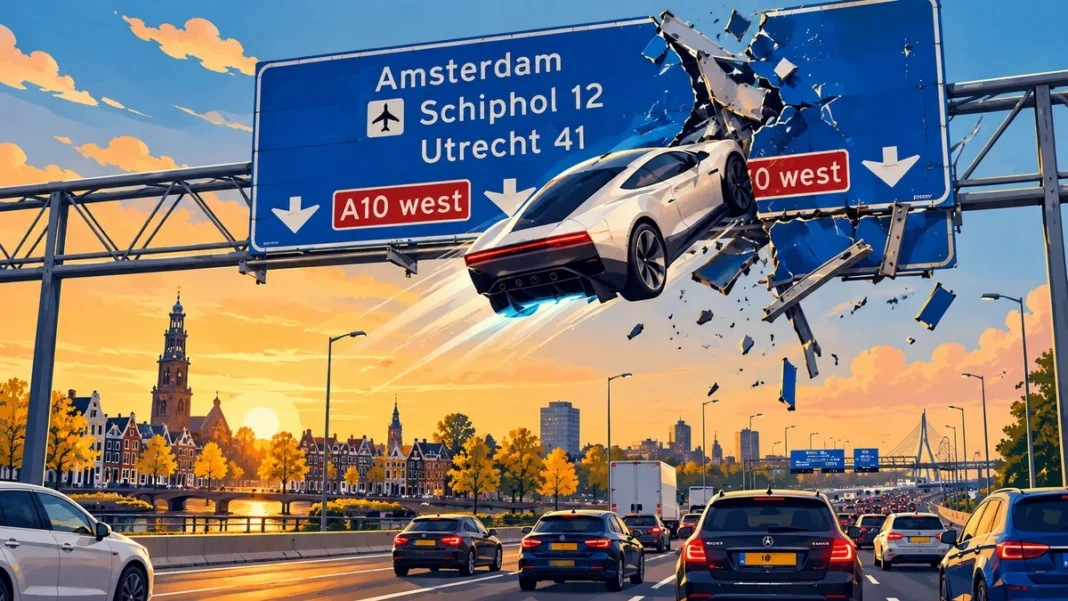
AMSTERDAM, 18 October 2026 — Can a Tesla really fly over traffic? Elon Musk’s latest Roadster demonstration has inspired a wave of AI-generated videos imagining what would happen if drivers could simply take off whenever the road became inconvenient. One Dutch-themed Instagram Reel shows a futuristic car crashing into a motorway sign pointing towards Amsterdam, Schiphol and Utrecht. The scene is a fictional parody, not evidence of a real traffic accident in the Netherlands.
The videos follow Tesla’s 15 October demonstration of its next-generation Roadster, which featured a prototype performing brief airborne manoeuvres using technology developed with SpaceX. Social media creators have taken that spectacle and turned it into an everyday joke: escaping traffic jams, jumping over obstacles and treating the sky as an alternative lane.
Watch the Amsterdam-themed AI parody: View the Tesla Roadster Reel on Instagram.
But what did Tesla actually demonstrate? Can the Roadster fly like an aircraft, and could drivers legally use such a feature on Dutch motorways? Here is what is known about the real vehicle, the AI meme trend and the video that brings the joke to a Dutch road sign.
In This Article
- What Tesla actually demonstrated
- Can the Tesla Roadster really fly?
- Why AI flying-car memes are spreading
- The Amsterdam motorway sign video
- How to recognise an AI-generated car video
- Could a flying Roadster be used on Dutch roads?
- Frequently asked questions
- Sources and further reading
- Dutch Learning Corner
1. What Did Tesla Actually Demonstrate?
On 15 October 2026, Tesla presented its next-generation Roadster at an event hosted at a SpaceX rocket testing and development facility in Texas. The demonstration showed a prototype driving up a steep, curved ramp, launching into the air, performing a mid-air flip and landing.
According to the Associated Press, the vehicle uses cold-gas thrusters and a multi-mode suction system. Tesla said the technology can launch the car into the air for short periods and allow it to spin mid-flight. The demonstration also featured a claimed acceleration from zero to 60 miles per hour in less than a second.
Elon Musk described the reveal as evidence that the future has flying cars. The phrase quickly became a natural starting point for jokes, reaction videos and AI-generated scenarios. Yet a dramatic demonstration is not the same thing as a finished vehicle that can routinely fly through public traffic.
Tesla has said consumer production is not expected to begin until 2028. The company was accepting reservations, but the fine print reported by AP stated that there was no guaranteed delivery date — or guarantee that a vehicle would be delivered at all.
For now, the important distinction is between what a prototype demonstrated in a controlled environment and what an ordinary customer can actually buy, operate and legally use.
2. Can the Tesla Roadster Really Fly?
The answer depends on what you mean by fly.
The demonstration showed a Roadster prototype making a short airborne manoeuvre with assistance from thrusters. That is a real and unusual engineering demonstration, but it is not the same as a conventional aircraft or an electric vertical-take-off vehicle capable of sustained flight.
The word “flying car” can make the technology sound more practical than it currently is. A vehicle briefly leaving a ramp, spinning in the air and landing again does not prove that it can take off from an ordinary road, hover safely above traffic, navigate around buildings or make a controlled landing in a city.
The Roadster’s rocket-assisted configuration also raises practical questions. How would the system operate around pedestrians and other vehicles? What safety standards would apply? Where could it be used, and what would happen if a manoeuvre failed?
Those questions are not answered simply by watching a successful demonstration. They require technical validation, safety testing and regulatory approval. Tesla’s presentation should therefore be understood as a showcase of unusual prototype technology, not proof that everyday flying-car transport is ready.
3. Why Are AI Flying-Car Memes Spreading?
After the Roadster reveal, social media users began imagining how a car that could briefly leave the ground might change familiar driving situations. AI-generated clips show cars escaping traffic queues, jumping over blocked roads, clearing obstacles and taking shortcuts that ordinary drivers can only dream about.
GIGAZINE reported on 18 October that AI-generated videos inspired by the Roadster demonstration were appearing across social media. The examples included fictional traffic escapes and clips built around captions such as “Day one of flying a Tesla Roadster”.
4. The Amsterdam Motorway Sign Video
The Instagram Reel shared with The Dutch Daily gives the flying-car joke a Dutch setting. A futuristic sports car appears to fly into an overhead motorway sign displaying directions for Amsterdam, Schiphol and Utrecht. The sign also includes a reference to the A10 West.
The video carries the caption “Day 1 of owning a Tesla Roadster”. The joke is that someone buys an extraordinary car and immediately uses its fictional flying ability in the most chaotic way possible — apparently aiming straight for a road sign instead of driving along the motorway.
The Dutch locations make the scene recognisable to local viewers. But familiar signs and road markings do not prove that an event actually took place there. The clip is presented as an AI-generated parody, not real footage of a Tesla crash or a flying vehicle on an Amsterdam motorway.
Watch the original Reel: Instagram — “Day 1 of owning a Tesla Roadster”.
The distinction matters because the video uses the visual language of real road footage. Without context, someone scrolling quickly through social media could mistake a fictional scene for an actual incident. Its role in this story is to illustrate the meme trend, not to report a traffic accident.
5. How to Recognise an AI-Generated Car Video
AI-generated video is becoming more realistic, which makes context and verification increasingly important. A convincing motorway scene is not enough to establish that an event occurred.
Look for the original post
Check who published the video, the caption and whether the creator identifies it as AI-generated or a parody. In this case, the Reel is included as an example of the Roadster meme, not as evidence of a real incident.
Compare the claim with reliable reporting
If a clip appears to show a spectacular accident, check whether credible news outlets or relevant authorities have reported it. A dramatic video with no independent confirmation should not automatically be treated as factual.
Separate real technology from fictional use
The Roadster demonstration in Texas was real. The Amsterdam sign scene is a separate, fictional scenario inspired by it. The existence of a real prototype does not authenticate every video made using the same concept.
Be careful with visual details
AI systems can create recognisable road signs, buildings and vehicles without accurately reproducing a real location. Distorted lettering, inconsistent reflections, changing vehicle details or objects that move unnaturally may offer clues, but none of these signs is conclusive on its own.
The safest approach is to combine visual inspection with the source, the caption, the date and independent reporting.
6. Could a Flying Tesla Roadster Be Used on Dutch Roads?
The demonstration does not establish that the Roadster’s rocket-assisted configuration can legally or safely be used as a flying car on Dutch public roads.
The Verge’s report on the Roadster reveal says the showcased “Rocket” configuration will not be approved for public-road use. That is a significant limitation for anyone interpreting the demonstration as the arrival of a practical flying vehicle.
For Dutch drivers, the short version is straightforward: do not treat a social-media clip as proof that an extraordinary driving manoeuvre is permitted. Public-road use depends on the vehicle’s approved configuration and the applicable safety and legal requirements.
The consumer production timeline remains another uncertainty. Tesla has said production is not expected until 2028, and AP reported that reservations did not come with a guaranteed delivery date. Even if a vehicle eventually reaches customers, its precise capabilities, availability and permitted uses should be verified against the final production model and applicable rules.
7. Frequently Asked Questions
Can Tesla’s Roadster really fly?
The demonstrated prototype can perform short airborne manoeuvres using thrusters. This does not establish that it can fly like an aircraft or routinely travel above public traffic.
Was the Amsterdam motorway sign video a real accident?
No. The Instagram Reel discussed here is an AI-generated parody. It should not be treated as evidence of a real Tesla crash or a flying-car incident in the Netherlands.
What did Elon Musk demonstrate on 15 October 2026?
Tesla demonstrated a next-generation Roadster prototype using cold-gas thrusters and a suction system for dramatic manoeuvres, including a brief airborne flip and landing at a controlled event in Texas.
Why are people making flying Tesla videos with AI?
The Roadster demonstration inspired a simple joke: if a car could briefly fly, it might escape traffic jams or bypass obstacles. AI video lets creators turn that idea into fictional scenes set in different places.
When will the new Tesla Roadster be available?
According to the Associated Press report following the reveal, consumer production is not expected to begin until 2028. Tesla did not provide a guaranteed delivery timeline, so the date should be treated as a projected schedule rather than a confirmed delivery promise.
Can the rocket-assisted Roadster fly on Dutch motorways?
The demonstration does not mean it is approved for that use. The showcased Rocket configuration has been reported as not approved for public-road use. Its legal status should be checked against the final vehicle specifications and applicable requirements.
Where can I watch the Amsterdam-themed AI video?
You can view it through the original Instagram Reel shared in this article. It is included as a fictional parody, not as real traffic footage.
Related reading
- The Netherlands’ flying car: PAL-V production approval: a Dutch flying car that is moving towards production.
- Dutch electric car tax 2027: what electric cars cost in tax in the Netherlands.
- Musk sues OpenAI and Microsoft: more on Elon Musk and AI.
Sources and Further Reading
- Associated Press — Tesla’s new Roadster can thrust itself in the air, but don’t expect to drive it anytime soon
- The Verge — The incredible flying Tesla Roadster is just for show
- GIGAZINE — AI-generated “What if the Roadster existed?” videos
- Instagram — Amsterdam-themed Tesla Roadster parody Reel
Editorial note: This article distinguishes the real Tesla Roadster demonstration from AI-generated social-media content. The Instagram Reel is included as an example of the meme, not as evidence of a real accident in the Netherlands. Vehicle specifications, production timing and permitted uses may change as more information becomes available.
8. Dutch Learning Corner
| Dutch | English |
|---|---|
| De vliegende auto | The flying car |
| De snelweg | The motorway |
| Het verkeersbord | The road sign |
| De file | The traffic jam |
| Kunstmatige intelligentie | Artificial intelligence |
| De grap | The joke |
| Het prototype | The prototype |
| De verkeersveiligheid | Road safety |
| De demonstratie | The demonstration |
| De nepvideo | The fake video |
Useful sentence: Deze video is gemaakt met kunstmatige intelligentie.
English: This video was made with artificial intelligence.
Free: Netherlands 2027 Money Checklist
Every deadline and number you need before and after 1 January 2027, on two printable pages. Confirm your email and the PDF is yours; we will also email you when the 2027 figures are confirmed.
 Read nextNewsAlbert Heijn Cybersecurity Incident: Deliveries, Refunds and What to Do